AQA · A-Level · History
Course version: 7042 · Version from Sept 2017
Louis XIV, France and Europe, 1643– 1715 (A-level only) – France defeated,…
Full specification wording
2F The Sun King: Louis XIV, France and Europe, 1643– 1715 (A-level only) – France defeated, 1697–1715: The War of the Spanish Succession: the war in Europe; the war in North America, the Caribbean and Asia
The War of the Spanish Succession (1702–1714) was a global conflict fought across multiple theatres.
Checked against the AQA 7042 specification (opens in a new tab) on .
- Point 2 of 4
Study notes
From the checked teaching notes for this specification point.
The idea
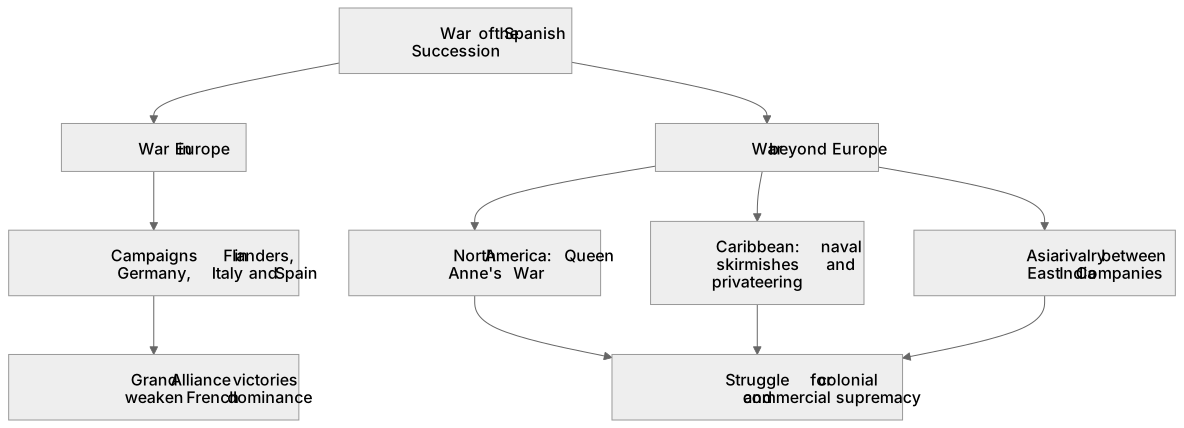
The War of the Spanish Succession (1702–1714) was a global conflict fought across multiple theatres. In Europe, major campaigns occurred in Flanders, Germany, Italy, and Spain, characterised by decisive Grand Alliance victories like Blenheim (1704) and Ramillies (1706) under Marlborough, which severely weakened French dominance. Beyond Europe, the conflict expanded into a struggle for colonial and commercial supremacy. In North America (Queen Anne's War), French and English colonists clashed over Acadia and indigenous alliances. Naval skirmishes and privateering disrupted lucrative trade routes in the Caribbean, while in Asia, rival East India Companies engaged in proxy conflicts to secure valuable trading posts and global dominance.
What earns the marks
- Analyse the major military campaigns and turning points in Europe, including the battles of Blenheim, Ramillies, Oudenarde, and Malplaquet.
- Evaluate the impact of the war in North America, focusing on colonial skirmishes, the capture of Port Royal, and the involvement of indigenous populations.
- Assess the significance of naval warfare and privateering in the Caribbean, highlighting the struggle for control over sugar islands and trade routes.
- Examine the extension of the conflict into Asia, specifically the commercial rivalry and localised clashes between European trading companies in India.
Common mistakes and how to put them right
Focusing exclusively on the European theatre and ignoring the global dimensions of the conflict.
Put it right: Ensure equal analytical weight is given to the colonial theatres in North America, the Caribbean, and Asia as specified in the syllabus.
Treating the colonial conflicts as entirely separate wars.
Put it right: Explain how events in North America, the Caribbean, and Asia were directly tied to the broader European struggle for the Spanish succession and global trade dominance.
Overstating the scale of land battles in Asia and the Caribbean.
Put it right: Clarify that conflict in these regions was primarily characterised by naval engagements, privateering, and commercial competition rather than massive pitched battles.
Exam tips
- Compare the strategic importance of the European land campaigns with the economic significance of the colonial conflicts in the Caribbean and Asia.
- Use specific examples of colonial engagements, such as the capture of Acadia in North America, to illustrate the global reach of the war.
- Consider how the outcomes in the overseas theatres influenced the final peace settlements at Utrecht.
Try the lesson
The start of the 2F The Sun King: Louis XIV, France and Europe, 1643– 1715 (A-level only) – France defeated, 1697–1715: The War of the Spanish Succession: the war in Europe; the war in North America, the Caribbean and Asia lesson, made from checked teaching notes for this specification point.
Have a go first
Which major 1704 European battle resulted in a decisive victory for the Grand Alliance and saved Vienna from a Franco-Bavarian threat?
Listen
The War of the Spanish Succession (1702–1714) was a global conflict fought across multiple theatres. In Europe, major campaigns occurred in Flanders, Germany, Italy, and Spain, characterised by decisive Grand Alliance victories like Blenheim (1704) and Ramillies (1706) under Marlborough, which severely weakened French dominance. Beyond Europe, the conflict expanded into a struggle for colonial and commercial supremacy. In North America (Queen Anne's War), French and English colonists clashed over Acadia and indigenous alliances. Naval skirmishes and privateering disrupted lucrative trade routes in the Caribbean, while in Asia, rival East India Companies engaged in proxy conflicts to secure valuable trading posts and global dominance. A strong answer earns marks for these points. Analyse the major military campaigns and turning points in Europe, including the battles of Blenheim, Ramillies, Oudenarde, and Malplaquet. Evaluate the impact of the war in North America, focusing on colonial skirmishes, the capture of Port Royal, and the involvement of indigenous populations. Assess the significance of naval warfare and privateering in the Caribbean, highlighting the struggle for control over sugar islands and trade routes. Examine the extension of the conflict into Asia, specifically the commercial rivalry and localised clashes between European trading companies in India. A common slip: Focusing exclusively on the European theatre and ignoring the global dimensions of the conflict. Instead, Ensure equal analytical weight is given to the colonial theatres in North America, the Caribbean, and Asia as specified in the syllabus. Exam tip: Compare the strategic importance of the European land campaigns with the economic significance of the colonial conflicts in the Caribbean and Asia.
See it
Put the events in order
Put these events in the order they happened, earliest first.
- 1. The War of the Spanish Succession begins
- 2. Grand Alliance victory at the battle of Ramillies
- 3. Grand Alliance victory at the battle of Blenheim
Label the diagram
Some boxes have lost their names. Pick the right name for each number.
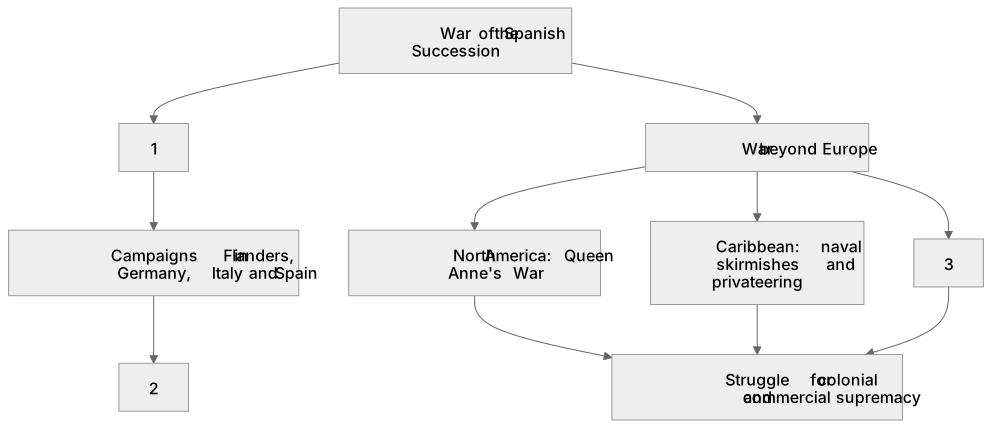
1Box 1
2Box 2
3Box 3
There is more to this lesson
The full lesson goes on to check your understanding and help you earn the marks. Create a free account to carry on, with your progress saved.
A week of Premium from your first lesson · Then the free plan continues · No card, no charge
Test your understanding of 2F The Sun King: Louis XIV, France and Europe, 1643– 1715 (A-level only) – France defeated, 1697–1715: The War of the Spanish Succession: the war in Europe; the war in North America, the Caribbean and Asia
Active recall beats re-reading. Take an instant quiz now to test what you’ve learned and lock it into long-term memory.
A week of Premium from your first lesson · Then the free plan continues · No card, no charge