AQA · A-Level · History
Course version: 7042 · Version from Sept 2017
Louis XIV, France and Europe, 1643– 1715 (A-level only) – Louis XIV and…
Full specification wording
2F The Sun King: Louis XIV, France and Europe, 1643– 1715 (A-level only) – Louis XIV and Europe, 1661–1685: France and the policy of Reunions: the drive to annex ‘lost’ territories to France such as Luxembourg, Casale and Strasbourg; the Treaty of Ratisbon
Louis XIV initiated the policy of Reunions to consolidate France's borders after 1679.
Checked against the AQA 7042 specification (opens in a new tab) on .
- Point 4 of 4
- 3 key terms
Study notes
From the checked teaching notes for this specification point.
The idea
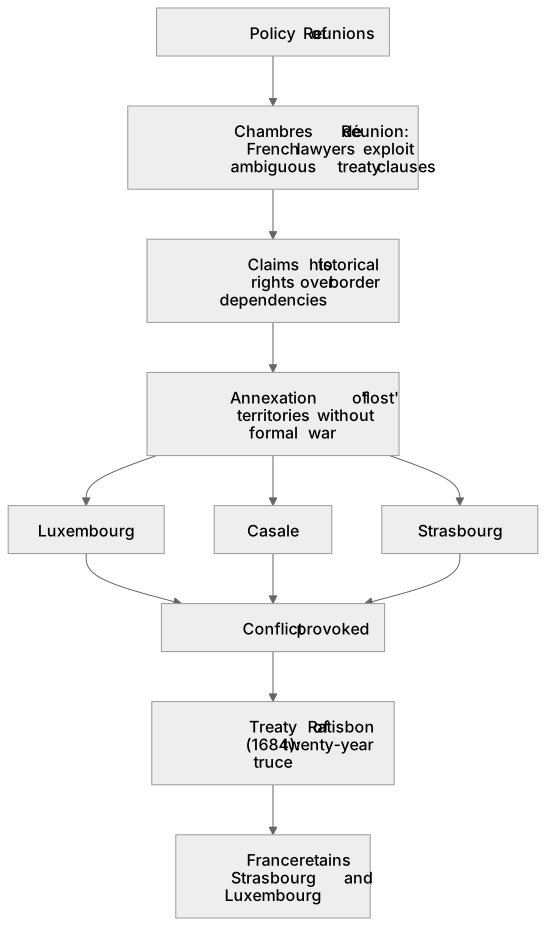
Louis XIV initiated the policy of Reunions to consolidate France's borders after 1679. Using legal courts called Chambres de Réunion, French lawyers exploited ambiguous treaty clauses to claim historical rights over border dependencies. This drive to annex 'lost' territories allowed Louis to seize strategic locations without formal war. Key acquisitions included the vital fortress of Luxembourg, the Italian stronghold of Casale, and the independent city of Strasbourg in 1681. This aggressive expansion provoked conflict, temporarily resolved by the Treaty of Ratisbon (1684). This agreement granted France a twenty-year truce, allowing Louis to retain Strasbourg and Luxembourg, representing the absolute peak of his territorial expansion and European dominance.
What earns the marks
- Define the policy of Reunions and explain the function of the Chambres de Réunion in providing a legal pretext for territorial expansion.
- Analyse the strategic importance of annexing specific 'lost' territories, notably the defensive value of Strasbourg, Luxembourg, and Casale.
- Evaluate the European reaction to the Reunions, noting the inability of the Holy Roman Empire and Spain to mount an effective immediate resistance.
- Assess the significance of the Treaty of Ratisbon (1684) as a high-water mark for Louis XIV, securing a twenty-year truce and recognition of his recent annexations.
Common mistakes and how to put them right
Describing the Reunions as purely military conquests.
Put it right: Emphasise that the Reunions were primarily a legalistic strategy using courts to claim sovereignty, backed by the threat of military force.
Stating that the Treaty of Ratisbon permanently ceded the territories to France.
Put it right: Clarify that Ratisbon was a twenty-year truce allowing France to occupy the territories, not a permanent treaty of cession.
Confusing the locations and strategic purposes of the annexed territories.
Put it right: Specify that Strasbourg secured the Rhine frontier, Luxembourg protected the northern border, and Casale provided a gateway into northern Italy.
Exam tips
- Use the annexation of Strasbourg (1681) as a prime example of Louis XIV's opportunistic foreign policy, taking advantage of the Emperor's distraction by the Ottoman threat.
- Discuss the policy of Reunions as a transition from the aggressive warfare of the 1670s to a more defensive, albeit highly provocative, strategy of border consolidation.
- Evaluate how the Treaty of Ratisbon contributed to growing anti-French sentiment across Europe, laying the groundwork for the League of Augsburg.
Try the lesson
The start of the 2F The Sun King: Louis XIV, France and Europe, 1643– 1715 (A-level only) – Louis XIV and Europe, 1661–1685: France and the policy of Reunions: the drive to annex ‘lost’ territories to France such as Luxembourg, Casale and Strasbourg; the Treaty of Ratisbon lesson, made from checked teaching notes for this specification point.
Have a go first
What legal mechanism did Louis XIV use during the 1680s to justify the annexation of territories such as Strasbourg and Luxembourg under the policy of Reunions?
Listen
Louis XIV initiated the policy of Reunions to consolidate France's borders after 1679. Using legal courts called Chambres de Réunion, French lawyers exploited ambiguous treaty clauses to claim historical rights over border dependencies. This drive to annex 'lost' territories allowed Louis to seize strategic locations without formal war. Key acquisitions included the vital fortress of Luxembourg, the Italian stronghold of Casale, and the independent city of Strasbourg in 1681. This aggressive expansion provoked conflict, temporarily resolved by the Treaty of Ratisbon (1684). This agreement granted France a twenty-year truce, allowing Louis to retain Strasbourg and Luxembourg, representing the absolute peak of his territorial expansion and European dominance. A strong answer earns marks for these points. Define the policy of Reunions and explain the function of the Chambres de Réunion in providing a legal pretext for territorial expansion. Analyse the strategic importance of annexing specific 'lost' territories, notably the defensive value of Strasbourg, Luxembourg, and Casale. Evaluate the European reaction to the Reunions, noting the inability of the Holy Roman Empire and Spain to mount an effective immediate resistance. Assess the significance of the Treaty of Ratisbon (1684) as a high-water mark for Louis XIV, securing a twenty-year truce and recognition of his recent annexations. A common slip: Describing the Reunions as purely military conquests. Instead, Emphasise that the Reunions were primarily a legalistic strategy using courts to claim sovereignty, backed by the threat of military force. Exam tip: Use the annexation of Strasbourg (1681) as a prime example of Louis XIV's opportunistic foreign policy, taking advantage of the Emperor's distraction by the Ottoman threat.
See it
Key words
Say what each word means before you turn the card.
Reunions
Try answering aloud or in your head before turning the card.
Chambres de Réunion
Try answering aloud or in your head before turning the card.
Treaty of Ratisbon
Try answering aloud or in your head before turning the card.
See every definition
- Reunions
- Policy initiated to consolidate France's borders after 1679 by annexing 'lost' territories to France such as Luxembourg, Casale and Strasbourg.
- Chambres de Réunion
- Legal courts through which French lawyers exploited ambiguous treaty clauses to claim historical rights over border dependencies.
- Treaty of Ratisbon
- Agreement of 1684 that granted France a twenty-year truce, allowing Louis to retain Strasbourg and Luxembourg.
Label the diagram
Some boxes have lost their names. Pick the right name for each number.
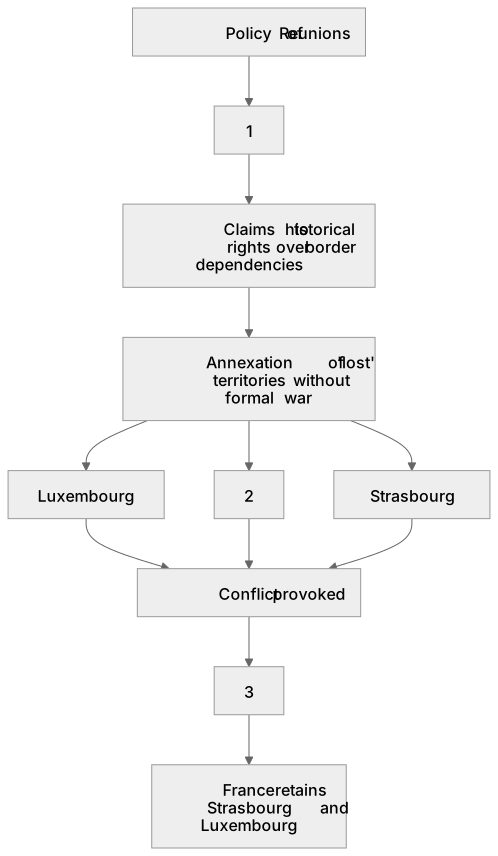
1Box 1
2Box 2
3Box 3
There is more to this lesson
The full lesson goes on to check your understanding and help you earn the marks. Create a free account to carry on, with your progress saved.
A week of Premium from your first lesson · Then the free plan continues · No card, no charge
Test your understanding of 2F The Sun King: Louis XIV, France and Europe, 1643– 1715 (A-level only) – Louis XIV and Europe, 1661–1685: France and the policy of Reunions: the drive to annex ‘lost’ territories to France such as Luxembourg, Casale and Strasbourg; the Treaty of Ratisbon
Active recall beats re-reading. Take an instant quiz now to test what you’ve learned and lock it into long-term memory.
A week of Premium from your first lesson · Then the free plan continues · No card, no charge