AQA · A-Level · History
Course version: 7042 · Version from Sept 2017
Louis XIV, France and Europe, 1643– 1715 (A-level only) – Louis XIV and…
Full specification wording
2F The Sun King: Louis XIV, France and Europe, 1643– 1715 (A-level only) – Louis XIV and Europe, 1661–1685: France and the Dutch Republic: relations between Louis XIV and Charles II of England; the Franco-Dutch War; the Peace of Nijmegen
Louis XIV sought to destroy the Dutch Republic due to economic rivalry and revenge for the Triple Alliance.
Checked against the AQA 7042 specification (opens in a new tab) on .
- Point 3 of 4
- 4 key terms
Study notes
From the checked teaching notes for this specification point.
The idea
Louis XIV sought to destroy the Dutch Republic due to economic rivalry and revenge for the Triple Alliance. To isolate the Dutch, Louis negotiated the Secret Treaty of Dover (1670) with Charles II of England, providing subsidies in exchange for English naval support. This diplomacy enabled the Franco-Dutch War (1672–1678). Despite rapid initial French advances, the Dutch flooded their lands to halt the invasion, expanding the conflict into a wider European war. The war concluded with the Peace of Nijmegen (1678–1679). Although Louis failed to annihilate the Dutch Republic, the treaties secured significant territorial gains for France, notably Franche-Comté, marking the zenith of Louis XIV’s European dominance and diplomatic leverage.
What earns the marks
- Explain the motivations for the Franco-Dutch War, including Louis XIV's desire for gloire, economic tariffs, and revenge for the 1668 Triple Alliance.
- Analyse the terms and significance of the Secret Treaty of Dover (1670) in securing English neutrality and naval assistance from Charles II.
- Evaluate the course of the Franco-Dutch War, noting the initial French military success and the subsequent stalemate caused by the Dutch opening the dykes.
- Assess the outcomes of the Peace of Nijmegen (1678-1679), specifically the acquisition of Franche-Comté and towns in Flanders, and its impact on French hegemony.
Common mistakes and how to put them right
Claiming the Peace of Nijmegen resulted in the complete defeat of the Dutch Republic.
Put it right: State that the Dutch Republic survived and retained its territory, while France gained land primarily from Spain, such as Franche-Comté.
Confusing Charles II of England with Charles II of Spain.
Put it right: Ensure Charles II of England is identified as Louis XIV's ally via the Treaty of Dover, whereas Charles II of Spain was the Habsburg monarch whose territories Louis targeted.
Viewing the Franco-Dutch War solely as a religious conflict.
Put it right: Emphasise that while religion played a minor role, the primary drivers were economic competition, territorial expansion, and Louis XIV's pursuit of personal glory.
Exam tips
- Use the Secret Treaty of Dover to demonstrate Louis XIV's diplomatic skill in isolating his enemies before launching a military campaign.
- When evaluating the Peace of Nijmegen, contrast Louis XIV's original war aims (destroying the Dutch) with the actual territorial outcomes to assess his overall success.
- Link the financial cost of the Franco-Dutch War to the growing strain on the French economy, setting up the context for later domestic and foreign crises.
Try the lesson
The start of the 2F The Sun King: Louis XIV, France and Europe, 1643– 1715 (A-level only) – Louis XIV and Europe, 1661–1685: France and the Dutch Republic: relations between Louis XIV and Charles II of England; the Franco-Dutch War; the Peace of Nijmegen lesson, made from checked teaching notes for this specification point.
Have a go first
Which treaty concluded the Franco-Dutch War in 1678, resulting in France acquiring Franche-Comté from Spain?
Listen
Louis XIV sought to destroy the Dutch Republic due to economic rivalry and revenge for the Triple Alliance. To isolate the Dutch, Louis negotiated the Secret Treaty of Dover (1670) with Charles II of England, providing subsidies in exchange for English naval support. This diplomacy enabled the Franco-Dutch War (1672–1678). Despite rapid initial French advances, the Dutch flooded their lands to halt the invasion, expanding the conflict into a wider European war. The war concluded with the Peace of Nijmegen (1678–1679). Although Louis failed to annihilate the Dutch Republic, the treaties secured significant territorial gains for France, notably Franche-Comté, marking the zenith of Louis XIV’s European dominance and diplomatic leverage. A strong answer earns marks for these points. Explain the motivations for the Franco-Dutch War, including Louis XIV's desire for gloire, economic tariffs, and revenge for the 1668 Triple Alliance. Analyse the terms and significance of the Secret Treaty of Dover (1670) in securing English neutrality and naval assistance from Charles II. Evaluate the course of the Franco-Dutch War, noting the initial French military success and the subsequent stalemate caused by the Dutch opening the dykes. Assess the outcomes of the Peace of Nijmegen (1678-1679), specifically the acquisition of Franche-Comté and towns in Flanders, and its impact on French hegemony. A common slip: Claiming the Peace of Nijmegen resulted in the complete defeat of the Dutch Republic. Instead, State that the Dutch Republic survived and retained its territory, while France gained land primarily from Spain, such as Franche-Comté. Exam tip: Use the Secret Treaty of Dover to demonstrate Louis XIV's diplomatic skill in isolating his enemies before launching a military campaign.
See it
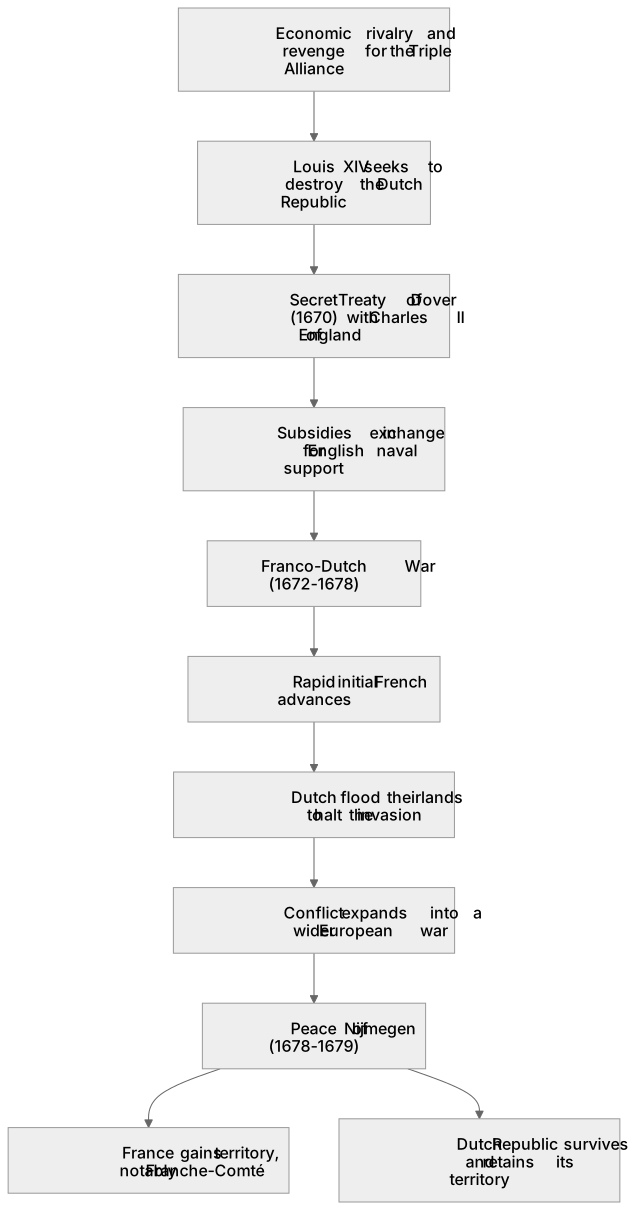
Key words
Say what each word means before you turn the card.
Diplomacy and alliances
Try answering aloud or in your head before turning the card.
Economic rivalry
Try answering aloud or in your head before turning the card.
Military conflict and strategy
Try answering aloud or in your head before turning the card.
Territorial expansion
Try answering aloud or in your head before turning the card.
See every definition
- Diplomacy and alliances
- Louis negotiated the Secret Treaty of Dover with Charles II of England, providing subsidies in exchange for English naval support, to isolate the Dutch.
- Economic rivalry
- This was one of the reasons Louis XIV sought to destroy the Dutch Republic.
- Military conflict and strategy
- The Dutch flooded their lands to halt the French invasion, expanding the conflict into a wider European war.
- Territorial expansion
- The treaties of the Peace of Nijmegen secured significant territorial gains for France, notably Franche-Comté.
Label the diagram
Some boxes have lost their names. Pick the right name for each number.
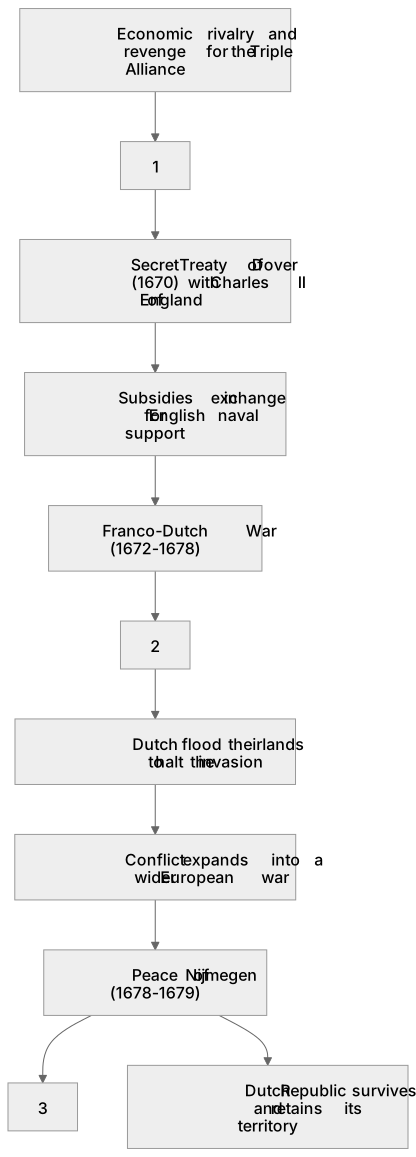
1Box 1
2Box 2
3Box 3
There is more to this lesson
The full lesson goes on to check your understanding and help you earn the marks. Create a free account to carry on, with your progress saved.
A week of Premium from your first lesson · Then the free plan continues · No card, no charge
Test your understanding of 2F The Sun King: Louis XIV, France and Europe, 1643– 1715 (A-level only) – Louis XIV and Europe, 1661–1685: France and the Dutch Republic: relations between Louis XIV and Charles II of England; the Franco-Dutch War; the Peace of Nijmegen
Active recall beats re-reading. Take an instant quiz now to test what you’ve learned and lock it into long-term memory.
A week of Premium from your first lesson · Then the free plan continues · No card, no charge