AQA · A-Level · History
Course version: 7042 · Version from Sept 2017
Louis XIV, France and Europe, 1643– 1715 (A-level only) – Louis XIV and…
Full specification wording
2F The Sun King: Louis XIV, France and Europe, 1643– 1715 (A-level only) – Louis XIV and Europe, 1661–1685: The context of French foreign policy in 1661: Louis XIV’s aims, the extent of French military resources; the Military Academy; the role of Louvois
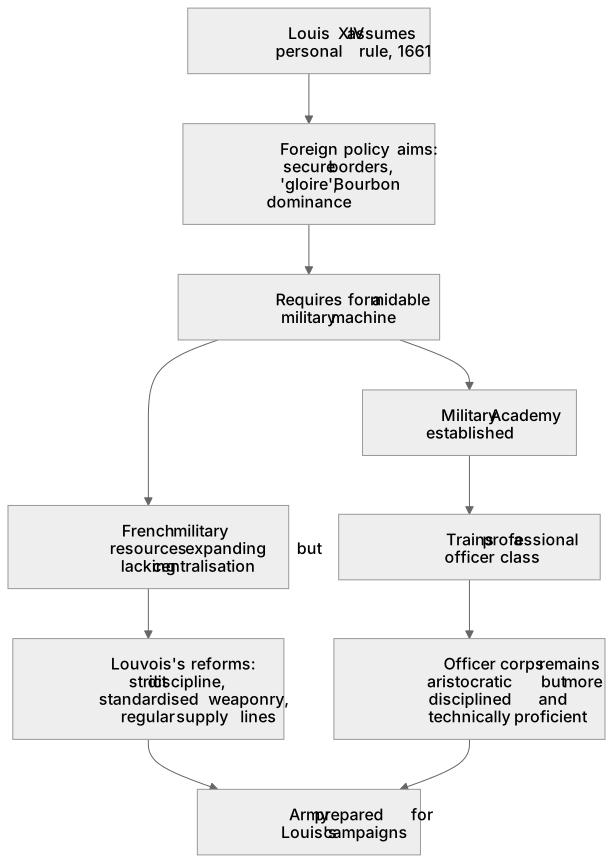
In 1661, Louis XIV assumed personal rule with clear foreign policy aims: securing vulnerable borders, achieving 'gloire', and asserting Bourbon dominance.
Checked against the AQA 7042 specification (opens in a new tab) on .
- Point 1 of 4
- 4 key terms
Study notes
From the checked teaching notes for this specification point.
The idea
In 1661, Louis XIV assumed personal rule with clear foreign policy aims: securing vulnerable borders, achieving 'gloire', and asserting Bourbon dominance. To achieve this, he required a formidable military machine. French military resources were expanding but lacked centralisation. The Marquis de Louvois revolutionised the army by enforcing strict discipline, standardising weaponry, and establishing regular supply lines. Crucially, the establishment of military academies aimed to train a professional officer class. Rather than shifting promotion to merit, these academies specifically trained young nobles, ensuring the officer corps remained aristocratic while becoming more disciplined and technically proficient for Louis's campaigns.
What earns the marks
- Identify Louis XIV's primary foreign policy aims in 1661, including the pursuit of 'gloire', dynastic prestige, and the securing of defensible frontiers.
- Evaluate the state of French military resources at the beginning of Louis's personal rule, noting the transition from mercenary bands to a standing state army.
- Assess the specific reforms implemented by Louvois, such as the introduction of uniforms, standardisation of weapons, and the magazine supply system.
- Explain the significance of the Military Academy in professionalising the officer corps by training noble cadets, thereby improving discipline without dismantling aristocratic privilege.
Common mistakes and how to put them right
Confusing the roles of Colbert and Louvois.
Put it right: Ensure Colbert is discussed in relation to finance and the navy, while Louvois is strictly credited with army reforms and military administration.
Assuming the French army was already Europe's dominant force in 1661.
Put it right: Emphasise that in 1661 the army was still recovering from the Fronde and required Louvois's extensive reforms to achieve dominance.
Claiming the Military Academy created a meritocratic officer corps.
Put it right: Understand that the academies specifically trained young nobles, professionalising the army while preserving aristocratic privilege.
Exam tips
- When discussing Louis's foreign policy aims, always link the concept of 'gloire' to practical military preparations and the resources required to achieve it.
- Use Louvois's specific reforms, such as the magazine system, as concrete evidence when arguing how France sustained long campaigns.
- Discuss the Military Academy as a tool for centralising royal control over the nobility, turning independent aristocrats into disciplined, loyal officers.
Try the lesson
The start of the 2F The Sun King: Louis XIV, France and Europe, 1643– 1715 (A-level only) – Louis XIV and Europe, 1661–1685: The context of French foreign policy in 1661: Louis XIV’s aims, the extent of French military resources; the Military Academy; the role of Louvois lesson, made from checked teaching notes for this specification point.
Have a go first
What was the primary role of the Marquis de Louvois in developing French military resources during the early decades of Louis XIV's personal rule?
Listen
In 1661, Louis XIV assumed personal rule with clear foreign policy aims: securing vulnerable borders, achieving 'gloire', and asserting Bourbon dominance. To achieve this, he required a formidable military machine. French military resources were expanding but lacked centralisation. The Marquis de Louvois revolutionised the army by enforcing strict discipline, standardising weaponry, and establishing regular supply lines. Crucially, the establishment of military academies aimed to train a professional officer class. Rather than shifting promotion to merit, these academies specifically trained young nobles, ensuring the officer corps remained aristocratic while becoming more disciplined and technically proficient for Louis's campaigns. A strong answer earns marks for these points. Identify Louis XIV's primary foreign policy aims in 1661, including the pursuit of 'gloire', dynastic prestige, and the securing of defensible frontiers. Evaluate the state of French military resources at the beginning of Louis's personal rule, noting the transition from mercenary bands to a standing state army. Assess the specific reforms implemented by Louvois, such as the introduction of uniforms, standardisation of weapons, and the magazine supply system. Explain the significance of the Military Academy in professionalising the officer corps by training noble cadets, thereby improving discipline without dismantling aristocratic privilege. A common slip: Confusing the roles of Colbert and Louvois. Instead, Ensure Colbert is discussed in relation to finance and the navy, while Louvois is strictly credited with army reforms and military administration. Exam tip: When discussing Louis's foreign policy aims, always link the concept of 'gloire' to practical military preparations and the resources required to achieve it.
See it
Key words
Say what each word means before you turn the card.
Military revolution and state-building
Try answering aloud or in your head before turning the card.
The pursuit of 'gloire' and dynastic prestige
Try answering aloud or in your head before turning the card.
Centralisation of administrative power
Try answering aloud or in your head before turning the card.
Professionalisation of the armed forces
Try answering aloud or in your head before turning the card.
See every definition
- Military revolution and state-building
- The expansion of French military resources alongside the transition from mercenary bands to a standing state army, which in 1661 still lacked centralisation.
- The pursuit of 'gloire' and dynastic prestige
- Louis XIV's foreign policy aims of achieving 'gloire', asserting Bourbon dominance and securing vulnerable borders and defensible frontiers.
- Centralisation of administrative power
- The process by which Louvois revolutionised the army through strict discipline, standardised weaponry and regular supply lines, and academies centralised royal control over the nobility.
- Professionalisation of the armed forces
- The training of a professional officer class in military academies, which specifically trained young nobles so the officer corps remained aristocratic while becoming more disciplined and technically proficient.
Label the diagram
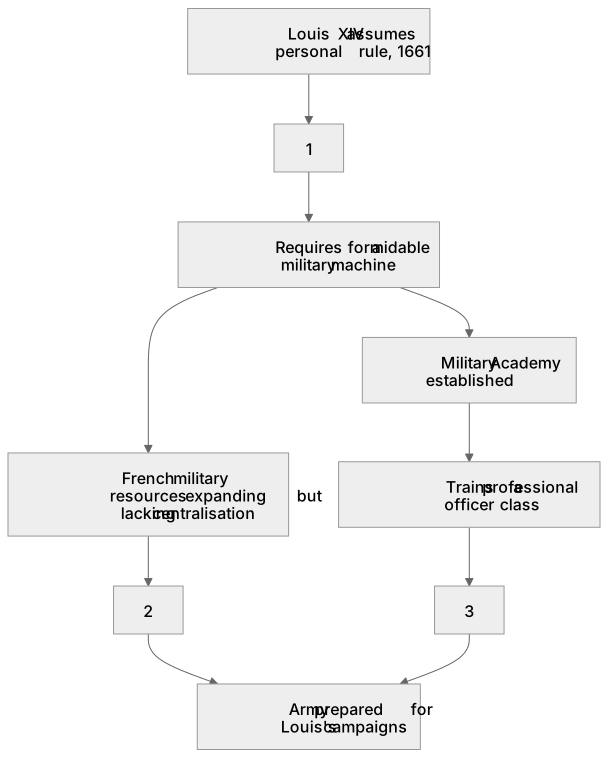
Some boxes have lost their names. Pick the right name for each number.
1Box 1
2Box 2
3Box 3
There is more to this lesson
The full lesson goes on to check your understanding and help you earn the marks. Create a free account to carry on, with your progress saved.
A week of Premium from your first lesson · Then the free plan continues · No card, no charge
Test your understanding of 2F The Sun King: Louis XIV, France and Europe, 1643– 1715 (A-level only) – Louis XIV and Europe, 1661–1685: The context of French foreign policy in 1661: Louis XIV’s aims, the extent of French military resources; the Military Academy; the role of Louvois
Active recall beats re-reading. Take an instant quiz now to test what you’ve learned and lock it into long-term memory.
A week of Premium from your first lesson · Then the free plan continues · No card, no charge