AQA · A-Level · History
Course version: 7042 · Version from Sept 2017
Louis XIV, France and Europe, 1643– 1715 (A-level only) – Louis XIV and…
Full specification wording
2F The Sun King: Louis XIV, France and Europe, 1643– 1715 (A-level only) – Louis XIV and Europe, 1661–1685: France and Spain: the decline of Spanish military power; the War of Devolution
The 1660s saw a dramatic shift in the Franco-Spanish balance of power.
Checked against the AQA 7042 specification (opens in a new tab) on .
- Point 2 of 4
- 4 key terms
Study notes
From the checked teaching notes for this specification point.
The idea
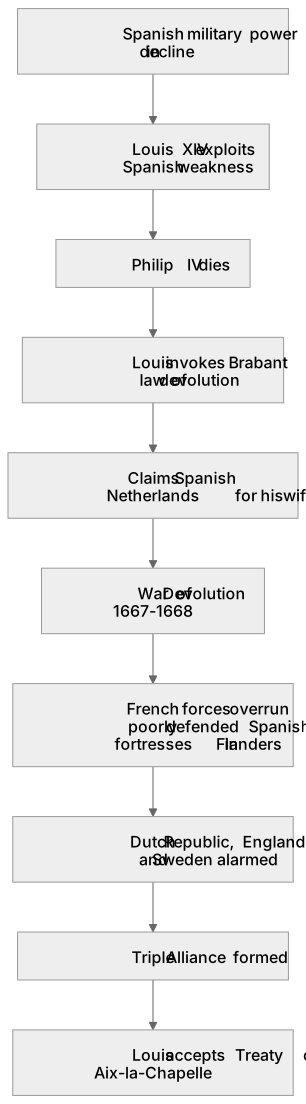
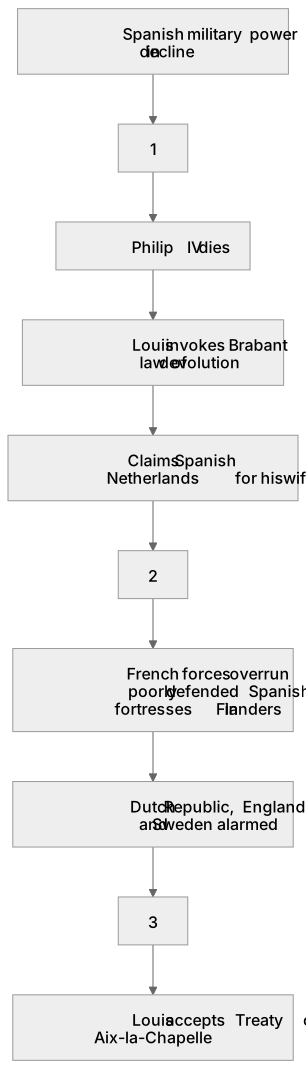
The 1660s saw a dramatic shift in the Franco-Spanish balance of power. Spanish military might was in steep decline due to economic exhaustion and previous defeats. Louis XIV ruthlessly exploited this weakness. Following Philip IV's death, Louis invoked the Brabant law of 'devolution' to claim the Spanish Netherlands for his wife, triggering the War of Devolution (1667–1668). French forces easily overran poorly defended Spanish fortresses in Flanders. However, this rapid success alarmed the Dutch Republic, England, and Sweden. They formed the Triple Alliance, forcing Louis to accept the Treaty of Aix-la-Chapelle. This conflict highlighted Spanish vulnerability while demonstrating the potency of the French military machine on the European stage.
What earns the marks
- Analyse the underlying causes of Spanish military decline, including financial bankruptcy, demographic stagnation, and the legacy of the Thirty Years' War.
- Explain the legal and dynastic pretext used by Louis XIV to initiate the War of Devolution, specifically the unpaid dowry and the local laws of Brabant.
- Evaluate the military execution of the War of Devolution, noting the speed and efficiency of the French siege warfare against weakened Spanish garrisons.
- Assess the diplomatic consequences of the war, particularly how French aggression catalysed the formation of the Triple Alliance and shifted Dutch-French relations.
Common mistakes and how to put them right
Claiming the War of Devolution was a total failure for France because of the Triple Alliance.
Put it right: Note that while Louis was forced to negotiate, France still made significant territorial gains, including Lille and Tournai, under the Treaty of Aix-la-Chapelle.
Confusing the War of Devolution with the later Dutch War.
Put it right: Clearly distinguish the War of Devolution (1667-1668) which targeted the Spanish Netherlands, from the Franco-Dutch War (1672-1678) which was a direct attack on the Dutch Republic.
Attributing Spanish decline solely to poor leadership.
Put it right: Emphasise the structural and economic factors, such as the exhaustion of silver imports and the cost of maintaining a global empire, that crippled the Spanish military.
Exam tips
- Use the War of Devolution as a prime example of Louis XIV testing his newly reformed military against a traditional, yet declining, Habsburg rival.
- When discussing the causes of the war, explicitly mention the legal justification (the law of devolution) to demonstrate precise knowledge of Louis's diplomatic methods.
- Link the outcome of the War of Devolution to the origins of the Franco-Dutch War, showing how the Triple Alliance bred Louis's resentment towards the Dutch.
Try the lesson
The start of the 2F The Sun King: Louis XIV, France and Europe, 1643– 1715 (A-level only) – Louis XIV and Europe, 1661–1685: France and Spain: the decline of Spanish military power; the War of Devolution lesson, made from checked teaching notes for this specification point.
Have a go first
What was the primary legal justification used by Louis XIV to initiate the War of Devolution against Spain in 1667?
Listen
The 1660s saw a dramatic shift in the Franco-Spanish balance of power. Spanish military might was in steep decline due to economic exhaustion and previous defeats. Louis XIV ruthlessly exploited this weakness. Following Philip IV's death, Louis invoked the Brabant law of 'devolution' to claim the Spanish Netherlands for his wife, triggering the War of Devolution (1667–1668). French forces easily overran poorly defended Spanish fortresses in Flanders. However, this rapid success alarmed the Dutch Republic, England, and Sweden. They formed the Triple Alliance, forcing Louis to accept the Treaty of Aix-la-Chapelle. This conflict highlighted Spanish vulnerability while demonstrating the potency of the French military machine on the European stage. A strong answer earns marks for these points. Analyse the underlying causes of Spanish military decline, including financial bankruptcy, demographic stagnation, and the legacy of the Thirty Years' War. Explain the legal and dynastic pretext used by Louis XIV to initiate the War of Devolution, specifically the unpaid dowry and the local laws of Brabant. Evaluate the military execution of the War of Devolution, noting the speed and efficiency of the French siege warfare against weakened Spanish garrisons. Assess the diplomatic consequences of the war, particularly how French aggression catalysed the formation of the Triple Alliance and shifted Dutch-French relations. A common slip: Claiming the War of Devolution was a total failure for France because of the Triple Alliance. Instead, Note that while Louis was forced to negotiate, France still made significant territorial gains, including Lille and Tournai, under the Treaty of Aix-la-Chapelle. Exam tip: Use the War of Devolution as a prime example of Louis XIV testing his newly reformed military against a traditional, yet declining, Habsburg rival.
See it
Key words
Say what each word means before you turn the card.
The decline of the Spanish Habsburgs
Try answering aloud or in your head before turning the card.
Dynastic claims and legal pretexts for war
Try answering aloud or in your head before turning the card.
The shifting balance of power in Europe
Try answering aloud or in your head before turning the card.
The emergence of coalition warfare against French hegemony
Try answering aloud or in your head before turning the card.
See every definition
- The decline of the Spanish Habsburgs
- Spanish military might was in steep decline due to economic exhaustion and previous defeats, leaving Spanish fortresses poorly defended.
- Dynastic claims and legal pretexts for war
- Louis invoked the Brabant law of 'devolution' to claim the Spanish Netherlands for his wife following Philip IV's death.
- The shifting balance of power in Europe
- The 1660s saw a dramatic shift in the Franco-Spanish balance of power, with French forces easily overrunning Spanish fortresses in Flanders.
- The emergence of coalition warfare against French hegemony
- Alarmed by rapid French success, the Dutch Republic, England and Sweden formed the Triple Alliance, forcing Louis to accept the Treaty of Aix-la-Chapelle.
Label the diagram
Some boxes have lost their names. Pick the right name for each number.
1Box 1
2Box 2
3Box 3
There is more to this lesson
The full lesson goes on to check your understanding and help you earn the marks. Create a free account to carry on, with your progress saved.
A week of Premium from your first lesson · Then the free plan continues · No card, no charge
Test your understanding of 2F The Sun King: Louis XIV, France and Europe, 1643– 1715 (A-level only) – Louis XIV and Europe, 1661–1685: France and Spain: the decline of Spanish military power; the War of Devolution
Active recall beats re-reading. Take an instant quiz now to test what you’ve learned and lock it into long-term memory.
A week of Premium from your first lesson · Then the free plan continues · No card, no charge