AQA · A-Level · History
Course version: 7042 · Version from Sept 2017
Louis XIV, France and Europe, 1643– 1715 (A-level only) – The Regency,…
Full specification wording
2F The Sun King: Louis XIV, France and Europe, 1643– 1715 (A-level only) – The Regency, 1643–1661: France and Europe: the rise of French power at the expense of the Habsburgs; the treaties of Westphalia and the Pyrenees
Between 1643 and 1661, France transformed its European position by systematically weakening the Austrian and Spanish Habsburgs.
Checked against the AQA 7042 specification (opens in a new tab) on .
- Point 3 of 4
Study notes
From the checked teaching notes for this specification point.
The idea
Between 1643 and 1661, France transformed its European position by systematically weakening the Austrian and Spanish Habsburgs. The Thirty Years' War concluded with the 1648 Peace of Westphalia, which fragmented the Holy Roman Empire and granted France strategic territories like Alsace, diminishing Austrian Habsburg dominance. Conflict with Spain continued until the 1659 Treaty of the Pyrenees. This landmark agreement secured French territorial gains, including Artois and Roussillon, and arranged Louis XIV's marriage to the Spanish Infanta Maria Theresa. Together, these treaties marked a decisive shift in European hegemony, establishing France as the pre-eminent continental power at the direct expense of Habsburg encirclement.
What earns the marks
- Identify the strategic gains made by France at Westphalia (1648), such as the acquisition of the bishoprics of Metz, Toul, and Verdun, and parts of Alsace.
- Explain how the fragmentation of the Holy Roman Empire weakened the Austrian Habsburgs and removed the threat of a unified German state on France's eastern border.
- Analyse the terms of the Treaty of the Pyrenees (1659), specifically the territorial acquisitions of Artois and Roussillon which strengthened French frontiers.
- Evaluate the diplomatic significance of Louis XIV's marriage to Maria Theresa of Spain, including the unpaid dowry that provided future pretexts for war.
Common mistakes and how to put them right
Confusing the two branches of the Habsburgs.
Put it right: Clearly distinguish between the Austrian Habsburgs (affected primarily by Westphalia) and the Spanish Habsburgs (affected by the Pyrenees).
Assuming Westphalia ended all French conflicts.
Put it right: Note that while Westphalia ended the Thirty Years' War, the Franco-Spanish War continued for another eleven years until 1659.
Overstating French dominance in 1648.
Put it right: Recognise that internal instability during the Fronde temporarily hindered French power between the two treaties.
Exam tips
- Use specific territorial gains, such as Alsace and Artois, as concrete evidence when arguing that French borders became more secure.
- Link foreign policy successes directly to the work of Cardinal Mazarin, demonstrating how his diplomacy paved the way for Louis XIV's personal rule.
- When evaluating the 'rise of French power', contrast France's ascending trajectory with the structural and financial decline of the Spanish Empire.
Try the lesson
The start of the 2F The Sun King: Louis XIV, France and Europe, 1643– 1715 (A-level only) – The Regency, 1643–1661: France and Europe: the rise of French power at the expense of the Habsburgs; the treaties of Westphalia and the Pyrenees lesson, made from checked teaching notes for this specification point.
Have a go first
Which two treaties were most significant in confirming the rise of French power at the expense of the Habsburgs in the period leading up to Louis XIV's personal rule in 1661?
Listen
Between 1643 and 1661, France transformed its European position by systematically weakening the Austrian and Spanish Habsburgs. The Thirty Years' War concluded with the 1648 Peace of Westphalia, which fragmented the Holy Roman Empire and granted France strategic territories like Alsace, diminishing Austrian Habsburg dominance. Conflict with Spain continued until the 1659 Treaty of the Pyrenees. This landmark agreement secured French territorial gains, including Artois and Roussillon, and arranged Louis XIV's marriage to the Spanish Infanta Maria Theresa. Together, these treaties marked a decisive shift in European hegemony, establishing France as the pre-eminent continental power at the direct expense of Habsburg encirclement. A strong answer earns marks for these points. Identify the strategic gains made by France at Westphalia (1648), such as the acquisition of the bishoprics of Metz, Toul, and Verdun, and parts of Alsace. Explain how the fragmentation of the Holy Roman Empire weakened the Austrian Habsburgs and removed the threat of a unified German state on France's eastern border. Analyse the terms of the Treaty of the Pyrenees (1659), specifically the territorial acquisitions of Artois and Roussillon which strengthened French frontiers. Evaluate the diplomatic significance of Louis XIV's marriage to Maria Theresa of Spain, including the unpaid dowry that provided future pretexts for war. A common slip: Confusing the two branches of the Habsburgs. Instead, clearly distinguish between the Austrian Habsburgs (affected primarily by Westphalia) and the Spanish Habsburgs (affected by the Pyrenees). Exam tip: Use specific territorial gains, such as Alsace and Artois, as concrete evidence when arguing that French borders became more secure.
See it
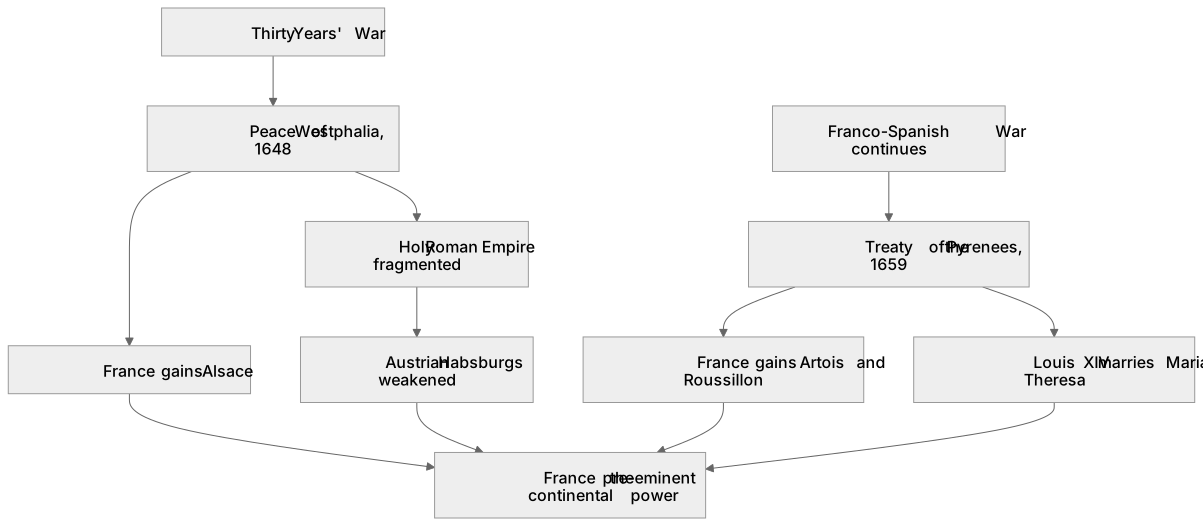
Label the diagram
Some boxes have lost their names. Pick the right name for each number.
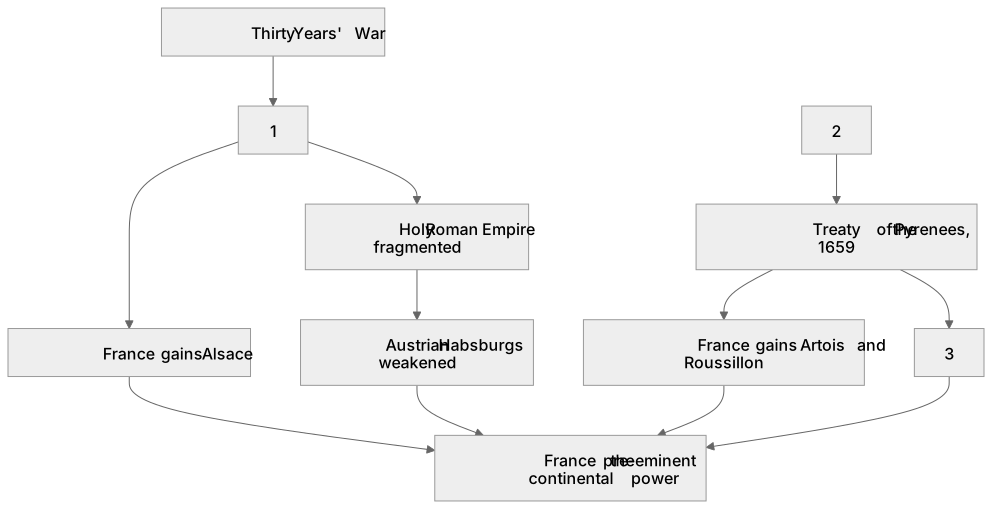
1Box 1
2Box 2
3Box 3
There is more to this lesson
The full lesson goes on to check your understanding and help you earn the marks. Create a free account to carry on, with your progress saved.
A week of Premium from your first lesson · Then the free plan continues · No card, no charge
Test your understanding of 2F The Sun King: Louis XIV, France and Europe, 1643– 1715 (A-level only) – The Regency, 1643–1661: France and Europe: the rise of French power at the expense of the Habsburgs; the treaties of Westphalia and the Pyrenees
Active recall beats re-reading. Take an instant quiz now to test what you’ve learned and lock it into long-term memory.
A week of Premium from your first lesson · Then the free plan continues · No card, no charge