AQA · A-Level · History
Course version: 7042 · Version from Sept 2017
Louis XIV, France and Europe, 1643– 1715 (A-level only) – The Regency,…
Full specification wording
2F The Sun King: Louis XIV, France and Europe, 1643– 1715 (A-level only) – The Regency, 1643–1661: The Minority of Louis XIV: the roles of Anne of Austria and Mazarin; the Parlement of Paris, unrest and opposition; the Frondes
During Louis XIV's minority, France was governed by Anne of Austria and Cardinal Mazarin.
Checked against the AQA 7042 specification (opens in a new tab) on .
- Point 2 of 4
Study notes
From the checked teaching notes for this specification point.
The idea
During Louis XIV's minority, France was governed by Anne of Austria and Cardinal Mazarin. Their continuation of the Thirty Years' War required aggressive financial policies, such as the toisé and paulette renewal terms, alienating the Parlement of Paris. Seeking to protect its privileges, the Parlement issued the 27 Articles in 1648 demanding limits on royal power. This unrest sparked the Frondes (1648–1653), a series of civil wars. The Fronde of the Parlements (1648–1649) saw magistrates rebel against fiscal oppression, while the Fronde of the Princes (1650–1653) involved nobles like Condé attempting to overthrow Mazarin. The Crown ultimately survived, but the chaos deeply influenced Louis XIV's later absolutist rule.
What earns the marks
- Analyse the political partnership between Anne of Austria and Mazarin, focusing on their commitment to royal prerogative and foreign war.
- Explain the specific financial grievances of the Parlement of Paris, such as the manipulation of the paulette and the introduction of new taxes.
- Differentiate between the causes and participants of the Fronde of the Parlements and the Fronde of the Princes.
- Evaluate the impact of the Frondes on the young Louis XIV, particularly how the experience of fleeing Paris shaped his later absolutist policies.
Common mistakes and how to put them right
Treating the Frondes as a single, unified rebellion against the Crown.
Put it right: Distinguish between the distinct phases: the parliamentary Fronde (driven by legal and fiscal grievances) and the princely Fronde (driven by noble ambition).
Assuming the Parlement of Paris was a democratic, representative body like the English Parliament.
Put it right: Define the Parlement as a sovereign court of justice composed of ennobled magistrates (noblesse de robe) protecting their own privileges.
Stating that Mazarin was universally popular and easily controlled the nobility.
Put it right: Highlight that Mazarin was deeply unpopular due to his Italian origins, perceived greed, and centralising policies, making him the primary target of the frondeurs.
Exam tips
- Use specific examples of fiscal expedients, such as the toisé or the manipulation of the paulette, to explain why the magistrates of the Parlement of Paris moved into open opposition, and note how the Crown used the lit de justice as a judicial procedure to force these through.
- When evaluating the threat of the Frondes, contrast the military danger posed by the Princes with the constitutional challenge posed by the Parlement.
- Link the events of the minority directly to Louis XIV's later decision to rule without a chief minister and to relocate the court to Versailles.
Try the lesson
The start of the 2F The Sun King: Louis XIV, France and Europe, 1643– 1715 (A-level only) – The Regency, 1643–1661: The Minority of Louis XIV: the roles of Anne of Austria and Mazarin; the Parlement of Paris, unrest and opposition; the Frondes lesson, made from checked teaching notes for this specification point.
Have a go first
During the minority of Louis XIV, what name was given to the series of civil rebellions that challenged the authority of Anne of Austria and Cardinal Mazarin?
Listen
During Louis XIV's minority, France was governed by Anne of Austria and Cardinal Mazarin. Their continuation of the Thirty Years' War required aggressive financial policies, such as the toisé and paulette renewal terms, alienating the Parlement of Paris. Seeking to protect its privileges, the Parlement issued the 27 Articles in 1648 demanding limits on royal power. This unrest sparked the Frondes (1648–1653), a series of civil wars. The Fronde of the Parlements (1648–1649) saw magistrates rebel against fiscal oppression, while the Fronde of the Princes (1650–1653) involved nobles like Condé attempting to overthrow Mazarin. The Crown ultimately survived, but the chaos deeply influenced Louis XIV's later absolutist rule. A strong answer earns marks for these points. Analyse the political partnership between Anne of Austria and Mazarin, focusing on their commitment to royal prerogative and foreign war. Explain the specific financial grievances of the Parlement of Paris, such as the manipulation of the paulette and the introduction of new taxes. Differentiate between the causes and participants of the Fronde of the Parlements and the Fronde of the Princes. Evaluate the impact of the Frondes on the young Louis XIV, particularly how the experience of fleeing Paris shaped his later absolutist policies. A common slip: Treating the Frondes as a single, unified rebellion against the Crown. Instead, Distinguish between the distinct phases: the parliamentary Fronde (driven by legal and fiscal grievances) and the princely Fronde (driven by noble ambition). Exam tip: Use specific examples of fiscal expedients, such as the toisé or the manipulation of the paulette, to explain why the magistrates of the Parlement of Paris moved into open opposition, and note how the Crown used the lit de justice as a judicial procedure to force these through.
See it
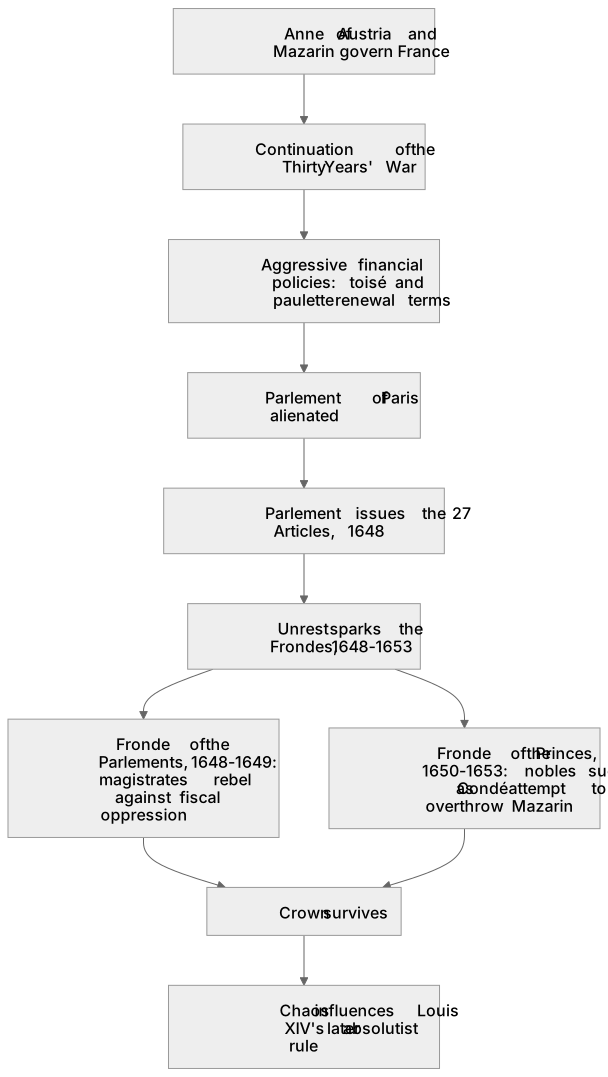
Label the diagram
Some boxes have lost their names. Pick the right name for each number.
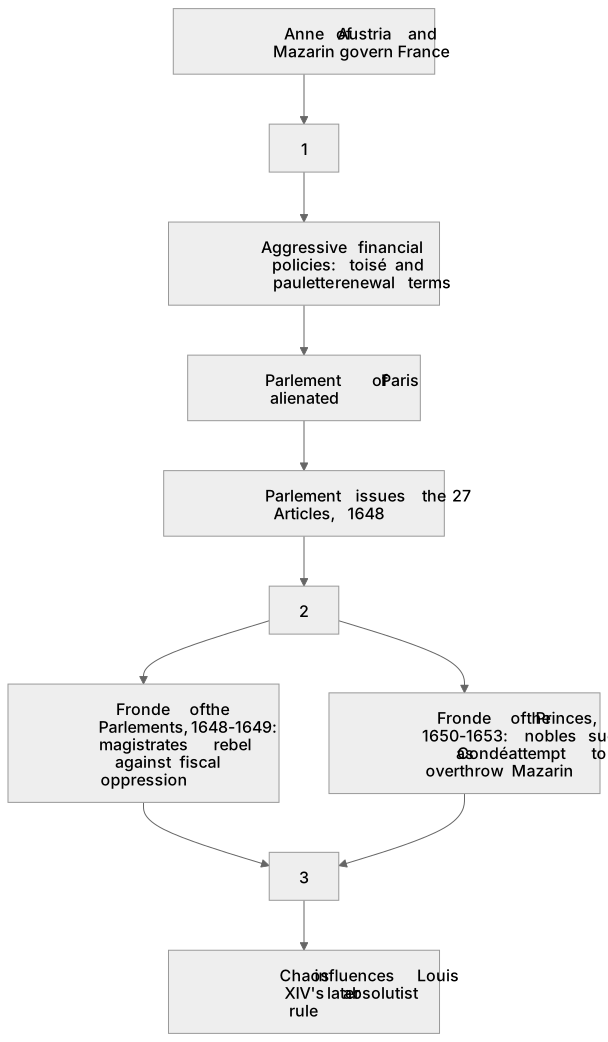
1Box 1
2Box 2
3Box 3
There is more to this lesson
The full lesson goes on to check your understanding and help you earn the marks. Create a free account to carry on, with your progress saved.
A week of Premium from your first lesson · Then the free plan continues · No card, no charge
Test your understanding of 2F The Sun King: Louis XIV, France and Europe, 1643– 1715 (A-level only) – The Regency, 1643–1661: The Minority of Louis XIV: the roles of Anne of Austria and Mazarin; the Parlement of Paris, unrest and opposition; the Frondes
Active recall beats re-reading. Take an instant quiz now to test what you’ve learned and lock it into long-term memory.
A week of Premium from your first lesson · Then the free plan continues · No card, no charge