AQA · A-Level · History
Course version: 7042 · Version from Sept 2017
Louis XIV, France and Europe, 1643– 1715 (A-level only) – The Regency,…
Full specification wording
2F The Sun King: Louis XIV, France and Europe, 1643– 1715 (A-level only) – The Regency, 1643–1661: The French monarchy in 1643: the legacy of Richelieu and Louis XIII; the establishment of the Regency
In 1643, the French monarchy faced a precarious transition following the deaths of Cardinal Richelieu and King Louis XIII.
Checked against the AQA 7042 specification (opens in a new tab) on .
- Point 1 of 4
Study notes
From the checked teaching notes for this specification point.
The idea
In 1643, the French monarchy faced a precarious transition following the deaths of Cardinal Richelieu and King Louis XIII. Their legacy was a more centralised state, achieved by suppressing Huguenot power and using intendants to bypass rebellious nobles. However, this legacy also included massive financial strain and widespread resentment due to heavy taxation funding the Thirty Years' War. The establishment of the Regency for the four-year-old Louis XIV was immediately contentious. Louis XIII's will attempted to limit the power of his widow, Anne of Austria, by imposing a regency council. Anne successfully appealed to the Parlement of Paris to overturn the will, establishing herself as sole Regent and appointing Cardinal Mazarin as her chief minister.
What earns the marks
- Identify the centralising policies of Richelieu and Louis XIII, such as the deployment of intendants and the dismantling of Huguenot military strongholds.
- Evaluate the financial and social costs of the Thirty Years' War, noting the reliance on oppressive taxes like the taille and the resulting popular unrest.
- Explain the constitutional mechanism by which Anne of Austria overturned Louis XIII's will using a lit de justice in the Parlement of Paris.
- Assess the immediate political implications of Anne appointing Cardinal Mazarin, a foreigner and Richelieu's protégé, as her chief minister.
Common mistakes and how to put them right
Claiming Louis XIII left France in a state of complete peace and financial stability.
Put it right: Emphasise that France was heavily indebted and facing internal unrest due to the ongoing Thirty Years' War.
Confusing the roles of Richelieu and Mazarin.
Put it right: Specify that Richelieu was the chief minister to Louis XIII who died in 1642, whereas Mazarin was appointed by Anne of Austria in 1643.
Stating that Anne of Austria automatically became absolute Regent upon her husband's death.
Put it right: Explain that Louis XIII's will restricted her power, and she had to actively use the Parlement of Paris to break the will.
Exam tips
- When discussing the legacy of 1643, explicitly link the financial burdens of foreign policy to the domestic instability that followed.
- Use the term 'intendants' to demonstrate specific knowledge of Richelieu's administrative reforms.
- Analyse how Anne of Austria's reliance on the Parlement of Paris to break the King's will inadvertently empowered the magistrates to challenge the Crown later.
Try the lesson
The start of the 2F The Sun King: Louis XIV, France and Europe, 1643– 1715 (A-level only) – The Regency, 1643–1661: The French monarchy in 1643: the legacy of Richelieu and Louis XIII; the establishment of the Regency lesson, made from checked teaching notes for this specification point.
Have a go first
Following the death of Louis XIII in 1643, who was established as the principal Regent for the young Louis XIV?
Listen
In 1643, the French monarchy faced a precarious transition following the deaths of Cardinal Richelieu and King Louis XIII. Their legacy was a more centralised state, achieved by suppressing Huguenot power and using intendants to bypass rebellious nobles. However, this legacy also included massive financial strain and widespread resentment due to heavy taxation funding the Thirty Years' War. The establishment of the Regency for the four-year-old Louis XIV was immediately contentious. Louis XIII's will attempted to limit the power of his widow, Anne of Austria, by imposing a regency council. Anne successfully appealed to the Parlement of Paris to overturn the will, establishing herself as sole Regent and appointing Cardinal Mazarin as her chief minister. A strong answer earns marks for these points. Identify the centralising policies of Richelieu and Louis XIII, such as the deployment of intendants and the dismantling of Huguenot military strongholds. Evaluate the financial and social costs of the Thirty Years' War, noting the reliance on oppressive taxes like the taille and the resulting popular unrest. Explain the constitutional mechanism by which Anne of Austria overturned Louis XIII's will using a lit de justice in the Parlement of Paris. Assess the immediate political implications of Anne appointing Cardinal Mazarin, a foreigner and Richelieu's protégé, as her chief minister. A common slip: Claiming Louis XIII left France in a state of complete peace and financial stability. Instead, Emphasise that France was heavily indebted and facing internal unrest due to the ongoing Thirty Years' War. Exam tip: When discussing the legacy of 1643, explicitly link the financial burdens of foreign policy to the domestic instability that followed.
See it
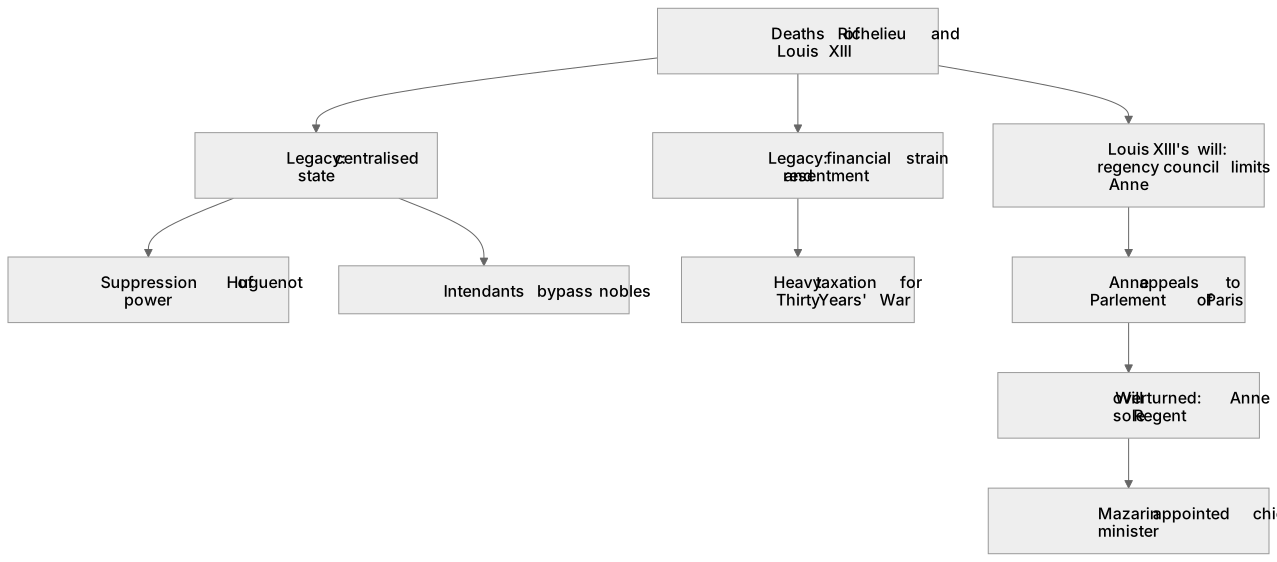
Label the diagram
Some boxes have lost their names. Pick the right name for each number.
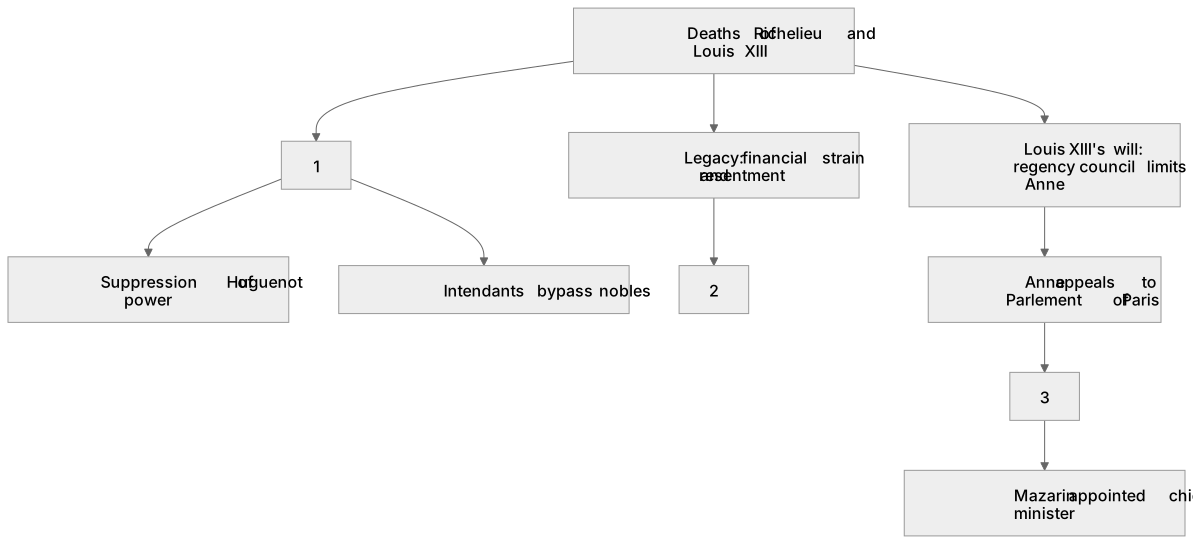
1Box 1
2Box 2
3Box 3
There is more to this lesson
The full lesson goes on to check your understanding and help you earn the marks. Create a free account to carry on, with your progress saved.
A week of Premium from your first lesson · Then the free plan continues · No card, no charge
Test your understanding of 2F The Sun King: Louis XIV, France and Europe, 1643– 1715 (A-level only) – The Regency, 1643–1661: The French monarchy in 1643: the legacy of Richelieu and Louis XIII; the establishment of the Regency
Active recall beats re-reading. Take an instant quiz now to test what you’ve learned and lock it into long-term memory.
A week of Premium from your first lesson · Then the free plan continues · No card, no charge