AQA · A-Level · History
Course version: 7042 · Version from Sept 2017
The hardening of colonial opposition: the First Continental Congress; the…
Full specification wording
2G The Birth of the USA, 1760–1801 – Ending the Colonial Relationship, 1774–1776: The hardening of colonial opposition: the First Continental Congress; the creation of new state constitutions
The period 1774–1776 witnessed a decisive shift from protesting specific British policies to establishing independent political structures.
Checked against the AQA 7042 specification (opens in a new tab) on .
- Point 1 of 4
- 4 key terms
Study notes
From the checked teaching notes for this specification point.
The idea
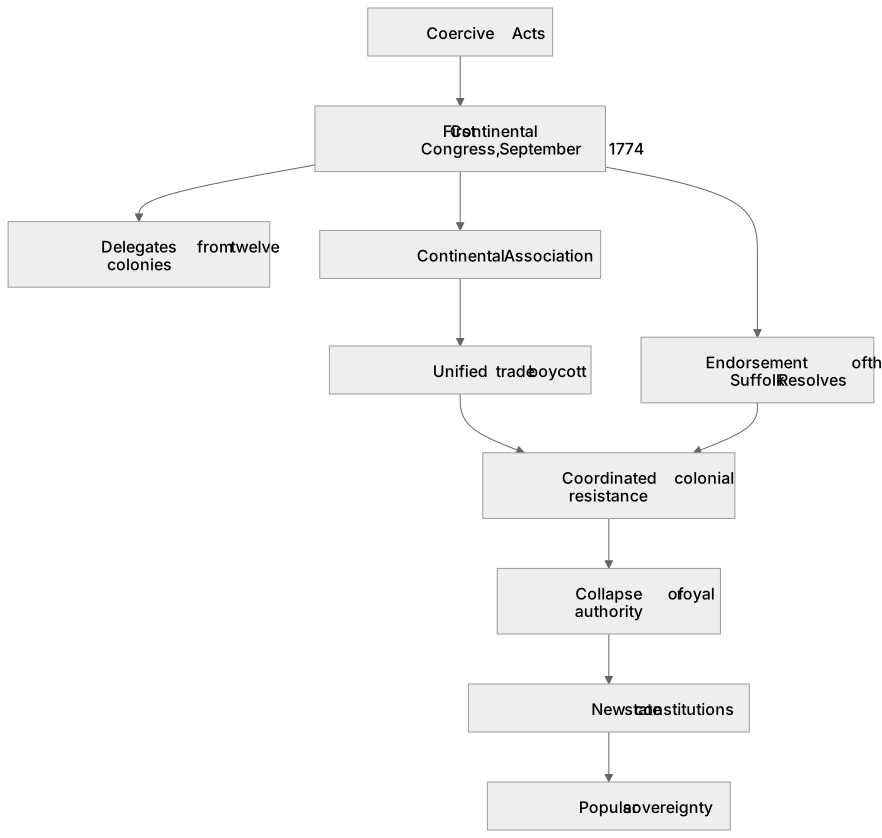
The period 1774–1776 witnessed a decisive shift from protesting specific British policies to establishing independent political structures. The First Continental Congress (September 1774) united delegates from twelve colonies in response to the Coercive Acts, endorsing the Suffolk Resolves and creating the Continental Association to enforce a unified trade boycott. This marked a critical hardening of opposition, transforming fragmented colonial resistance into a coordinated national effort. Concurrently, as royal authority collapsed, colonies began drafting new state constitutions.
For example: Virginia and New Hampshire established independent frameworks of government based on popular sovereignty, effectively replacing British colonial charters and laying the practical groundwork for full independence before the formal declaration in 1776.
What earns the marks
- Explain the role of the First Continental Congress in unifying colonial resistance through the Continental Association and trade boycotts.
- Analyse how the endorsement of the Suffolk Resolves signalled a militant shift in colonial opposition to British rule.
- Evaluate the significance of the collapse of royal authority in prompting the creation of new state constitutions.
- Assess how early state constitutions, such as those in Virginia and New Hampshire, institutionalised the principle of popular sovereignty.
Common mistakes and how to put them right
Confusing the First and Second Continental Congresses.
Put it right by noting the First (1774) focused on boycotts and petitions, while the Second (1775) managed the war effort and declared independence.
Assuming all thirteen colonies attended the First Continental Congress.
Put it right by stating that Georgia did not send delegates to the 1774 meeting.
Claiming state constitutions were only written after the Declaration of Independence.
Put it right by explaining that several colonies, like New Hampshire, drafted new constitutions months before July 1776.
Exam tips
- Use the Continental Association as a prime example of how the First Continental Congress enforced colonial unity at the grassroots level.
- When discussing the hardening of opposition, contrast the earlier, localised Stamp Act protests with the coordinated, inter-colonial response of 1774.
- Link the creation of state constitutions directly to the ideological shift towards republicanism and the practical need to replace collapsed royal governments.
Try the lesson
The start of the 2G The Birth of the USA, 1760–1801 – Ending the Colonial Relationship, 1774–1776: The hardening of colonial opposition: the First Continental Congress; the creation of new state constitutions lesson, made from checked teaching notes for this specification point.
Have a go first
What was a primary action taken by the First Continental Congress in 1774 to demonstrate hardened opposition to British policies?
Listen
The period 1774–1776 witnessed a decisive shift from protesting specific British policies to establishing independent political structures. The First Continental Congress (September 1774) united delegates from twelve colonies in response to the Coercive Acts, endorsing the Suffolk Resolves and creating the Continental Association to enforce a unified trade boycott. This marked a critical hardening of opposition, transforming fragmented colonial resistance into a coordinated national effort. Concurrently, as royal authority collapsed, colonies began drafting new state constitutions. For example, Virginia and New Hampshire established independent frameworks of government based on popular sovereignty, effectively replacing British colonial charters and laying the practical groundwork for full independence before the formal declaration in 1776. A strong answer earns marks for these points. Explain the role of the First Continental Congress in unifying colonial resistance through the Continental Association and trade boycotts. Analyse how the endorsement of the Suffolk Resolves signalled a militant shift in colonial opposition to British rule. Evaluate the significance of the collapse of royal authority in prompting the creation of new state constitutions. Assess how early state constitutions, such as those in Virginia and New Hampshire, institutionalised the principle of popular sovereignty. A common slip: Confusing the First and Second Continental Congresses. Instead, noting the First (1774) focused on boycotts and petitions, while the Second (1775) managed the war effort and declared independence. Exam tip: Use the Continental Association as a prime example of how the First Continental Congress enforced colonial unity at the grassroots level.
See it
Key words
Say what each word means before you turn the card.
Political unity and coordination
Try answering aloud or in your head before turning the card.
The collapse of royal authority
Try answering aloud or in your head before turning the card.
Constitutionalism and popular sovereignty
Try answering aloud or in your head before turning the card.
Escalation of resistance
Try answering aloud or in your head before turning the card.
See every definition
- Political unity and coordination
- The First Continental Congress united delegates from twelve colonies in response to the Coercive Acts, transforming fragmented colonial resistance into a coordinated national effort.
- The collapse of royal authority
- As royal authority collapsed, colonies began drafting new state constitutions, effectively replacing British colonial charters.
- Constitutionalism and popular sovereignty
- Colonies such as Virginia and New Hampshire established independent frameworks of government based on popular sovereignty.
- Escalation of resistance
- The endorsement of the Suffolk Resolves and the creation of the Continental Association marked a critical hardening of opposition and a militant shift.
Label the diagram
Some boxes have lost their names. Pick the right name for each number.
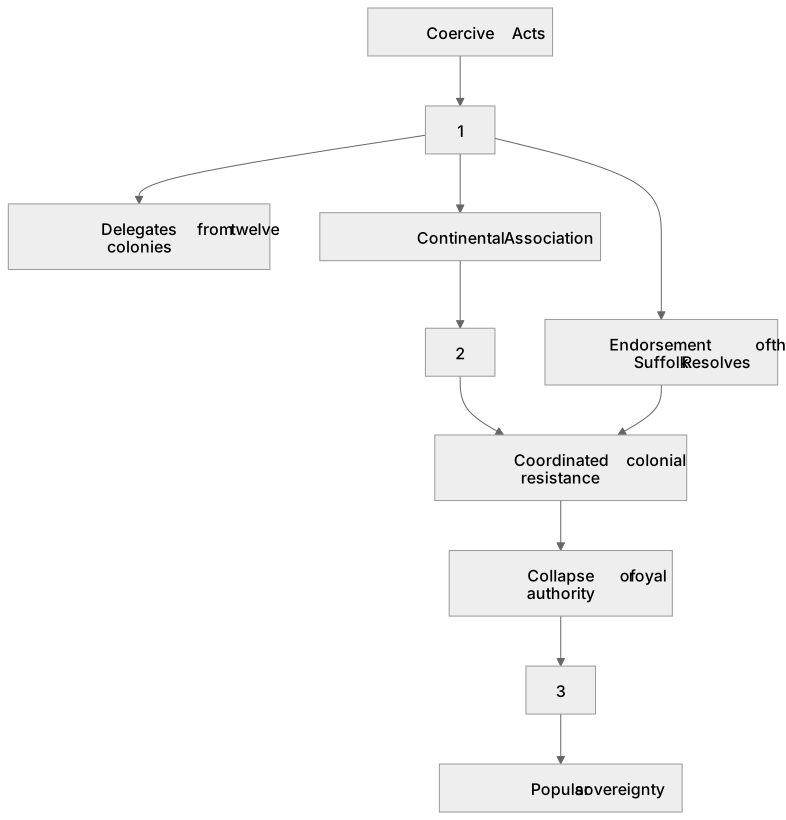
1Box 1
2Box 2
3Box 3
There is more to this lesson
The full lesson goes on to check your understanding and help you earn the marks. Create a free account to carry on, with your progress saved.
A week of Premium from your first lesson · Then the free plan continues · No card, no charge
Test your understanding of 2G The Birth of the USA, 1760–1801 – Ending the Colonial Relationship, 1774–1776: The hardening of colonial opposition: the First Continental Congress; the creation of new state constitutions
Active recall beats re-reading. Take an instant quiz now to test what you’ve learned and lock it into long-term memory.
A week of Premium from your first lesson · Then the free plan continues · No card, no charge