AQA · A-Level · History
Course version: 7042 · Version from Sept 2017
The ideology of revolution: Paine’s Common Sense; the influence of ideas…
Full specification wording
2G The Birth of the USA, 1760–1801 – Ending the Colonial Relationship, 1774–1776: The ideology of revolution: Paine’s Common Sense; the influence of ideas on colonial leaders such as Samuel Adams and Thomas Jefferson; divisions between loyalists and rebels
The ideological shift towards revolution was profoundly accelerated by Thomas Paine’s Common Sense (January 1776), which translated complex Enlightenment philosophy into accessible language,…
Checked against the AQA 7042 specification (opens in a new tab) on .
- Point 2 of 4
- 3 key terms
Study notes
From the checked teaching notes for this specification point.
The idea
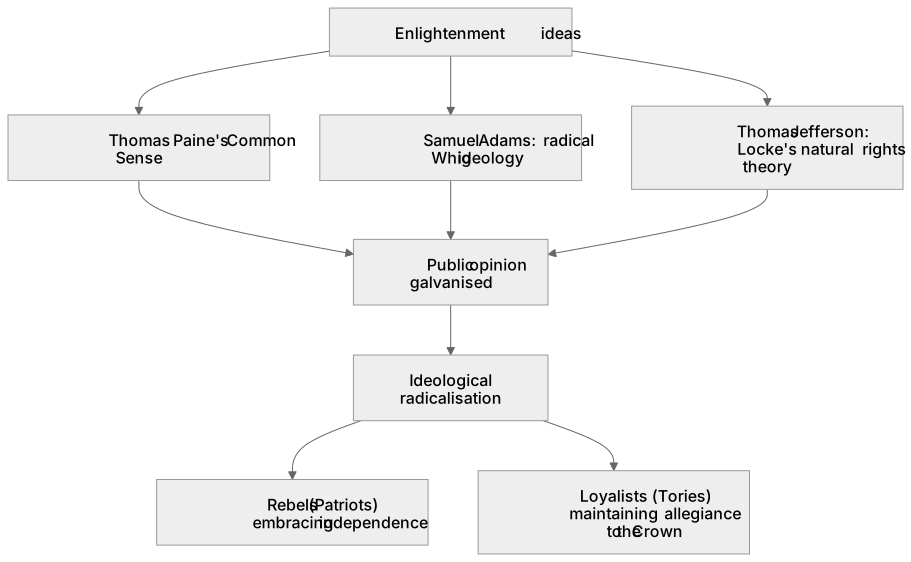
The ideological shift towards revolution was profoundly accelerated by Thomas Paine’s Common Sense (January 1776), which translated complex Enlightenment philosophy into accessible language, openly attacking the monarchy and advocating for a democratic republic. This pamphlet galvanised public opinion, complementing the intellectual frameworks developed by colonial leaders. Samuel Adams utilised radical Whig ideology to mobilise grassroots resistance in Boston, while Thomas Jefferson drew heavily on John Locke’s natural rights theory to articulate the moral justification for independence. However, this ideological radicalisation fractured colonial society, creating bitter divisions between rebels (Patriots) who embraced independence and loyalists (Tories) who feared mob rule and maintained allegiance to the British Crown.
What earns the marks
- Assess the impact of Thomas Paine’s Common Sense in shifting public opinion from seeking reconciliation to demanding outright independence.
- Analyse how Enlightenment ideas, particularly Locke's social contract and natural rights, influenced Thomas Jefferson's political writings.
- Evaluate Samuel Adams's role in translating radical Whig ideology into practical political action and grassroots mobilisation.
- Examine the demographic and ideological factors that divided colonial society into loyalist and rebel factions during the crisis.
Common mistakes and how to put them right
Stating that Common Sense introduced Enlightenment ideas to the colonies.
Put it right by explaining it popularised existing ideas and directed them specifically against the institution of monarchy.
Assuming colonial leaders shared a single, unified ideology.
Put it right by distinguishing between Samuel Adams's radical populism and the more elite, philosophical approach of figures like Thomas Jefferson.
Treating the colonial population as universally supportive of revolution.
Put it right by highlighting that approximately twenty percent of the population remained active loyalists.
Exam tips
- Quote or reference specific arguments from Common Sense, such as the absurdity of an island ruling a continent, to demonstrate its persuasive power.
- Connect Jefferson’s ideological stance directly to his drafting of the Declaration of Independence to show the practical application of Enlightenment thought.
- When evaluating the loyalist perspective, avoid dismissing them as merely stubborn; explain their legitimate fears of anarchy and economic ruin.
Try the lesson
The start of the 2G The Birth of the USA, 1760–1801 – Ending the Colonial Relationship, 1774–1776: The ideology of revolution: Paine’s Common Sense; the influence of ideas on colonial leaders such as Samuel Adams and Thomas Jefferson; divisions between loyalists and rebels lesson, made from checked teaching notes for this specification point.
Have a go first
What was the central argument presented by Thomas Paine in his highly influential 1776 pamphlet Common Sense?
Listen
The ideological shift towards revolution was profoundly accelerated by Thomas Paine’s Common Sense (January 1776), which translated complex Enlightenment philosophy into accessible language, openly attacking the monarchy and advocating for a democratic republic. This pamphlet galvanised public opinion, complementing the intellectual frameworks developed by colonial leaders. Samuel Adams utilised radical Whig ideology to mobilise grassroots resistance in Boston, while Thomas Jefferson drew heavily on John Locke’s natural rights theory to articulate the moral justification for independence. However, this ideological radicalisation fractured colonial society, creating bitter divisions between rebels (Patriots) who embraced independence and loyalists (Tories) who feared mob rule and maintained allegiance to the British Crown. A strong answer earns marks for these points. Assess the impact of Thomas Paine’s Common Sense in shifting public opinion from seeking reconciliation to demanding outright independence. Analyse how Enlightenment ideas, particularly Locke's social contract and natural rights, influenced Thomas Jefferson's political writings. Evaluate Samuel Adams's role in translating radical Whig ideology into practical political action and grassroots mobilisation. Examine the demographic and ideological factors that divided colonial society into loyalist and rebel factions during the crisis. A common slip: Stating that Common Sense introduced Enlightenment ideas to the colonies. Instead, explaining it popularised existing ideas and directed them specifically against the institution of monarchy. Exam tip: Quote or reference specific arguments from Common Sense, such as the absurdity of an island ruling a continent, to demonstrate its persuasive power.
See it
Key words
Say what each word means before you turn the card.
Enlightenment philosophy and natural rights
Try answering aloud or in your head before turning the card.
Social division and civil conflict
Try answering aloud or in your head before turning the card.
Radicalism versus conservatism
Try answering aloud or in your head before turning the card.
See every definition
- Enlightenment philosophy and natural rights
- Complex ideas translated into accessible language, with John Locke's natural rights theory used to articulate the moral justification for independence.
- Social division and civil conflict
- Ideological radicalisation fractured colonial society, creating bitter divisions between rebels who embraced independence and loyalists who feared mob rule.
- Radicalism versus conservatism
- Radical Whig ideology mobilised grassroots resistance, while loyalists feared mob rule and maintained allegiance to the British Crown.
Label the diagram
Some boxes have lost their names. Pick the right name for each number.
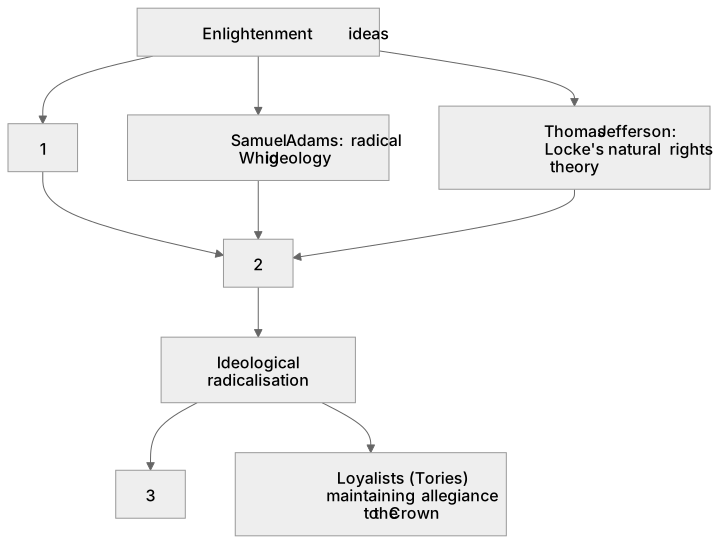
1Box 1
2Box 2
3Box 3
There is more to this lesson
The full lesson goes on to check your understanding and help you earn the marks. Create a free account to carry on, with your progress saved.
A week of Premium from your first lesson · Then the free plan continues · No card, no charge
Test your understanding of 2G The Birth of the USA, 1760–1801 – Ending the Colonial Relationship, 1774–1776: The ideology of revolution: Paine’s Common Sense; the influence of ideas on colonial leaders such as Samuel Adams and Thomas Jefferson; divisions between loyalists and rebels
Active recall beats re-reading. Take an instant quiz now to test what you’ve learned and lock it into long-term memory.
A week of Premium from your first lesson · Then the free plan continues · No card, no charge