AQA · A-Level · History
Course version: 7042 · Version from Sept 2017
British government legislation and policies towards the colonies;…
Full specification wording
2G The Birth of the USA, 1760–1801 – Enforcing the Colonial Relationship, 1763–1774: British government legislation and policies towards the colonies; including the Proclamation of 1763; the Stamp Act and the Townshend Acts
Following the Seven Years' War, British policy shifted from salutary neglect to active imperial control to manage new territories and reduce national debt.
Checked against the AQA 7042 specification (opens in a new tab) on .
- Point 1 of 4
- 2 key terms
Study notes
From the checked teaching notes for this specification point.
The idea
Following the Seven Years' War, British policy shifted from salutary neglect to active imperial control to manage new territories and reduce national debt. The Proclamation of 1763 restricted colonial expansion west of the Appalachians to prevent Native American conflicts, frustrating land speculators. To raise revenue, Parliament passed the Stamp Act in 1765, imposing a direct tax on printed materials, sparking intense debates over taxation without representation. Following its repeal, the Townshend Acts of 1767 introduced indirect duties on glass, lead, paint, paper, and tea. These policies collectively alienated the colonies, transforming economic grievances into a unified ideological resistance against British parliamentary sovereignty.
What earns the marks
- Explain the financial and administrative motivations behind British policy shifts after 1763, particularly the debt from the Seven Years' War.
- Assess the impact of the Proclamation of 1763 on colonial land speculators and frontiersmen.
- Analyse the constitutional significance of the Stamp Act as the first direct internal tax levied on the colonies by Parliament.
- Evaluate the strategic shift represented by the Townshend Acts, moving from direct taxation to indirect customs duties to raise revenue and pay colonial officials.
Common mistakes and how to put them right
Confusing the Stamp Act with the Townshend Acts.
Put it right: The Stamp Act was a direct internal tax on printed goods, whereas the Townshend Acts were indirect external duties on imported goods.
Assuming the Proclamation of 1763 was designed to punish the colonists.
Put it right: It was actually intended to stabilise the western frontier and prevent costly wars with Native Americans.
Claiming the British government wanted to oppress the colonies.
Put it right: Their primary goal was simply to make the colonies contribute to the cost of their own defence and administration.
Exam tips
- Link specific legislation to the broader shift from salutary neglect to imperial enforcement when evaluating the causes of the American Revolution.
- Use the Stamp Act as a primary example of how British financial policies inadvertently united disparate colonies through shared constitutional grievances.
- When discussing the Townshend Acts, highlight how the revenue was intended to pay the salaries of colonial governors, thereby threatening the power of colonial assemblies.
Try the lesson
The start of the 2G The Birth of the USA, 1760–1801 – Enforcing the Colonial Relationship, 1763–1774: British government legislation and policies towards the colonies; including the Proclamation of 1763; the Stamp Act and the Townshend Acts lesson, made from checked teaching notes for this specification point.
Have a go first
What was the primary geographical restriction imposed on the American colonies by the Proclamation of 1763?
Listen
Following the Seven Years' War, British policy shifted from salutary neglect to active imperial control to manage new territories and reduce national debt. The Proclamation of 1763 restricted colonial expansion west of the Appalachians to prevent Native American conflicts, frustrating land speculators. To raise revenue, Parliament passed the Stamp Act in 1765, imposing a direct tax on printed materials, sparking intense debates over taxation without representation. Following its repeal, the Townshend Acts of 1767 introduced indirect duties on glass, lead, paint, paper, and tea. These policies collectively alienated the colonies, transforming economic grievances into a unified ideological resistance against British parliamentary sovereignty. A strong answer earns marks for these points. Explain the financial and administrative motivations behind British policy shifts after 1763, particularly the debt from the Seven Years' War. Assess the impact of the Proclamation of 1763 on colonial land speculators and frontiersmen. Analyse the constitutional significance of the Stamp Act as the first direct internal tax levied on the colonies by Parliament. Evaluate the strategic shift represented by the Townshend Acts, moving from direct taxation to indirect customs duties to raise revenue and pay colonial officials. Exam tip: Link specific legislation to the broader shift from salutary neglect to imperial enforcement when evaluating the causes of the American Revolution.
See it
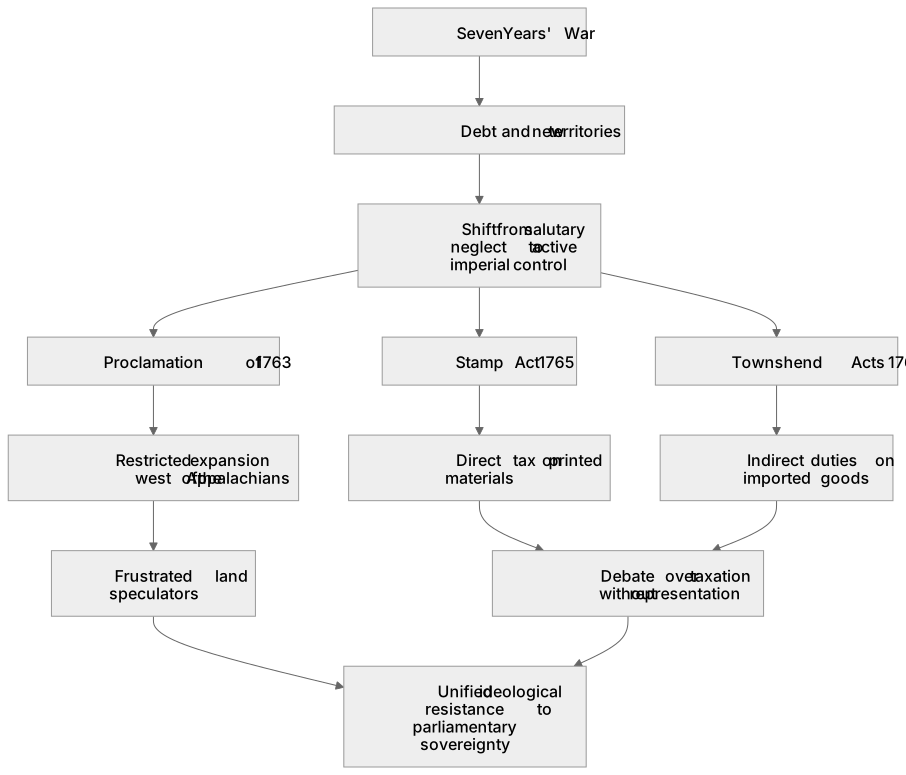
Put the events in order
Put these events in the order they happened, earliest first.
- 1. Proclamation restricted colonial expansion west of the Appalachians
- 2. Townshend Acts introduced indirect duties on imported goods
- 3. Stamp Act imposed a direct tax on printed materials
Key words
Say what each word means before you turn the card.
Imperial control
Try answering aloud or in your head before turning the card.
Salutary neglect
Try answering aloud or in your head before turning the card.
See every definition
- Imperial control
- Active management of the colonies by the British government, to which policy shifted from salutary neglect after the Seven Years' War.
- Salutary neglect
- The earlier British policy from which policy shifted to active imperial control after the Seven Years' War.
Label the diagram
Some boxes have lost their names. Pick the right name for each number.
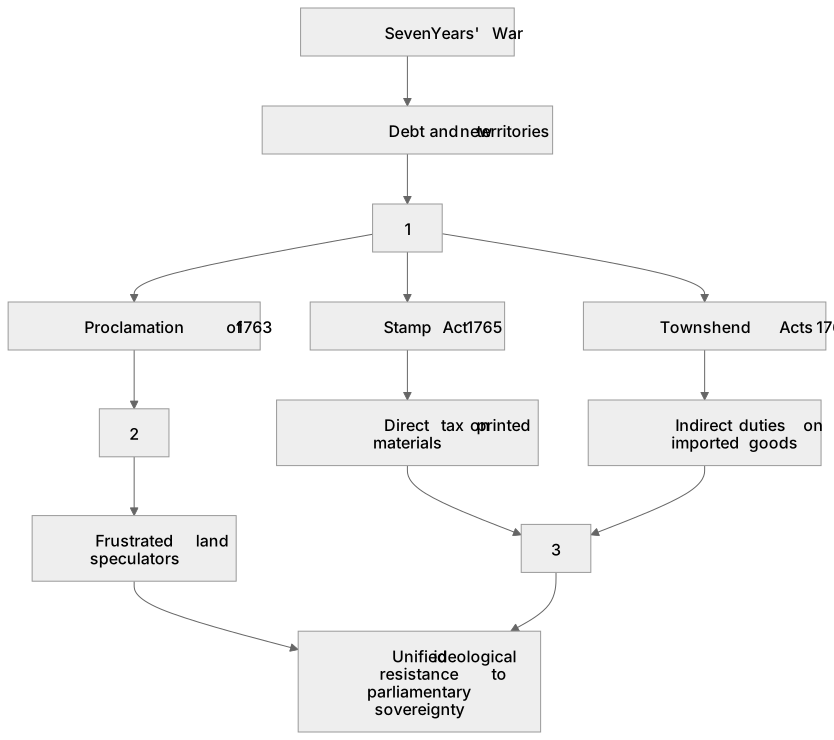
1Box 1
2Box 2
3Box 3
There is more to this lesson
The full lesson goes on to check your understanding and help you earn the marks. Create a free account to carry on, with your progress saved.
A week of Premium from your first lesson · Then the free plan continues · No card, no charge
Test your understanding of 2G The Birth of the USA, 1760–1801 – Enforcing the Colonial Relationship, 1763–1774: British government legislation and policies towards the colonies; including the Proclamation of 1763; the Stamp Act and the Townshend Acts
Active recall beats re-reading. Take an instant quiz now to test what you’ve learned and lock it into long-term memory.
A week of Premium from your first lesson · Then the free plan continues · No card, no charge