AQA · A-Level · History
Course version: 7042 · Version from Sept 2017
The reaction of the colonists: the attitude of the colonial elites
Full specification wording
2G The Birth of the USA, 1760–1801 – Enforcing the Colonial Relationship, 1763–1774: The reaction of the colonists: the attitude of the colonial elites
Colonial reaction to British policies was shaped by elites, including wealthy merchants, planters, and lawyers.
Checked against the AQA 7042 specification (opens in a new tab) on .
- Point 2 of 4
- 4 key terms
Study notes
From the checked teaching notes for this specification point.
The idea
Colonial reaction to British policies was shaped by elites, including wealthy merchants, planters, and lawyers. These figures initially sought to protect their economic interests and political autonomy rather than pursue independence. Elites articulated resistance through constitutional arguments, drafting petitions that championed the rights of Englishmen and condemned taxation without representation. They formed networks like the Committees of Correspondence to coordinate opposition while attempting to control popular protests to prevent mob rule. Consequently, the elites provided the intellectual framework and respectable leadership necessary to unify colonial resistance against British authority without immediately overturning the existing social order.
What earns the marks
- Identify the composition of the colonial elite, including Northern merchants, Southern planters, and legal professionals.
- Analyse the ideological and constitutional arguments formulated by the elites, such as the distinction between internal and external taxation.
- Evaluate the role of elites in establishing intercolonial networks, such as the Stamp Act Congress and Committees of Correspondence.
- Assess the tension between the elites' desire to resist British policy and their fear of unleashing uncontrollable popular radicalism or mob violence.
Common mistakes and how to put them right
Assuming the colonial elites desired independence from the outset.
Put it right: Their initial goal was a return to salutary neglect and the restoration of their rights as Englishmen.
Treating the colonists as a single, unified group.
Put it right: The elites often had different motivations and methods compared to the lower classes or radical groups like the Sons of Liberty.
Claiming the elites fully supported violent protests.
Put it right: They frequently attempted to moderate mob actions to protect property and maintain social hierarchy.
Exam tips
- Contrast the constitutional and petition-based resistance of the elites with the direct action and intimidation tactics used by the lower classes.
- Use specific examples of elite leadership, such as John Dickinson's 'Letters from a Farmer in Pennsylvania', to illustrate their ideological contributions.
- Discuss how British policies inadvertently united disparate elite groups, such as Virginian planters and Massachusetts merchants, through shared economic and political grievances.
Try the lesson
The start of the 2G The Birth of the USA, 1760–1801 – Enforcing the Colonial Relationship, 1763–1774: The reaction of the colonists: the attitude of the colonial elites lesson, made from checked teaching notes for this specification point.
Have a go first
Which of the following best describes the initial attitude of the colonial elites towards British taxation policies in the 1760s?
Listen
Colonial reaction to British policies was shaped by elites, including wealthy merchants, planters, and lawyers. These figures initially sought to protect their economic interests and political autonomy rather than pursue independence. Elites articulated resistance through constitutional arguments, drafting petitions that championed the rights of Englishmen and condemned taxation without representation. They formed networks like the Committees of Correspondence to coordinate opposition while attempting to control popular protests to prevent mob rule. Consequently, the elites provided the intellectual framework and respectable leadership necessary to unify colonial resistance against British authority without immediately overturning the existing social order. A strong answer earns marks for these points. Identify the composition of the colonial elite, including Northern merchants, Southern planters, and legal professionals. Analyse the ideological and constitutional arguments formulated by the elites, such as the distinction between internal and external taxation. Evaluate the role of elites in establishing intercolonial networks, such as the Stamp Act Congress and Committees of Correspondence. Assess the tension between the elites' desire to resist British policy and their fear of unleashing uncontrollable popular radicalism or mob violence. Exam tip: Contrast the constitutional and petition-based resistance of the elites with the direct action and intimidation tactics used by the lower classes.
See it
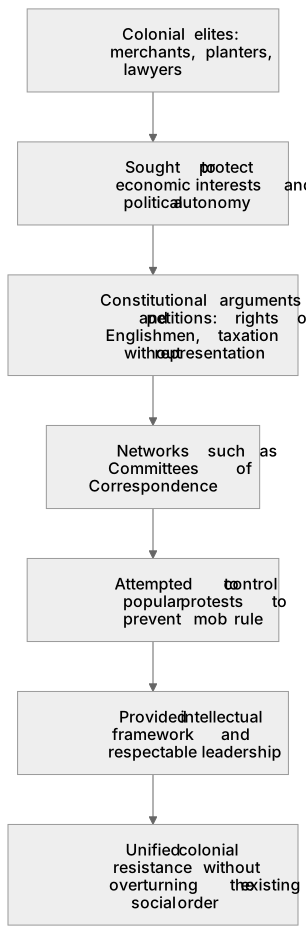
Put it in order
Put these steps in the order they happen.
- 1. Unified colonial resistance without overturning the existing social order
- 2. Provided intellectual framework and respectable leadership
- 3. Constitutional arguments and petitions: rights of Englishmen, taxation without representation
- 4. Attempted to control popular protests to prevent mob rule
- 5. Colonial elites: merchants, planters, lawyers
- 6. Sought to protect economic interests and political autonomy
- 7. Networks such as Committees of Correspondence
Key words
Say what each word means before you turn the card.
Social hierarchy
Try answering aloud or in your head before turning the card.
Ideological resistance
Try answering aloud or in your head before turning the card.
Political leadership
Try answering aloud or in your head before turning the card.
Colonial unity
Try answering aloud or in your head before turning the card.
See every definition
- Social hierarchy
- The existing social order that elites sought to maintain while resisting British authority, attempting to control popular protests to prevent mob rule.
- Ideological resistance
- Resistance articulated by elites through constitutional arguments, drafting petitions that championed the rights of Englishmen and condemned taxation without representation.
- Political leadership
- Respectable leadership provided by elites, who supplied the intellectual framework necessary to unify colonial resistance against British authority.
- Colonial unity
- Unification of colonial resistance against British authority, achieved through elite leadership without immediately overturning the existing social order.
Label the diagram
Some boxes have lost their names. Pick the right name for each number.
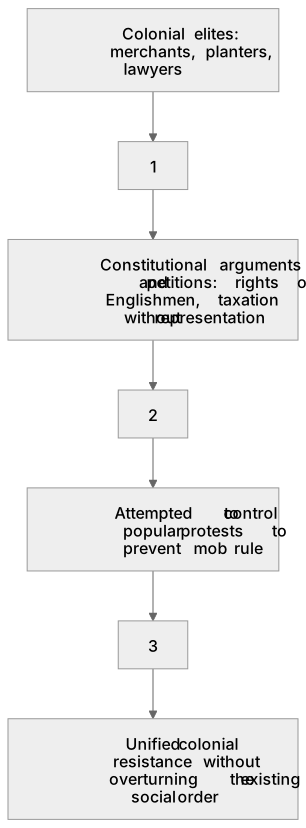
1Box 1
2Box 2
3Box 3
There is more to this lesson
The full lesson goes on to check your understanding and help you earn the marks. Create a free account to carry on, with your progress saved.
A week of Premium from your first lesson · Then the free plan continues · No card, no charge
Test your understanding of 2G The Birth of the USA, 1760–1801 – Enforcing the Colonial Relationship, 1763–1774: The reaction of the colonists: the attitude of the colonial elites
Active recall beats re-reading. Take an instant quiz now to test what you’ve learned and lock it into long-term memory.
A week of Premium from your first lesson · Then the free plan continues · No card, no charge