AQA · A-Level · History
Course version: 7042 · Version from Sept 2017
Escalating tensions: the Boston Tea Party; the ‘intolerable’ Five Acts;…
Full specification wording
2G The Birth of the USA, 1760–1801 – Enforcing the Colonial Relationship, 1763–1774: Escalating tensions: the Boston Tea Party; the ‘intolerable’ Five Acts; the organisation of colonial opposition in Massachusetts
Escalating tensions between Britain and the colonies culminated in the 1773 Boston Tea Party, where the Sons of Liberty destroyed East India Company tea to protest the Tea Act.
Checked against the AQA 7042 specification (opens in a new tab) on .
- Point 4 of 4
- 4 key terms
Study notes
From the checked teaching notes for this specification point.
The idea
Escalating tensions between Britain and the colonies culminated in the 1773 Boston Tea Party, where the Sons of Liberty destroyed East India Company tea to protest the Tea Act. Britain retaliated with the Coercive Acts of 1774, dubbed the 'intolerable' Five Acts by colonists. These included the Boston Port Act, Massachusetts Government Act, Impartial Administration of Justice Act, Quartering Act, and the Quebec Act. Rather than isolating Massachusetts, these punitive measures spurred the organisation of colonial opposition within the province. Local Committees of Correspondence coordinated resistance, leading to the Suffolk Resolves and the establishment of a Provincial Congress, effectively ending royal authority outside Boston.
What earns the marks
- Detail the events and immediate economic impact of the Boston Tea Party as a catalyst for severe British retaliation.
- Identify and explain the specific provisions of the 'intolerable' Five Acts, including the Quebec Act, and why colonists viewed them as a threat to liberty.
- Analyse the organisation of colonial opposition in Massachusetts, specifically the role of Committees of Correspondence and the creation of the Provincial Congress.
- Evaluate how the British strategy to isolate Massachusetts through the Coercive Acts backfired, instead fostering inter-colonial unity and escalating tensions.
Common mistakes and how to put them right
Confusing the Coercive Acts with earlier legislation like the Townshend Duties.
Put it right: Clearly date the 'intolerable' Five Acts to 1774 as a direct response to the Boston Tea Party.
Omitting the Quebec Act from the 'intolerable' Five Acts.
Put it right: Explicitly include the Quebec Act, noting that while not originally a punitive measure, colonists grouped it with the Coercive Acts.
Stating that the Boston Tea Party immediately started the Revolutionary War.
Put it right: Explain that it was the subsequent British legislation and the resulting organisation of opposition that escalated tensions toward war.
Exam tips
- Memorise the specific names and functions of at least three of the 'intolerable' Five Acts to provide precise evidence in essays.
- Link the organisation of opposition in Massachusetts, such as the Suffolk Resolves, directly to the convening of the First Continental Congress.
- Argue whether the Boston Tea Party or the British response was the more significant turning point in escalating tensions.
Try the lesson
The start of the 2G The Birth of the USA, 1760–1801 – Enforcing the Colonial Relationship, 1763–1774: Escalating tensions: the Boston Tea Party; the ‘intolerable’ Five Acts; the organisation of colonial opposition in Massachusetts lesson, made from checked teaching notes for this specification point.
Have a go first
Which of the following was a direct provision of the 'Intolerable' (Coercive) Acts passed by the British Parliament in 1774?
Listen
Escalating tensions between Britain and the colonies culminated in the 1773 Boston Tea Party, where the Sons of Liberty destroyed East India Company tea to protest the Tea Act. Britain retaliated with the Coercive Acts of 1774, dubbed the 'intolerable' Five Acts by colonists. These included the Boston Port Act, Massachusetts Government Act, Impartial Administration of Justice Act, Quartering Act, and the Quebec Act. Rather than isolating Massachusetts, these punitive measures spurred the organisation of colonial opposition within the province. Local Committees of Correspondence coordinated resistance, leading to the Suffolk Resolves and the establishment of a Provincial Congress, effectively ending royal authority outside Boston. A strong answer earns marks for these points. Detail the events and immediate economic impact of the Boston Tea Party as a catalyst for severe British retaliation. Identify and explain the specific provisions of the 'intolerable' Five Acts, including the Quebec Act, and why colonists viewed them as a threat to liberty. Analyse the organisation of colonial opposition in Massachusetts, specifically the role of Committees of Correspondence and the creation of the Provincial Congress. Evaluate how the British strategy to isolate Massachusetts through the Coercive Acts backfired, instead fostering inter-colonial unity and escalating tensions. A common slip: Confusing the Coercive Acts with earlier legislation like the Townshend Duties. Instead, clearly date the 'intolerable' Five Acts to 1774 as a direct response to the Boston Tea Party. Exam tip: Memorise the specific names and functions of at least three of the 'intolerable' Five Acts to provide precise evidence in essays.
See it
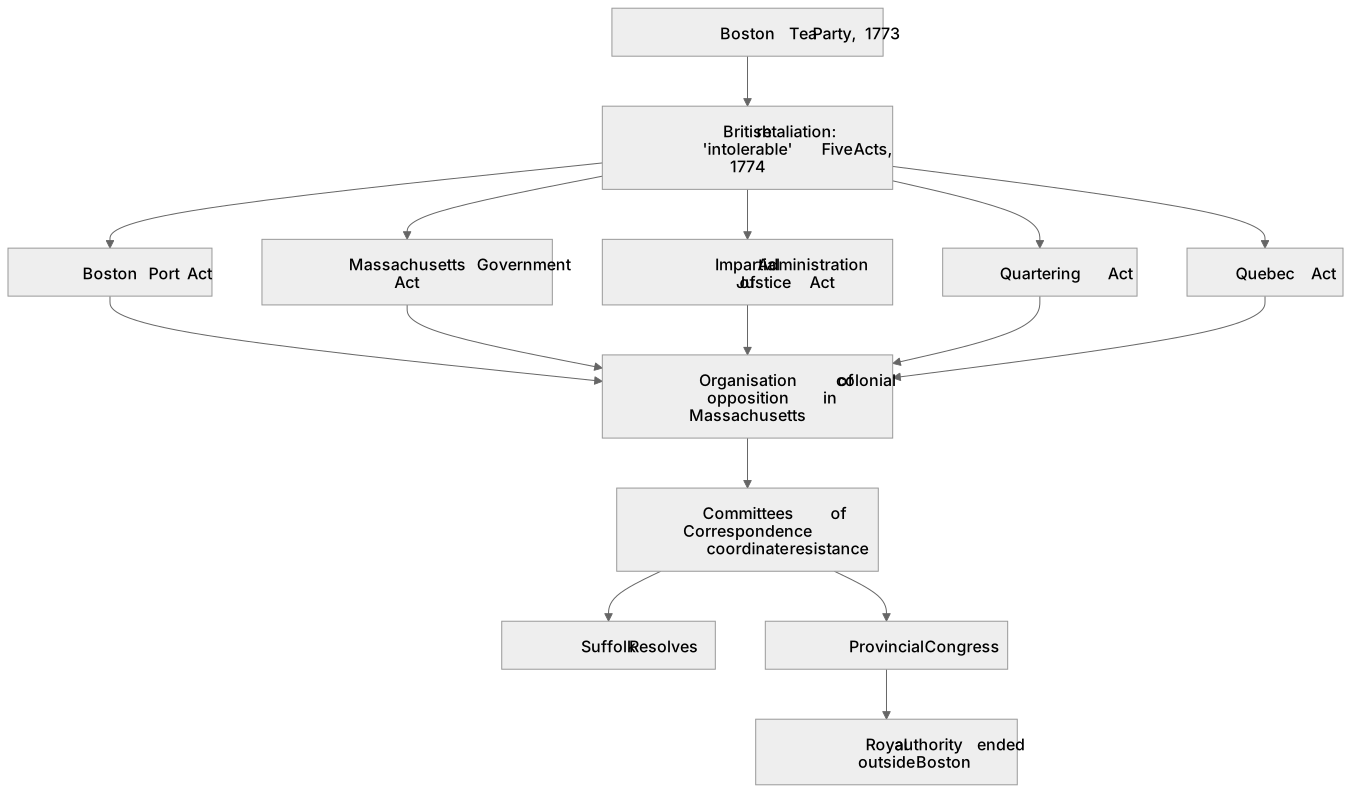
Key words
Say what each word means before you turn the card.
Imperial retaliation
Try answering aloud or in your head before turning the card.
Political organisation
Try answering aloud or in your head before turning the card.
Escalation of conflict
Try answering aloud or in your head before turning the card.
Colonial unity
Try answering aloud or in your head before turning the card.
See every definition
- Imperial retaliation
- Britain responded to the Boston Tea Party with the Coercive Acts of 1774, dubbed the 'intolerable' Five Acts by colonists.
- Political organisation
- Local Committees of Correspondence coordinated resistance in Massachusetts, leading to the Suffolk Resolves and the establishment of a Provincial Congress.
- Escalation of conflict
- Tensions escalated as the Boston Tea Party was followed by British legislation and the resulting organisation of opposition toward war.
- Colonial unity
- The British strategy to isolate Massachusetts through the Coercive Acts backfired, instead fostering inter-colonial unity and escalating tensions.
Label the diagram
Some boxes have lost their names. Pick the right name for each number.
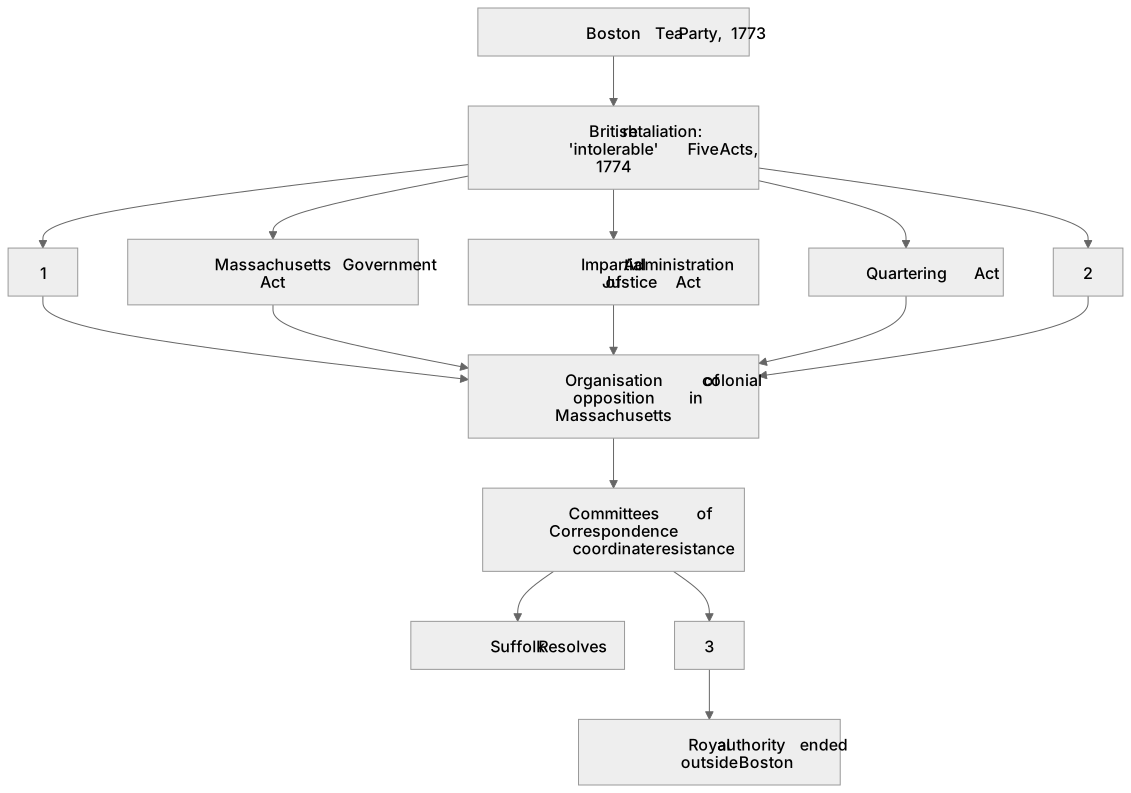
1Box 1
2Box 2
3Box 3
There is more to this lesson
The full lesson goes on to check your understanding and help you earn the marks. Create a free account to carry on, with your progress saved.
A week of Premium from your first lesson · Then the free plan continues · No card, no charge
Test your understanding of 2G The Birth of the USA, 1760–1801 – Enforcing the Colonial Relationship, 1763–1774: Escalating tensions: the Boston Tea Party; the ‘intolerable’ Five Acts; the organisation of colonial opposition in Massachusetts
Active recall beats re-reading. Take an instant quiz now to test what you’ve learned and lock it into long-term memory.
A week of Premium from your first lesson · Then the free plan continues · No card, no charge