AQA · A-Level · History
Course version: 7042 · Version from Sept 2017
The reaction of the colonists: pressure and reform movements from below
Full specification wording
2G The Birth of the USA, 1760–1801 – Enforcing the Colonial Relationship, 1763–1774: The reaction of the colonists: pressure and reform movements from below
The reaction of the colonists to British policies between 1763 and 1774 was characterised by intense pressure and the emergence of reform movements from below.
Checked against the AQA 7042 specification (opens in a new tab) on .
- Point 3 of 4
- 4 key terms
Study notes
From the checked teaching notes for this specification point.
The idea
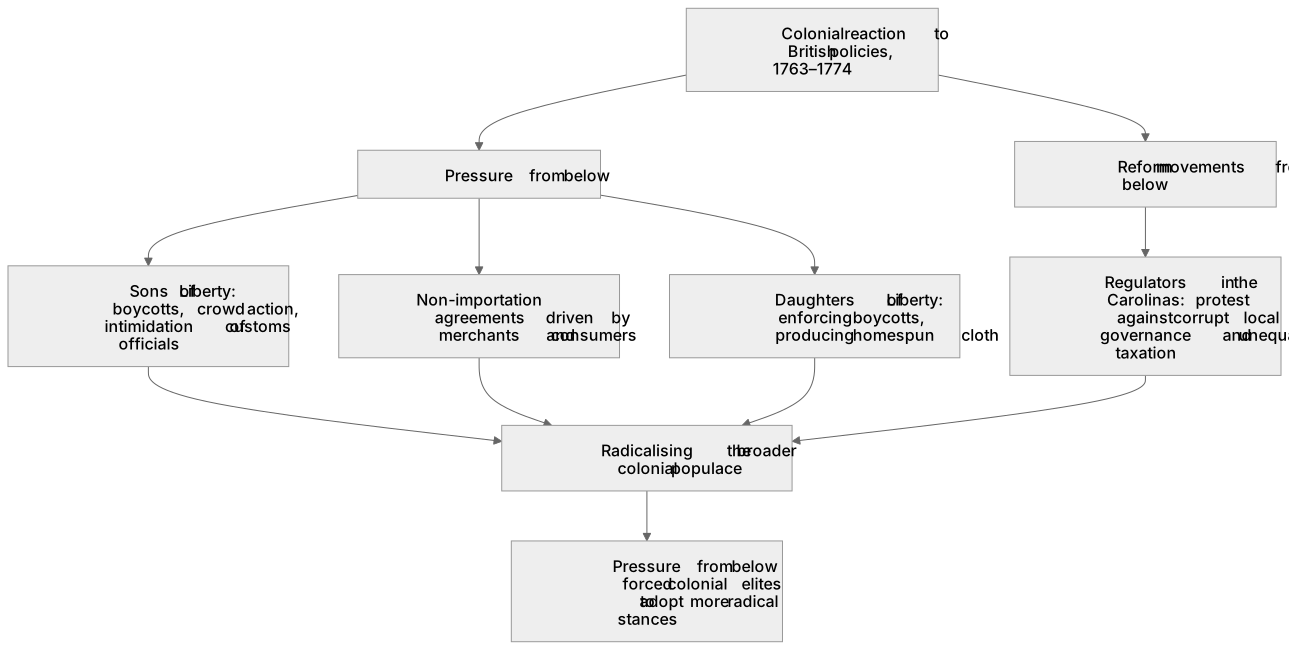
The reaction of the colonists to British policies between 1763 and 1774 was characterised by intense pressure and the emergence of reform movements from below. Rather than just elite political resistance, ordinary citizens actively participated in shaping opposition. Groups like the Sons of Liberty exerted direct pressure through boycotts, crowd action, and the intimidation of customs officials. Meanwhile, reform movements from below, such as the Regulators in the Carolinas, protested against corrupt local governance and unequal taxation, demonstrating that colonial discontent was not solely directed at Britain but also at internal inequalities. This grassroots mobilisation was crucial in radicalising the broader colonial populace.
What earns the marks
- Identify specific grassroots organisations, such as the Sons of Liberty, and their methods of exerting pressure, including boycotts and effigy burnings.
- Explain the role of non-importation agreements as a form of economic pressure driven by merchants and consumers from below.
- Analyse internal reform movements, such as the Regulator movement in North and South Carolina, highlighting their grievances against local corruption and lack of representation.
- Evaluate how pressure from below forced colonial elites to adopt more radical stances against British imperial policies to maintain control.
Common mistakes and how to put them right
Assuming all colonial resistance was directed solely at the British Parliament.
Put it right: Acknowledge internal reform movements like the Regulators who targeted corrupt colonial elites.
Treating the colonists as a unified group with identical aims.
Put it right: Distinguish between the economic grievances of the lower classes and the constitutional arguments of the elite.
Overlooking the role of women in pressure movements.
Put it right: Include the contributions of the Daughters of Liberty in enforcing boycotts and producing homespun cloth.
Exam tips
- Use the Regulator movement as a prime example of a reform movement from below to demonstrate depth of knowledge regarding internal colonial tensions.
- When discussing pressure, explicitly link grassroots actions like crowd violence to the subsequent repeal of British legislation, such as the Stamp Act.
- Contrast the methods of elite political resistance with the direct action of movements from below to build a nuanced argument.
Try the lesson
The start of the 2G The Birth of the USA, 1760–1801 – Enforcing the Colonial Relationship, 1763–1774: The reaction of the colonists: pressure and reform movements from below lesson, made from checked teaching notes for this specification point.
Have a go first
Which of the following was a primary method used by colonial 'pressure from below' movements, such as the Sons of Liberty, to oppose British taxation in the 1760s?
Listen
The reaction of the colonists to British policies between 1763 and 1774 was characterised by intense pressure and the emergence of reform movements from below. Rather than just elite political resistance, ordinary citizens actively participated in shaping opposition. Groups like the Sons of Liberty exerted direct pressure through boycotts, crowd action, and the intimidation of customs officials. Meanwhile, reform movements from below, such as the Regulators in the Carolinas, protested against corrupt local governance and unequal taxation, demonstrating that colonial discontent was not solely directed at Britain but also at internal inequalities. This grassroots mobilisation was crucial in radicalising the broader colonial populace. A strong answer earns marks for these points. Identify specific grassroots organisations, such as the Sons of Liberty, and their methods of exerting pressure, including boycotts and effigy burnings. Explain the role of non-importation agreements as a form of economic pressure driven by merchants and consumers from below. Analyse internal reform movements, such as the Regulator movement in North and South Carolina, highlighting their grievances against local corruption and lack of representation. Evaluate how pressure from below forced colonial elites to adopt more radical stances against British imperial policies to maintain control. A common slip: Assuming all colonial resistance was directed solely at the British Parliament. Instead, acknowledge internal reform movements like the Regulators who targeted corrupt colonial elites. Exam tip: Use the Regulator movement as a prime example of a reform movement from below to demonstrate depth of knowledge regarding internal colonial tensions.
See it
Key words
Say what each word means before you turn the card.
Grassroots mobilisation
Try answering aloud or in your head before turning the card.
Economic resistance
Try answering aloud or in your head before turning the card.
Internal colonial divisions
Try answering aloud or in your head before turning the card.
Radicalisation
Try answering aloud or in your head before turning the card.
See every definition
- Grassroots mobilisation
- Participation by ordinary citizens in shaping opposition, which was crucial in radicalising the broader colonial populace.
- Economic resistance
- Pressure driven by merchants and consumers from below through non-importation agreements.
- Internal colonial divisions
- Discontent directed not solely at Britain but also at internal inequalities, as shown by reform movements protesting corrupt local governance and unequal taxation.
- Radicalisation
- The process by which grassroots mobilisation made the broader colonial populace more radical.
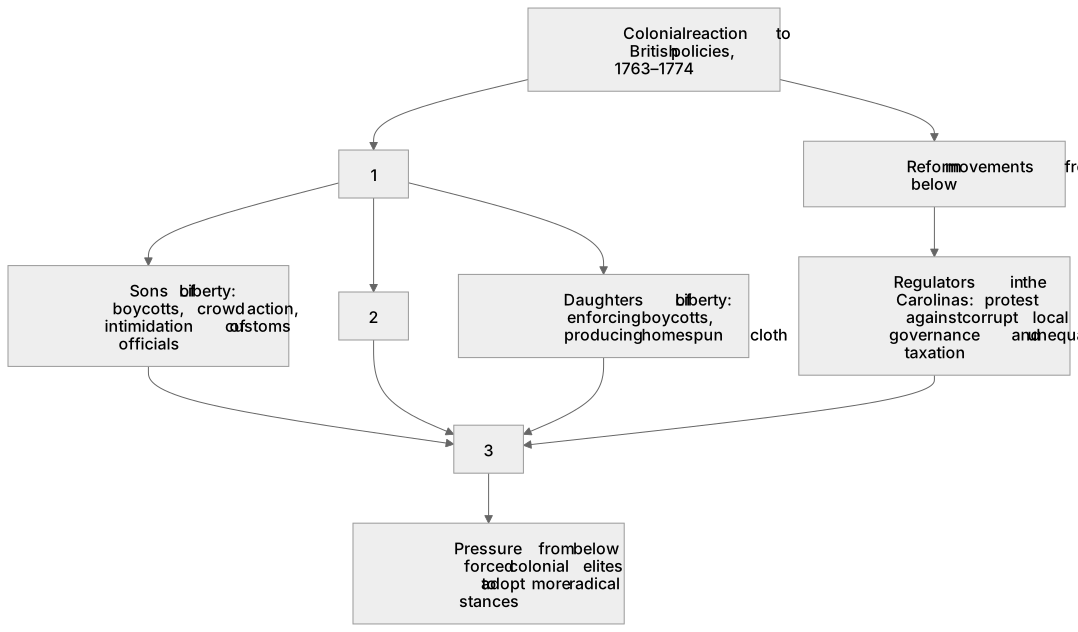
Label the diagram
Some boxes have lost their names. Pick the right name for each number.
1Box 1
2Box 2
3Box 3
There is more to this lesson
The full lesson goes on to check your understanding and help you earn the marks. Create a free account to carry on, with your progress saved.
A week of Premium from your first lesson · Then the free plan continues · No card, no charge
Test your understanding of 2G The Birth of the USA, 1760–1801 – Enforcing the Colonial Relationship, 1763–1774: The reaction of the colonists: pressure and reform movements from below
Active recall beats re-reading. Take an instant quiz now to test what you’ve learned and lock it into long-term memory.
A week of Premium from your first lesson · Then the free plan continues · No card, no charge