AQA · A-Level · History
Course version: 7042 · Version from Sept 2017
Ratification of the new Republic: the forwarding of the constitution to…
Full specification wording
2G The Birth of the USA, 1760–1801 – Founding the Republic, 1776–1789 (A-level only): Ratification of the new Republic: the forwarding of the constitution to the states by the Continental Congress, ratification of the constitution by state conventions
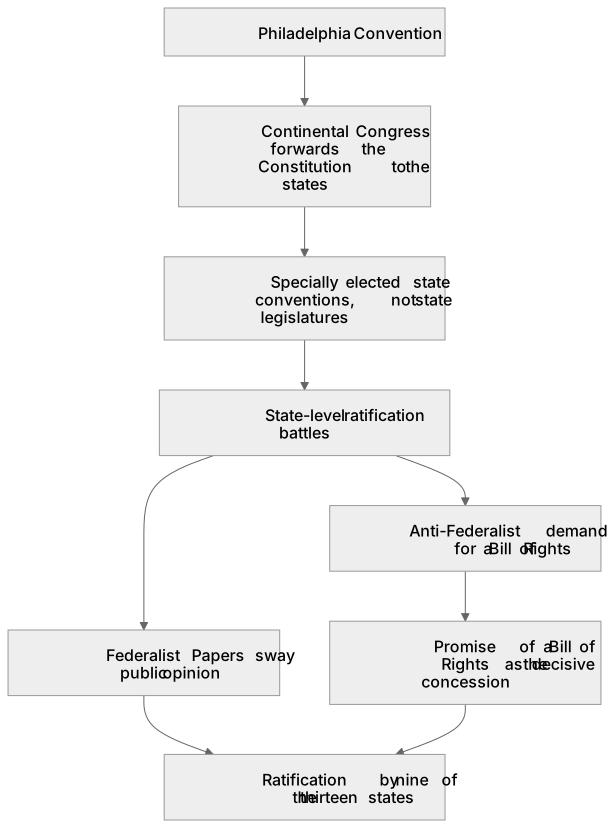
Following the Philadelphia Convention, the Continental Congress forwarded the proposed Constitution to the states, initiating a rigorous ratification process.
Checked against the AQA 7042 specification (opens in a new tab) on .
- Point 4 of 4
- 3 key terms
Study notes
From the checked teaching notes for this specification point.
The idea
Following the Philadelphia Convention, the Continental Congress forwarded the proposed Constitution to the states, initiating a rigorous ratification process. Rather than using state legislatures, ratification occurred through specially elected state conventions, requiring approval from nine of the thirteen states. This bypassed vested interests in existing state governments. The Federalist Papers played a vital role in swaying public opinion, while the promise of a Bill of Rights was the decisive concession needed to secure ratification from sceptical state conventions.
What earns the marks
- Explain the procedural decision by the Continental Congress to forward the Constitution to specially elected state conventions rather than existing state legislatures.
- Analyse the requirement for nine out of thirteen states to ratify the Constitution for it to take effect, bypassing the unanimity required under the Articles of Confederation.
- Evaluate the strategies used by Federalists to secure ratification in key battleground states, including the publication of the Federalist Papers in New York.
- Assess the role of the Anti-Federalists in state conventions and how their demand for a Bill of Rights forced a crucial compromise that enabled final ratification.
Common mistakes and how to put them right
Claiming that state legislatures ratified the Constitution.
Put it right by specifying that specially elected state ratifying conventions were used to bypass legislative opposition.
Assuming the Constitution required unanimous approval to be enacted.
Put it right by stating that Article VII required only nine of the thirteen states to ratify it.
Believing the Continental Congress actively campaigned for the Constitution.
Put it right by noting Congress merely forwarded the document to the states without a formal recommendation.
Exam tips
- Focus on the ratification struggles in large, influential states like Virginia and New York, as their approval was practically essential for the new Republic's survival.
- Discuss the strategic advantage the Federalists held by being proactive and offering a concrete plan, compared to the Anti-Federalists' largely negative opposition.
- Analyse the promise of the Bill of Rights not just as an ideological addition, but as a pragmatic political tool used to win over moderate delegates in state conventions.
Try the lesson
The start of the 2G The Birth of the USA, 1760–1801 – Founding the Republic, 1776–1789 (A-level only): Ratification of the new Republic: the forwarding of the constitution to the states by the Continental Congress, ratification of the constitution by state conventions lesson, made from checked teaching notes for this specification point.
Have a go first
After the Philadelphia Convention, what process was established for the ratification of the new United States Constitution?
Listen
Following the Philadelphia Convention, the Continental Congress forwarded the proposed Constitution to the states, initiating a rigorous ratification process. Rather than using state legislatures, ratification occurred through specially elected state conventions, requiring approval from nine of the thirteen states. This bypassed vested interests in existing state governments. The Federalist Papers played a vital role in swaying public opinion, while the promise of a Bill of Rights was the decisive concession needed to secure ratification from sceptical state conventions. A strong answer earns marks for these points. Explain the procedural decision by the Continental Congress to forward the Constitution to specially elected state conventions rather than existing state legislatures. Analyse the requirement for nine out of thirteen states to ratify the Constitution for it to take effect, bypassing the unanimity required under the Articles of Confederation. Evaluate the strategies used by Federalists to secure ratification in key battleground states, including the publication of the Federalist Papers in New York. Assess the role of the Anti-Federalists in state conventions and how their demand for a Bill of Rights forced a crucial compromise that enabled final ratification. A common slip: Claiming that state legislatures ratified the Constitution. Instead, specifying that specially elected state ratifying conventions were used to bypass legislative opposition. Exam tip: Focus on the ratification struggles in large, influential states like Virginia and New York, as their approval was practically essential for the new Republic's survival.
See it
Key words
Say what each word means before you turn the card.
Political strategy and campaigning
Try answering aloud or in your head before turning the card.
Public opinion and the press
Try answering aloud or in your head before turning the card.
Constitutional legality and process
Try answering aloud or in your head before turning the card.
See every definition
- Political strategy and campaigning
- The proactive tactics used by Federalists to secure ratification in key battleground states, including the publication of the Federalist Papers in New York.
- Public opinion and the press
- The role of the Federalist Papers in swaying public opinion during the fierce state-level ratification battles.
- Constitutional legality and process
- The forwarding of the constitution to the states by the Continental Congress and its ratification by state conventions, requiring approval from nine of the thirteen states.
Label the diagram
Some boxes have lost their names. Pick the right name for each number.
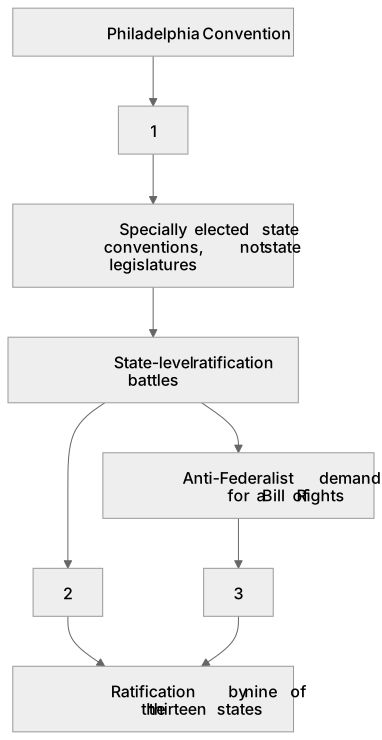
1Box 1
2Box 2
3Box 3
There is more to this lesson
The full lesson goes on to check your understanding and help you earn the marks. Create a free account to carry on, with your progress saved.
A week of Premium from your first lesson · Then the free plan continues · No card, no charge
Test your understanding of 2G The Birth of the USA, 1760–1801 – Founding the Republic, 1776–1789 (A-level only): Ratification of the new Republic: the forwarding of the constitution to the states by the Continental Congress, ratification of the constitution by state conventions
Active recall beats re-reading. Take an instant quiz now to test what you’ve learned and lock it into long-term memory.
A week of Premium from your first lesson · Then the free plan continues · No card, no charge