AQA · A-Level · History
Course version: 7042 · Version from Sept 2017
The powers of the presidency: Washington and Adams as presidents, the…
Full specification wording
2G The Birth of the USA, 1760–1801 – Washington and Adams, 1789–1801 (A-level only): The powers of the presidency: Washington and Adams as presidents, the implementation of the constitution
George Washington and John Adams were crucial in defining the powers of the presidency and implementing the newly ratified Constitution.
Checked against the AQA 7042 specification (opens in a new tab) on .
- Point 1 of 4
- 4 key terms
Study notes
From the checked teaching notes for this specification point.
The idea
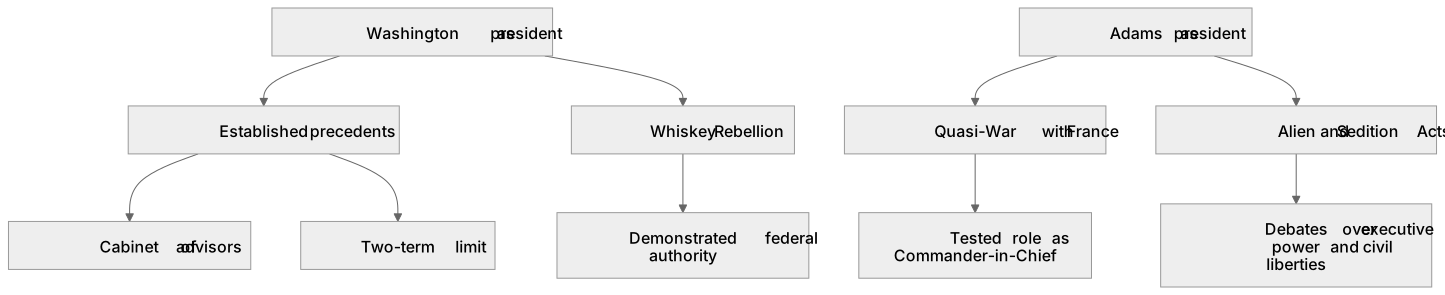
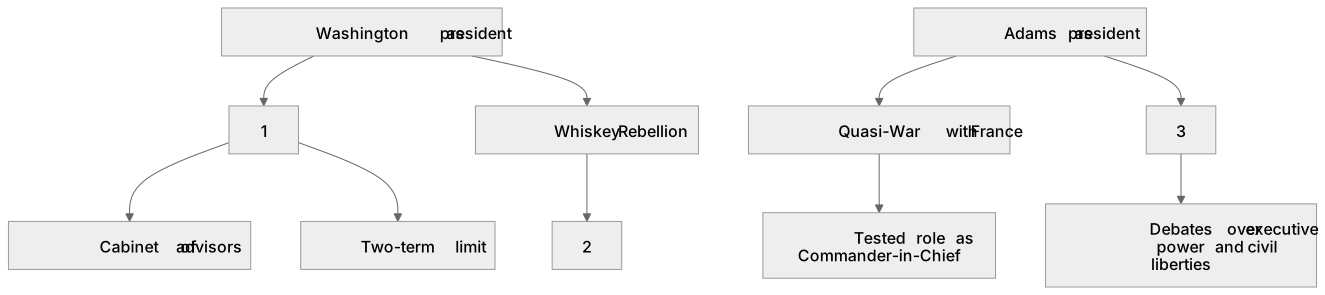
George Washington and John Adams were crucial in defining the powers of the presidency and implementing the newly ratified Constitution. Washington established vital precedents, such as forming a Cabinet of advisors and limiting his tenure to two terms, which practically interpreted the Constitution's broad executive clauses. He demonstrated federal authority during the Whiskey Rebellion, proving the new government could enforce its laws. Adams faced different challenges, notably the Quasi-War with France, which tested the president's role as Commander-in-Chief without a formal declaration of war. Adams also signed the controversial Alien and Sedition Acts, highlighting early constitutional debates over executive power and civil liberties.
What earns the marks
- Evaluate Washington's role in establishing the unwritten constitution through precedents like the two-term limit and the creation of executive departments.
- Analyse how Washington's response to the Whiskey Rebellion demonstrated the practical implementation of federal executive power.
- Assess Adams's use of presidential power during the Quasi-War, particularly regarding foreign policy and military command.
- Examine the constitutional crisis provoked by Adams's support for the Alien and Sedition Acts and its impact on the perceived overreach of presidential power.
Common mistakes and how to put them right
Assuming the Constitution explicitly detailed all presidential powers.
Put it right: In reality, Washington had to establish many practical precedents, such as the Cabinet.
Claiming Adams was a weak president who achieved nothing.
Put it right: Adams successfully navigated the Quasi-War and avoided a full-scale conflict with France despite immense political pressure.
Confusing the roles of Washington and Adams in implementing the Constitution.
Put it right: Washington established the initial framework and precedents, whereas Adams tested the limits of executive power regarding civil liberties.
Exam tips
- Compare how Washington and Adams utilised their executive powers to manage domestic and foreign crises.
- Use specific examples, such as the Whiskey Rebellion or the Alien and Sedition Acts, to illustrate the practical implementation of the Constitution.
- Consider the extent to which the early presidency was shaped by the personalities of Washington and Adams versus the written text of the Constitution.
Try the lesson
The start of the 2G The Birth of the USA, 1760–1801 – Washington and Adams, 1789–1801 (A-level only): The powers of the presidency: Washington and Adams as presidents, the implementation of the constitution lesson, made from checked teaching notes for this specification point.
Have a go first
Which precedent regarding the powers of the presidency was established by George Washington during his time in office?
Listen
George Washington and John Adams were crucial in defining the powers of the presidency and implementing the newly ratified Constitution. Washington established vital precedents, such as forming a Cabinet of advisors and limiting his tenure to two terms, which practically interpreted the Constitution's broad executive clauses. He demonstrated federal authority during the Whiskey Rebellion, proving the new government could enforce its laws. Adams faced different challenges, notably the Quasi-War with France, which tested the president's role as Commander-in-Chief without a formal declaration of war. Adams also signed the controversial Alien and Sedition Acts, highlighting early constitutional debates over executive power and civil liberties. A strong answer earns marks for these points. Evaluate Washington's role in establishing the unwritten constitution through precedents like the two-term limit and the creation of executive departments. Analyse how Washington's response to the Whiskey Rebellion demonstrated the practical implementation of federal executive power. Assess Adams's use of presidential power during the Quasi-War, particularly regarding foreign policy and military command. Examine the constitutional crisis provoked by Adams's support for the Alien and Sedition Acts and its impact on the perceived overreach of presidential power. A common slip: Claiming Adams was a weak president who achieved nothing. Instead, Adams successfully navigated the Quasi-War and avoided a full-scale conflict with France despite immense political pressure. Exam tip: Compare how Washington and Adams utilised their executive powers to manage domestic and foreign crises.
See it
Key words
Say what each word means before you turn the card.
Executive power and precedent
Try answering aloud or in your head before turning the card.
Constitutional interpretation
Try answering aloud or in your head before turning the card.
Federal authority versus civil liberties
Try answering aloud or in your head before turning the card.
Foreign policy and the Commander-in-Chief
Try answering aloud or in your head before turning the card.
See every definition
- Executive power and precedent
- Washington established vital precedents, such as forming a Cabinet of advisors and limiting his tenure to two terms, which practically interpreted the Constitution's broad executive clauses.
- Constitutional interpretation
- Washington's precedents practically interpreted the Constitution's broad executive clauses, shaping the unwritten constitution.
- Federal authority versus civil liberties
- Adams signed the controversial Alien and Sedition Acts, highlighting early constitutional debates over executive power and civil liberties.
- Foreign policy and the Commander-in-Chief
- The Quasi-War with France tested the president's role as Commander-in-Chief without a formal declaration of war.
Label the diagram
Some boxes have lost their names. Pick the right name for each number.
1Box 1
2Box 2
3Box 3
There is more to this lesson
The full lesson goes on to check your understanding and help you earn the marks. Create a free account to carry on, with your progress saved.
A week of Premium from your first lesson · Then the free plan continues · No card, no charge
Test your understanding of 2G The Birth of the USA, 1760–1801 – Washington and Adams, 1789–1801 (A-level only): The powers of the presidency: Washington and Adams as presidents, the implementation of the constitution
Active recall beats re-reading. Take an instant quiz now to test what you’ve learned and lock it into long-term memory.
A week of Premium from your first lesson · Then the free plan continues · No card, no charge