AQA · A-Level · History
Course version: 7042 · Version from Sept 2017
Financing the new nation: Alexander Hamilton as Secretary of Finance, the…
Full specification wording
2G The Birth of the USA, 1760–1801 – Washington and Adams, 1789–1801 (A-level only): Financing the new nation: Alexander Hamilton as Secretary of Finance, the balance between federal and state authority
As the first Secretary of Finance, Alexander Hamilton was tasked with resolving the severe economic crisis facing the new nation.
Checked against the AQA 7042 specification (opens in a new tab) on .
- Point 2 of 4
- 4 key terms
Study notes
From the checked teaching notes for this specification point.
The idea
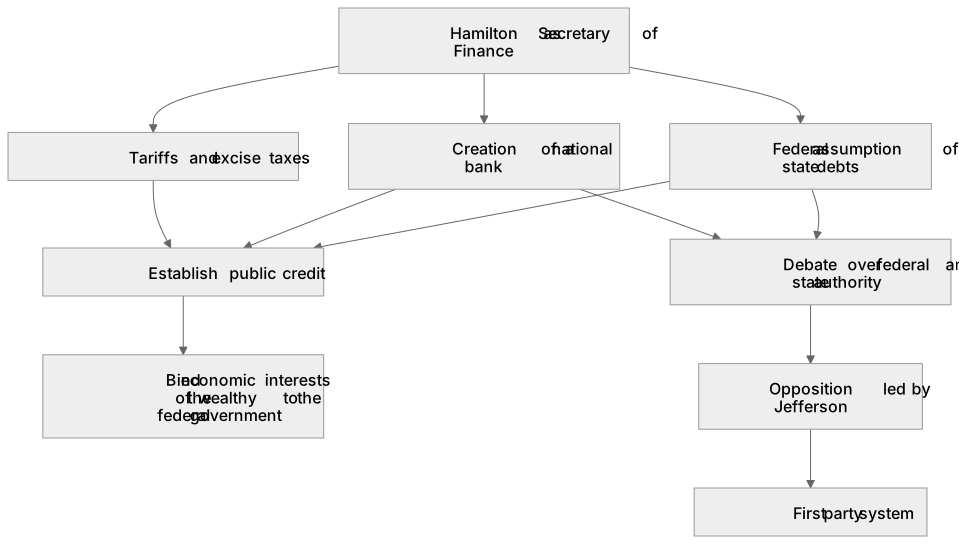
As the first Secretary of Finance, Alexander Hamilton was tasked with resolving the severe economic crisis facing the new nation. His ambitious financial programme included the federal assumption of state debts, the creation of a national bank, and the implementation of tariffs and excise taxes to generate revenue. This strategy was designed to establish public credit and bind the economic interests of the wealthy to the federal government. However, Hamilton's policies sparked intense debate over the balance between federal and state authority. Opponents, led by Thomas Jefferson, argued that assuming state debts unfairly burdened states that had already paid theirs, and that a national bank exceeded the federal government's powers.
What earns the marks
- Analyse the components of Hamilton's financial plan, including the assumption of state debts, the national bank, and new taxation.
- Evaluate how Hamilton's policies aimed to strengthen the federal government and establish international credit for the new nation.
- Assess the opposition to Hamilton's plan, focusing on the constitutional arguments regarding implied powers versus strict constructionism.
- Examine how the debate over financing the nation exacerbated tensions between federal authority and state sovereignty, leading to the first party system.
Common mistakes and how to put them right
Stating that all states supported the assumption of debt.
Put it right: Southern states like Virginia had largely paid their debts and strongly opposed assuming the debts of Northern states.
Assuming the Constitution explicitly authorised a national bank.
Put it right: Hamilton relied on the 'necessary and proper' clause to justify the bank, sparking a major debate over implied powers.
Confusing Hamilton's financial goals with purely economic motives.
Put it right: Hamilton's primary objective was deeply political, aiming to centralise power and strengthen federal authority over the states.
Exam tips
- Link Hamilton's financial policies directly to the broader ideological conflict over the balance of power between federal and state governments.
- Use the debate over the National Bank to illustrate the emergence of strict versus loose interpretations of the Constitution.
- Discuss the Compromise of 1790, which located the capital in the South in exchange for debt assumption, as a key example of resolving federal-state financial disputes.
Try the lesson
The start of the 2G The Birth of the USA, 1760–1801 – Washington and Adams, 1789–1801 (A-level only): Financing the new nation: Alexander Hamilton as Secretary of Finance, the balance between federal and state authority lesson, made from checked teaching notes for this specification point.
Have a go first
Which policy was a central component of Alexander Hamilton's strategy for financing the new nation and managing its debts?
Listen
As the first Secretary of Finance, Alexander Hamilton was tasked with resolving the severe economic crisis facing the new nation. His ambitious financial programme included the federal assumption of state debts, the creation of a national bank, and the implementation of tariffs and excise taxes to generate revenue. This strategy was designed to establish public credit and bind the economic interests of the wealthy to the federal government. However, Hamilton's policies sparked intense debate over the balance between federal and state authority. Opponents, led by Thomas Jefferson, argued that assuming state debts unfairly burdened states that had already paid theirs, and that a national bank exceeded the federal government's powers. A strong answer earns marks for these points. Analyse the components of Hamilton's financial plan, including the assumption of state debts, the national bank, and new taxation. Evaluate how Hamilton's policies aimed to strengthen the federal government and establish international credit for the new nation. Assess the opposition to Hamilton's plan, focusing on the constitutional arguments regarding implied powers versus strict constructionism. Examine how the debate over financing the nation exacerbated tensions between federal authority and state sovereignty, leading to the first party system. A common slip: Stating that all states supported the assumption of debt. Instead, Southern states like Virginia had largely paid their debts and strongly opposed assuming the debts of Northern states. Exam tip: Link Hamilton's financial policies directly to the broader ideological conflict over the balance of power between federal and state governments.
See it
Key words
Say what each word means before you turn the card.
Economic policy and national credit
Try answering aloud or in your head before turning the card.
Federalism and state sovereignty
Try answering aloud or in your head before turning the card.
Constitutional interpretation
Try answering aloud or in your head before turning the card.
The emergence of political factions
Try answering aloud or in your head before turning the card.
See every definition
- Economic policy and national credit
- Hamilton's financial programme included federal assumption of state debts, a national bank, and tariffs and excise taxes to generate revenue, designed to establish public credit.
- Federalism and state sovereignty
- Hamilton's policies sparked intense debate over the balance between federal and state authority, with opponents arguing that assuming state debts unfairly burdened states that had already paid theirs.
- Constitutional interpretation
- Opponents argued that a national bank exceeded the federal government's powers, while Hamilton relied on the 'necessary and proper' clause to justify the bank, sparking debate over implied powers.
- The emergence of political factions
- The debate over financing the nation exacerbated tensions between federal authority and state sovereignty, leading to the first party system.
Label the diagram
Some boxes have lost their names. Pick the right name for each number.
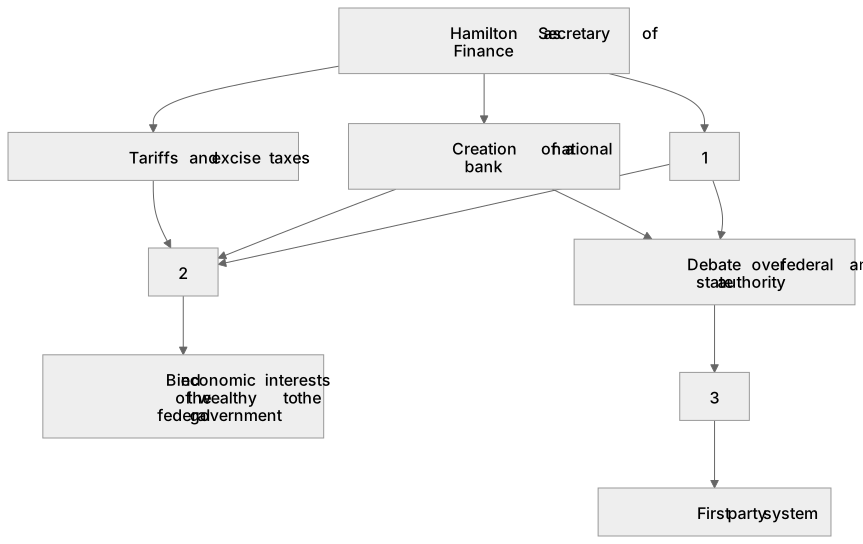
1Box 1
2Box 2
3Box 3
There is more to this lesson
The full lesson goes on to check your understanding and help you earn the marks. Create a free account to carry on, with your progress saved.
A week of Premium from your first lesson · Then the free plan continues · No card, no charge
Test your understanding of 2G The Birth of the USA, 1760–1801 – Washington and Adams, 1789–1801 (A-level only): Financing the new nation: Alexander Hamilton as Secretary of Finance, the balance between federal and state authority
Active recall beats re-reading. Take an instant quiz now to test what you’ve learned and lock it into long-term memory.
A week of Premium from your first lesson · Then the free plan continues · No card, no charge