AQA · A-Level · History
Course version: 7042 · Version from Sept 2017
The rise and influence of political parties: the Jefferson Republican…
Full specification wording
2G The Birth of the USA, 1760–1801 – Washington and Adams, 1789–1801 (A-level only): The rise and influence of political parties: the Jefferson Republican (Democratic Republican Party) under Jefferson and James Madison, the Federalist Party under Alexander Hamilton and John Adams
The emergence of the First Party System fundamentally shaped the early American republic.
Checked against the AQA 7042 specification (opens in a new tab) on .
- Point 3 of 4
Study notes
From the checked teaching notes for this specification point.
The idea
The emergence of the First Party System fundamentally shaped the early American republic. The Federalist Party, guided by Alexander Hamilton and John Adams, advocated for a strong central government, a robust financial system including a national bank, and pro-British foreign policy. Conversely, the Jeffersonian Republicans (Democratic-Republicans), led by Thomas Jefferson and James Madison, championed states' rights, agrarianism, and strict constitutional interpretation, while favouring revolutionary France. Their influence was profound, polarising the electorate through partisan press and culminating in the bitter election of 1800. This ideological divide established the precedent for peaceful transfers of power and defined the nation's early political trajectory.
What earns the marks
- Explain Hamilton's financial programme, including the Report on Public Credit and the National Bank, as a catalyst for Federalist consolidation.
- Analyse the role of Jefferson and Madison in forming the Democratic-Republican opposition, focusing on strict constructionism and agrarian ideals.
- Evaluate the impact of foreign policy, particularly the French Revolution and Jay's Treaty, on deepening partisan divisions.
- Assess the influence of John Adams' presidency, including the Alien and Sedition Acts, on the rise of Republican opposition and the election of 1800.
Common mistakes and how to put them right
Confusing the Jeffersonian Republicans with the modern Republican Party.
Put it right by referring to them as Democratic-Republicans or Jeffersonian Republicans.
Assuming political parties were intended by the Founders.
Put it right by noting that figures like Washington actively warned against 'factions' in his Farewell Address.
Overlooking Madison's role in the Democratic-Republican party.
Put it right by highlighting his crucial organisational work and authorship of the Virginia Resolutions alongside Jefferson.
Exam tips
- Use the Alien and Sedition Acts as a prime example of how Federalists attempted to curb Democratic-Republican influence.
- Contrast Hamilton's 'implied powers' with Jefferson's 'strict construction' to explain the ideological roots of the party divide.
- When discussing the election of 1800, emphasise its significance as the first peaceful transfer of power between opposing political parties.
Try the lesson
The start of the 2G The Birth of the USA, 1760–1801 – Washington and Adams, 1789–1801 (A-level only): The rise and influence of political parties: the Jefferson Republican (Democratic Republican Party) under Jefferson and James Madison, the Federalist Party under Alexander Hamilton and John Adams lesson, made from checked teaching notes for this specification point.
Have a go first
Which of the following pairs of political leaders were the primary figures in the formation and leadership of the Federalist Party during the 1790s?
Listen
The emergence of the First Party System fundamentally shaped the early American republic. The Federalist Party, guided by Alexander Hamilton and John Adams, advocated for a strong central government, a robust financial system including a national bank, and pro-British foreign policy. Conversely, the Jeffersonian Republicans (Democratic-Republicans), led by Thomas Jefferson and James Madison, championed states' rights, agrarianism, and strict constitutional interpretation, while favouring revolutionary France. Their influence was profound, polarising the electorate through partisan press and culminating in the bitter election of 1800. This ideological divide established the precedent for peaceful transfers of power and defined the nation's early political trajectory. A strong answer earns marks for these points. Explain Hamilton's financial programme, including the Report on Public Credit and the National Bank, as a catalyst for Federalist consolidation. Analyse the role of Jefferson and Madison in forming the Democratic-Republican opposition, focusing on strict constructionism and agrarian ideals. Evaluate the impact of foreign policy, particularly the French Revolution and Jay's Treaty, on deepening partisan divisions. Assess the influence of John Adams' presidency, including the Alien and Sedition Acts, on the rise of Republican opposition and the election of 1800. A common slip: Confusing the Jeffersonian Republicans with the modern Republican Party. Instead, referring to them as Democratic-Republicans or Jeffersonian Republicans. Exam tip: Use the Alien and Sedition Acts as a prime example of how Federalists attempted to curb Democratic-Republican influence.
See it
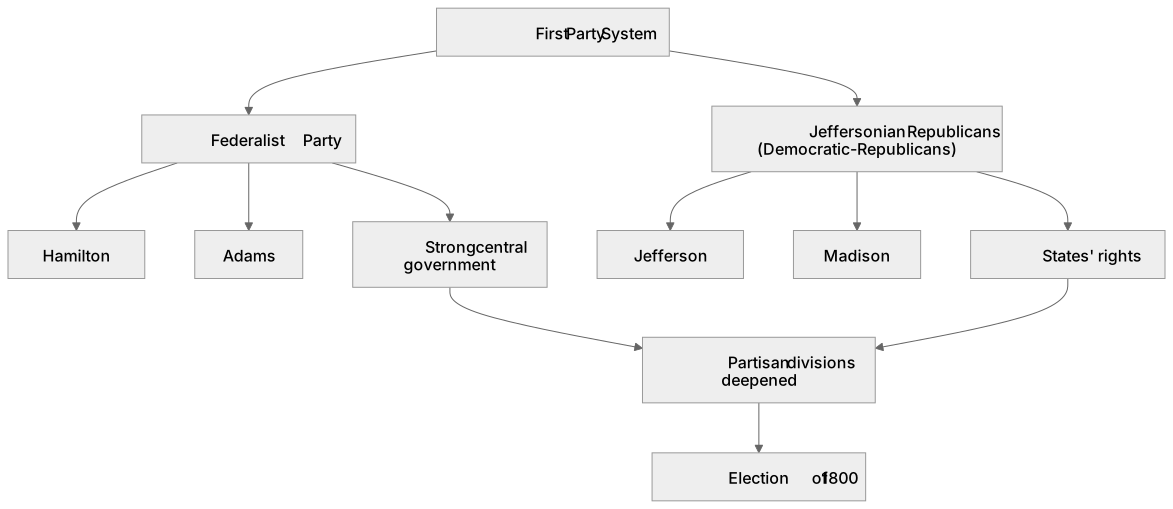
Label the diagram
Some boxes have lost their names. Pick the right name for each number.
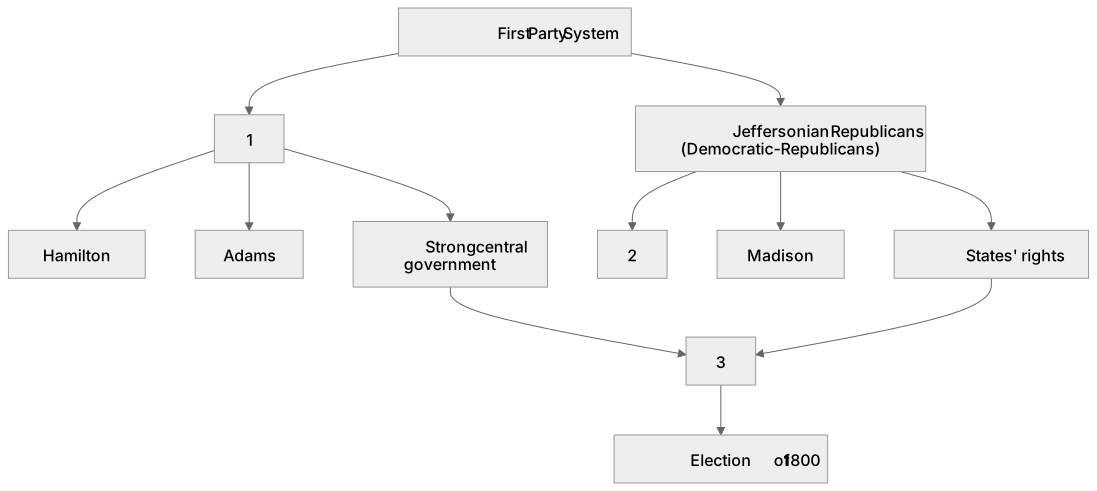
1Box 1
2Box 2
3Box 3
There is more to this lesson
The full lesson goes on to check your understanding and help you earn the marks. Create a free account to carry on, with your progress saved.
A week of Premium from your first lesson · Then the free plan continues · No card, no charge
Test your understanding of 2G The Birth of the USA, 1760–1801 – Washington and Adams, 1789–1801 (A-level only): The rise and influence of political parties: the Jefferson Republican (Democratic Republican Party) under Jefferson and James Madison, the Federalist Party under Alexander Hamilton and John Adams
Active recall beats re-reading. Take an instant quiz now to test what you’ve learned and lock it into long-term memory.
A week of Premium from your first lesson · Then the free plan continues · No card, no charge