AQA · A-Level · History
Course version: 7042 · Version from Sept 2017
Economic problems and royal finance: attempts to improve royal finances…
Full specification wording
2H France in Revolution, 1774–1815 (A-level only) – 1795 The origins of the French Revolution, 1774–1789: Economic problems and royal finance: attempts to improve royal finances under Turgot, Necker and Calonne
The French Crown faced severe economic problems and a mounting deficit, exacerbated by costly foreign wars like the American Revolution and an inefficient, regressive taxation system that exempted…
Checked against the AQA 7042 specification (opens in a new tab) on .
- Point 3 of 4
Study notes
From the checked teaching notes for this specification point.
The idea
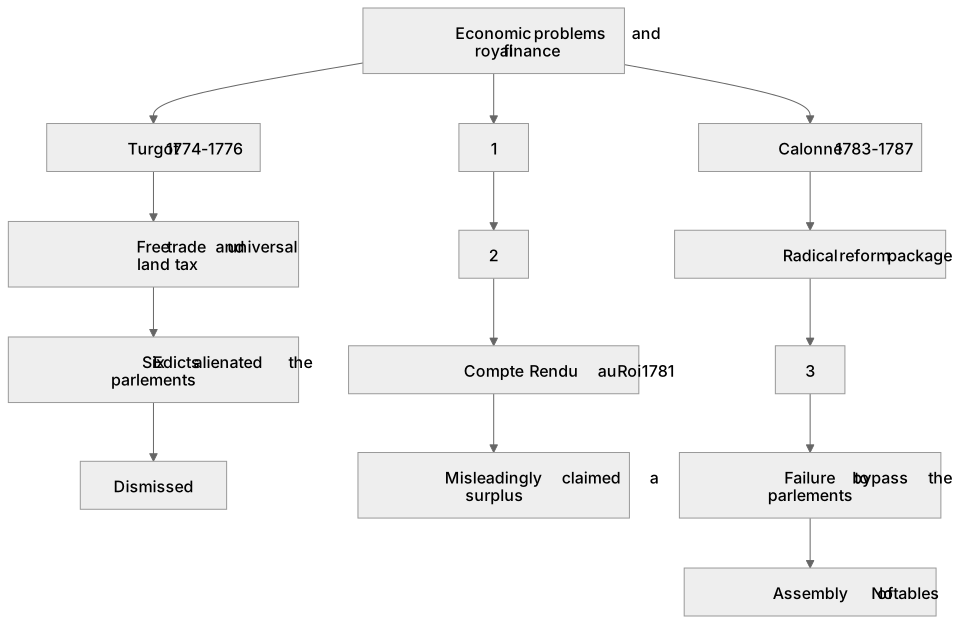
The French Crown faced severe economic problems and a mounting deficit, exacerbated by costly foreign wars like the American Revolution and an inefficient, regressive taxation system that exempted the privileged estates. Successive Controllers-General attempted to improve royal finances but faced insurmountable opposition. Turgot (1774–1776) advocated free trade and a universal land tax but was dismissed after his Six Edicts alienated the parlements. Necker (1777–1781) avoided new taxes by securing high-interest loans and published the Compte Rendu au Roi (1781), which misleadingly claimed a surplus, masking the true deficit. Calonne (1783–1787) proposed a radical reform package, including a general land tax payable by all, but his failure to bypass the parlements led to the disastrous Assembly of Notables.
What earns the marks
- Identify the structural weaknesses of the Ancien Régime taxation system, particularly the reliance on indirect taxes and the exemption of the First and Second Estates.
- Evaluate Turgot's physiocratic reforms, including the introduction of free trade in grain and the abolition of the corvée, noting the resistance from vested interests.
- Analyse Necker's financial strategy of funding the American War of Independence through loans rather than taxation, and the political impact of his Compte Rendu.
- Assess Calonne's comprehensive reform package of 1786, focusing on his proposed territorial subvention (land tax) and the decision to summon the Assembly of Notables.
Common mistakes and how to put them right
Claiming Necker's Compte Rendu accurately reflected the financial crisis.
Put it right: In reality, it concealed the deficit by omitting extraordinary war expenditure to maintain public credit.
Confusing the chronological order of the Controllers-General.
Put it right: The sequence is Turgot, Necker, then Calonne.
Stating that the financial crisis was solely caused by Marie Antoinette's spending.
Put it right by emphasising that structural tax inefficiencies and war debts were the primary causes.
Exam tips
- When evaluating the failure of financial reforms, explicitly link the Controllers-General's proposals to the entrenched power of the parlements and the nobility.
- Use the Compte Rendu as a key piece of evidence when discussing how public perception of royal finances diverged from the economic reality.
- Contrast Turgot's physiocratic approach with Necker's administrative approach to demonstrate a nuanced understanding of royal finance.
Try the lesson
The start of the 2H France in Revolution, 1774–1815 (A-level only) – 1795 The origins of the French Revolution, 1774–1789: Economic problems and royal finance: attempts to improve royal finances under Turgot, Necker and Calonne lesson, made from checked teaching notes for this specification point.
Have a go first
Which action did Jacques Necker take in 1781 in an attempt to manage public perception of royal finances?
Listen
The French Crown faced severe economic problems and a mounting deficit, exacerbated by costly foreign wars like the American Revolution and an inefficient, regressive taxation system that exempted the privileged estates. Successive Controllers-General attempted to improve royal finances but faced insurmountable opposition. Turgot (1774–1776) advocated free trade and a universal land tax but was dismissed after his Six Edicts alienated the parlements. Necker (1777–1781) avoided new taxes by securing high-interest loans and published the Compte Rendu au Roi (1781), which misleadingly claimed a surplus, masking the true deficit. Calonne (1783–1787) proposed a radical reform package, including a general land tax payable by all, but his failure to bypass the parlements led to the disastrous Assembly of Notables. A strong answer earns marks for these points. Identify the structural weaknesses of the Ancien Régime taxation system, particularly the reliance on indirect taxes and the exemption of the First and Second Estates. Evaluate Turgot's physiocratic reforms, including the introduction of free trade in grain and the abolition of the corvée, noting the resistance from vested interests. Analyse Necker's financial strategy of funding the American War of Independence through loans rather than taxation, and the political impact of his Compte Rendu. Assess Calonne's comprehensive reform package of 1786, focusing on his proposed territorial subvention (land tax) and the decision to summon the Assembly of Notables. A common slip: Stating that the financial crisis was solely caused by Marie Antoinette's spending. Instead, emphasising that structural tax inefficiencies and war debts were the primary causes. Exam tip: When evaluating the failure of financial reforms, explicitly link the Controllers-General's proposals to the entrenched power of the parlements and the nobility.
See it
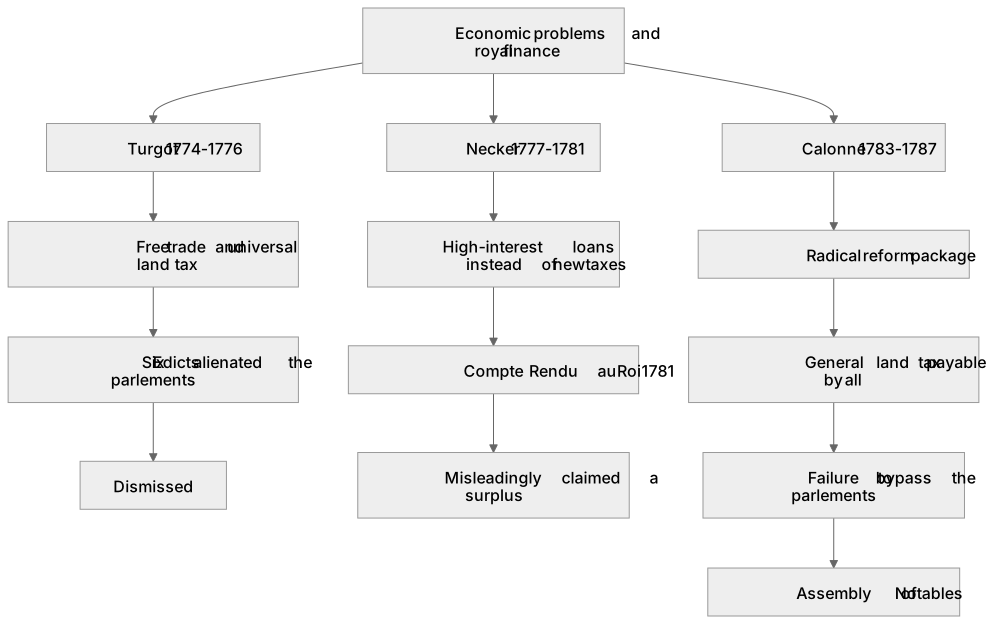
Put the events in order
Put these events in the order they happened, earliest first.
- 1. Turgot attempts to improve royal finances
- 2. Calonne attempts to improve royal finances
- 3. Necker attempts to improve royal finances
Label the diagram
Some boxes have lost their names. Pick the right name for each number.
1Box 1
2Box 2
3Box 3
There is more to this lesson
The full lesson goes on to check your understanding and help you earn the marks. Create a free account to carry on, with your progress saved.
A week of Premium from your first lesson · Then the free plan continues · No card, no charge
Test your understanding of 2H France in Revolution, 1774–1815 (A-level only) – 1795 The origins of the French Revolution, 1774–1789: Economic problems and royal finance: attempts to improve royal finances under Turgot, Necker and Calonne
Active recall beats re-reading. Take an instant quiz now to test what you’ve learned and lock it into long-term memory.
A week of Premium from your first lesson · Then the free plan continues · No card, no charge