AQA · A-Level · History
Course version: 7042 · Version from Sept 2017
The Assembly of Notables and political developments, February 1787 to May…
Full specification wording
2H France in Revolution, 1774–1815 (A-level only) – 1795 The origins of the French Revolution, 1774–1789: The Assembly of Notables and political developments, February 1787 to May 1789; the state of France, politically, economically and socially by the meeting of the Estates-General
The Assembly of Notables (February 1787) marked a turning point, as privileged elites rejected Calonne’s land tax, demanding the Estates-General's approval.
Checked against the AQA 7042 specification (opens in a new tab) on .
- Point 4 of 4
- 3 key terms
Study notes
From the checked teaching notes for this specification point.
The idea
The Assembly of Notables (February 1787) marked a turning point, as privileged elites rejected Calonne’s land tax, demanding the Estates-General's approval. This triggered a political crisis, leading to the 'Revolt of the Nobles' and the suspension of the parlements. By May 1789, France was politically paralysed; royal authority had collapsed, forcing Louis XVI to summon the Estates-General. Economically, the nation faced bankruptcy, exacerbated by the disastrous 1788 harvest, soaring bread prices, and widespread unemployment. Socially, tensions peaked as the Third Estate, politicised by pamphlets like Sieyès' What is the Third Estate?, demanded voting by head rather than by order, challenging the entrenched privileges of the First and Second Estates.
What earns the marks
- Explain the failure of the Assembly of Notables to endorse financial reforms, highlighting their insistence on convening the Estates-General.
- Trace the political developments from 1787 to 1789, including the clash between the Crown and the parlements, and the subsequent 'Day of the Tiles' in Grenoble.
- Assess the economic state of France by 1789, focusing on the impact of the Eden Treaty, the 1788 harvest failure, and the resulting urban and rural distress.
- Analyse the social and political climate on the eve of the Estates-General, including the drafting of the cahiers de doléances and the debate over voting mechanisms.
Common mistakes and how to put them right
Assuming the Assembly of Notables was a democratic body.
Put it right by noting it was a hand-picked group of high-ranking nobles, clergy, and officials.
Treating the economic crisis and political crisis as separate events.
Put it right: Ensure you explain how soaring bread prices directly fuelled political radicalisation among the urban poor.
Stating that the Third Estate wanted to overthrow the monarchy in May 1789.
Put it right by explaining they initially sought a constitutional monarchy and fairer representation.
Exam tips
- Use the drafting of the cahiers de doléances to provide specific evidence of the social and economic grievances held by different estates in 1789.
- When discussing the 'Revolt of the Nobles', emphasise how the privileged orders inadvertently paved the way for the revolution by undermining absolute royal authority.
- Link the short-term economic trigger of the 1788 harvest failure to the long-term structural weaknesses of the French economy to build a strong analytical argument.
Try the lesson
The start of the 2H France in Revolution, 1774–1815 (A-level only) – 1795 The origins of the French Revolution, 1774–1789: The Assembly of Notables and political developments, February 1787 to May 1789; the state of France, politically, economically and socially by the meeting of the Estates-General lesson, made from checked teaching notes for this specification point.
Have a go first
Why did King Louis XVI convene the Assembly of Notables in February 1787?
Listen
The Assembly of Notables (February 1787) marked a turning point, as privileged elites rejected Calonne’s land tax, demanding the Estates-General's approval. This triggered a political crisis, leading to the 'Revolt of the Nobles' and the suspension of the parlements. By May 1789, France was politically paralysed; royal authority had collapsed, forcing Louis XVI to summon the Estates-General. Economically, the nation faced bankruptcy, exacerbated by the disastrous 1788 harvest, soaring bread prices, and widespread unemployment. Socially, tensions peaked as the Third Estate, politicised by pamphlets like Sieyès' What is the Third Estate?, demanded voting by head rather than by order, challenging the entrenched privileges of the First and Second Estates. A strong answer earns marks for these points. Explain the failure of the Assembly of Notables to endorse financial reforms, highlighting their insistence on convening the Estates-General. Trace the political developments from 1787 to 1789, including the clash between the Crown and the parlements, and the subsequent 'Day of the Tiles' in Grenoble. Assess the economic state of France by 1789, focusing on the impact of the Eden Treaty, the 1788 harvest failure, and the resulting urban and rural distress. Analyse the social and political climate on the eve of the Estates-General, including the drafting of the cahiers de doléances and the debate over voting mechanisms. A common slip: Assuming the Assembly of Notables was a democratic body. Instead, noting it was a hand-picked group of high-ranking nobles, clergy, and officials. Exam tip: Use the drafting of the cahiers de doléances to provide specific evidence of the social and economic grievances held by different estates in 1789.
See it
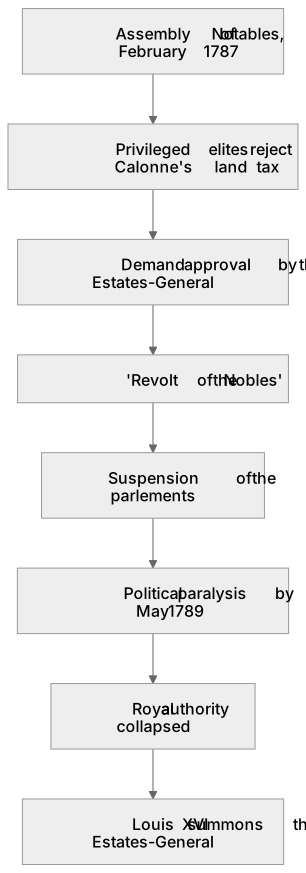
Put it in order
Put these steps in the order they happen.
- 1. Suspension of the parlements
- 2. Louis XVI summons the Estates-General
- 3. Political paralysis by May 1789
- 4. Assembly of Notables, February 1787
- 5. Privileged elites reject Calonne's land tax
- 6. Royal authority collapsed
- 7. Demand approval by the Estates-General
- 8. 'Revolt of the Nobles'
Put the events in order
Put these events in the order they happened, earliest first.
- 1. Assembly of Notables rejects Calonne's land tax
- 2. Louis XVI summons the Estates-General
- 3. Harvest failure worsens economic distress
Key words
Say what each word means before you turn the card.
The collapse of absolute monarchy
Try answering aloud or in your head before turning the card.
Popular protest and economic hardship
Try answering aloud or in your head before turning the card.
The politicisation of the Third Estate
Try answering aloud or in your head before turning the card.
See every definition
- The collapse of absolute monarchy
- Royal authority had collapsed by May 1789, leaving France politically paralysed and forcing Louis XVI to summon the Estates-General.
- Popular protest and economic hardship
- Bankruptcy, the disastrous 1788 harvest, soaring bread prices and widespread unemployment fuelled political radicalisation among the urban poor.
- The politicisation of the Third Estate
- Pamphlets such as Sieyès' What is the Third Estate? politicised the Third Estate, which demanded voting by head rather than by order.
Label the diagram
Some boxes have lost their names. Pick the right name for each number.
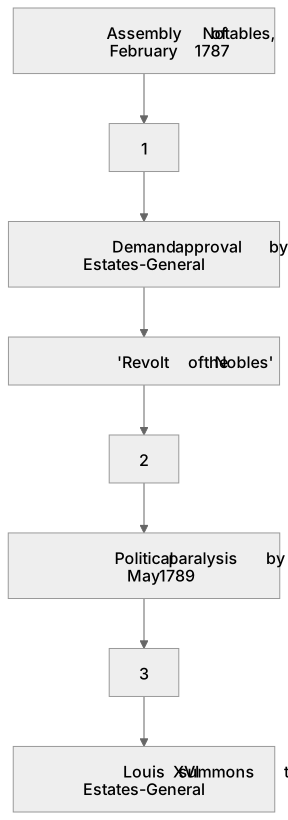
1Box 1
2Box 2
3Box 3
There is more to this lesson
The full lesson goes on to check your understanding and help you earn the marks. Create a free account to carry on, with your progress saved.
A week of Premium from your first lesson · Then the free plan continues · No card, no charge
Test your understanding of 2H France in Revolution, 1774–1815 (A-level only) – 1795 The origins of the French Revolution, 1774–1789: The Assembly of Notables and political developments, February 1787 to May 1789; the state of France, politically, economically and socially by the meeting of the Estates-General
Active recall beats re-reading. Take an instant quiz now to test what you’ve learned and lock it into long-term memory.
A week of Premium from your first lesson · Then the free plan continues · No card, no charge