AQA · A-Level · History
Course version: 7042 · Version from Sept 2017
The establishment of a Republic: problems and policies; debate leading to…
Full specification wording
2H France in Revolution, 1774–1815 (A-level only) – The emergence and spread of the Terror, September 1792–1795: The establishment of a Republic: problems and policies; debate leading to the execution of the King
The National Convention established the French Republic in September 1792, immediately facing severe problems including war with the First Coalition, economic inflation from devalued assignats,…
Checked against the AQA 7042 specification (opens in a new tab) on .
- Point 1 of 4
- 4 key terms
Study notes
From the checked teaching notes for this specification point.
The idea
The National Convention established the French Republic in September 1792, immediately facing severe problems including war with the First Coalition, economic inflation from devalued assignats, and bitter factionalism between Girondins and Jacobins. Early policies aimed to secure the revolution, such as secularising civil registers. The most critical issue was the debate leading to the execution of the King. The discovery of the armoire de fer proved Louis XVI's counter-revolutionary plotting. While Girondins proposed an appeal to the people to decide his fate, Jacobins like Robespierre argued that the King must die so the Republic could live. Louis was tried, found guilty of treason, and executed in January 1793, irrevocably dividing the nation.
What earns the marks
- Identify the political and economic problems facing the new Republic, including war and inflation.
- Evaluate the policies implemented by the National Convention to consolidate republican control.
- Analyse the arguments presented by the Girondins and Jacobins during the debate over the King's fate.
- Assess the impact of the armoire de fer discovery on the trial and execution of Louis XVI.
Common mistakes and how to put them right
Claiming the Girondins wanted to save the King's life unconditionally.
Put it right: The Girondins generally accepted his guilt but favoured an 'appel au peuple' (appeal to the people) or a reprieve, rather than outright acquittal.
Confusing the National Assembly with the National Convention.
Put it right: Ensure you specify the National Convention as the body that established the Republic and tried the King.
Stating the Republic was established after the King's execution.
Put it right: The Republic was declared in September 1792, months before Louis XVI was executed in January 1793.
Exam tips
- Use the debate over the King's execution to illustrate the growing ideological divide between the Girondins and the Montagnards.
- Link the economic problems, such as the depreciation of the assignat, to the growing radicalisation of the sans-culottes.
- When discussing policies, mention specific early republican reforms rather than just focusing on the Terror.
Try the lesson
The start of the 2H France in Revolution, 1774–1815 (A-level only) – The emergence and spread of the Terror, September 1792–1795: The establishment of a Republic: problems and policies; debate leading to the execution of the King lesson, made from checked teaching notes for this specification point.
Have a go first
Which political faction in the National Convention was most reluctant to execute Louis XVI, arguing instead for a national referendum known as the 'appel au peuple'?
Listen
The National Convention established the French Republic in September 1792, immediately facing severe problems including war with the First Coalition, economic inflation from devalued assignats, and bitter factionalism between Girondins and Jacobins. Early policies aimed to secure the revolution, such as secularising civil registers. The most critical issue was the debate leading to the execution of the King. The discovery of the armoire de fer proved Louis XVI's counter-revolutionary plotting. While Girondins proposed an appeal to the people to decide his fate, Jacobins like Robespierre argued that the King must die so the Republic could live. Louis was tried, found guilty of treason, and executed in January 1793, irrevocably dividing the nation. A strong answer earns marks for these points. Identify the political and economic problems facing the new Republic, including war and inflation. Evaluate the policies implemented by the National Convention to consolidate republican control. Analyse the arguments presented by the Girondins and Jacobins during the debate over the King's fate. Assess the impact of the armoire de fer discovery on the trial and execution of Louis XVI. A common slip: Claiming the Girondins wanted to save the King's life unconditionally. Instead, The Girondins generally accepted his guilt but favoured an 'appel au peuple' (appeal to the people) or a reprieve, rather than outright acquittal. Exam tip: Use the debate over the King's execution to illustrate the growing ideological divide between the Girondins and the Montagnards.
See it
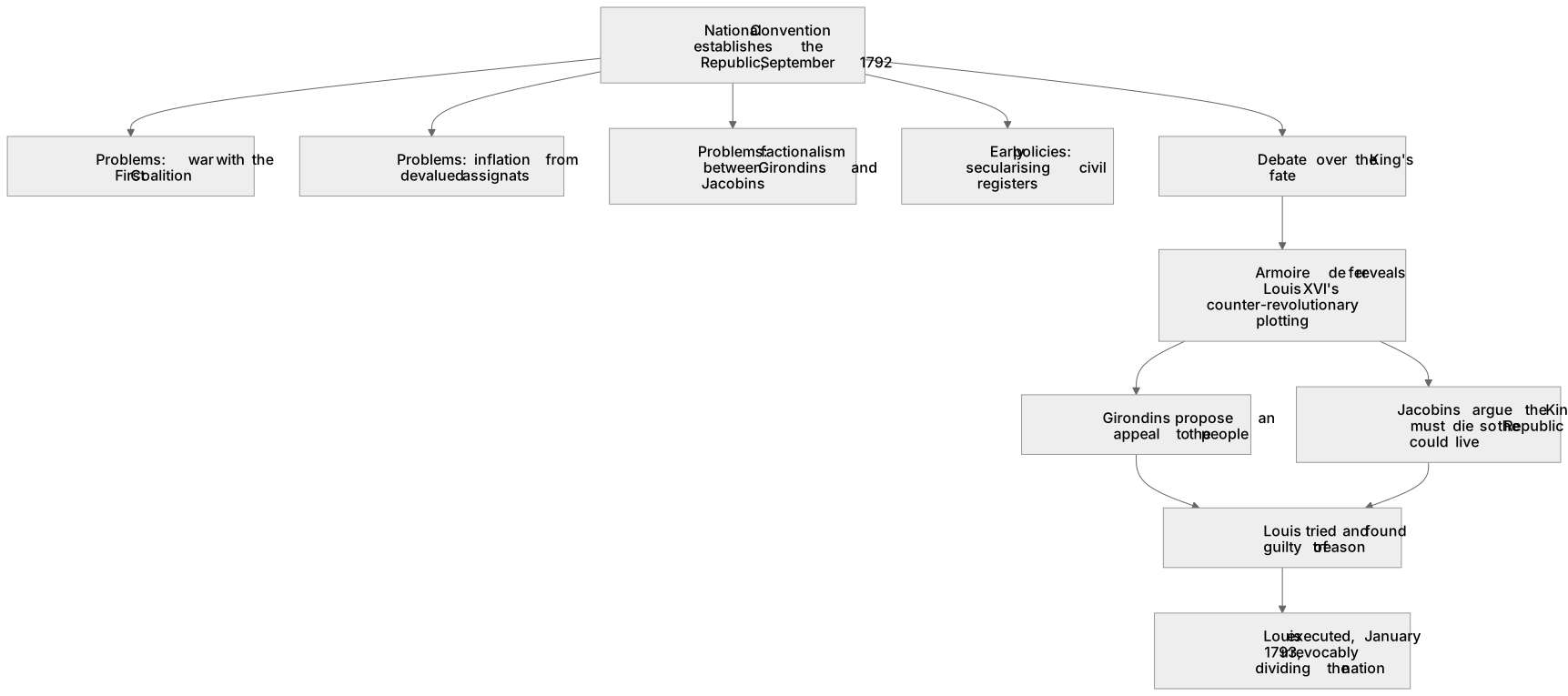
Key words
Say what each word means before you turn the card.
Factional conflict
Try answering aloud or in your head before turning the card.
Republicanism
Try answering aloud or in your head before turning the card.
Justice and retribution
Try answering aloud or in your head before turning the card.
Political radicalisation
Try answering aloud or in your head before turning the card.
See every definition
- Factional conflict
- Bitter factionalism between Girondins and Jacobins was among the severe problems the National Convention immediately faced.
- Republicanism
- The National Convention established the French Republic in September 1792, and policies aimed to secure the revolution and consolidate republican control.
- Justice and retribution
- Louis was tried, found guilty of treason, and executed in January 1793, with Jacobins arguing the King must die so the Republic could live.
- Political radicalisation
- The debate over the King's fate illustrated the growing ideological divide, and economic problems linked to growing radicalisation.
Label the diagram
Some boxes have lost their names. Pick the right name for each number.
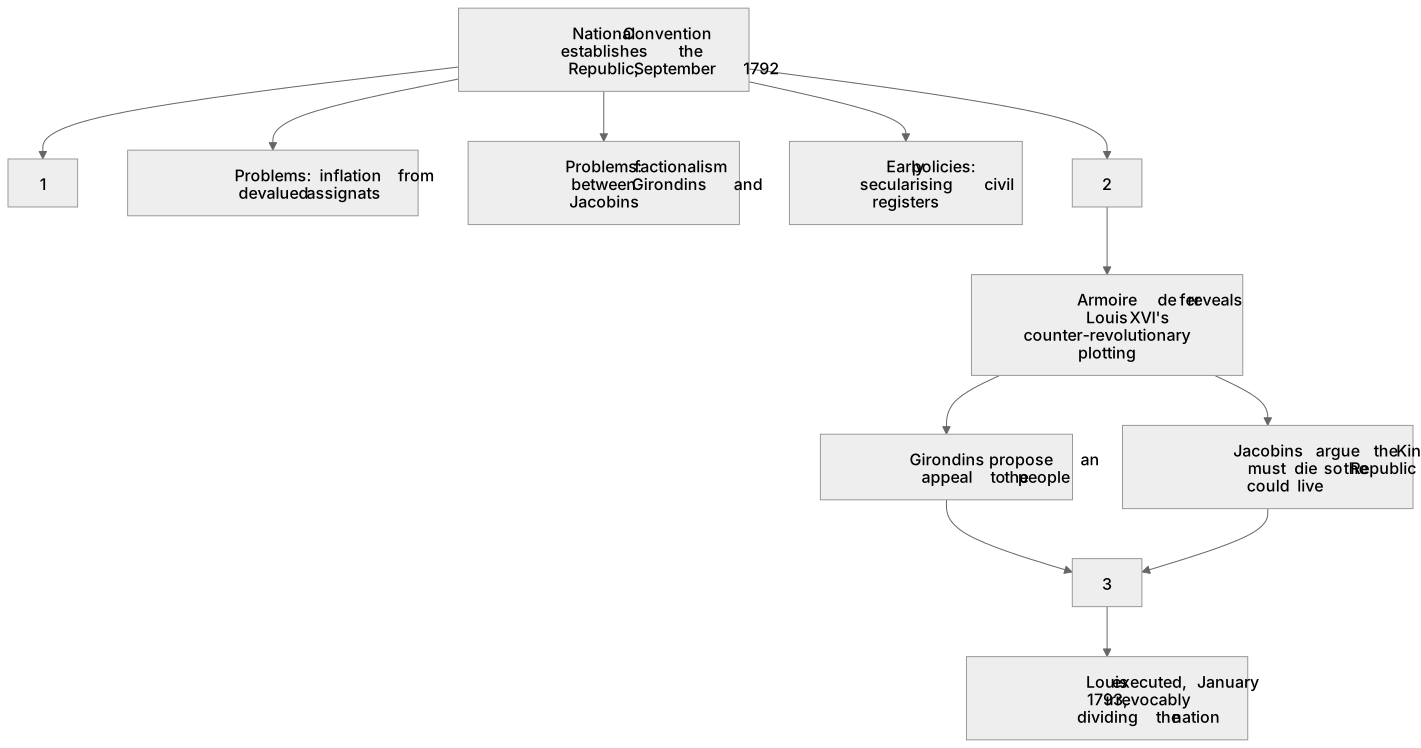
1Box 1
2Box 2
3Box 3
There is more to this lesson
The full lesson goes on to check your understanding and help you earn the marks. Create a free account to carry on, with your progress saved.
A week of Premium from your first lesson · Then the free plan continues · No card, no charge
Test your understanding of 2H France in Revolution, 1774–1815 (A-level only) – The emergence and spread of the Terror, September 1792–1795: The establishment of a Republic: problems and policies; debate leading to the execution of the King
Active recall beats re-reading. Take an instant quiz now to test what you’ve learned and lock it into long-term memory.
A week of Premium from your first lesson · Then the free plan continues · No card, no charge