AQA · A-Level · History
Course version: 7042 · Version from Sept 2017
Internal and external war: the spread of war; the rising in the Vendée;…
Full specification wording
2H France in Revolution, 1774–1815 (A-level only) – The emergence and spread of the Terror, September 1792–1795: Internal and external war: the spread of war; the rising in the Vendée; attempts to establish wartime control; Robespierre; the fall of the Girondins and the Federalist revolt
In 1793, France faced severe crises of internal and external war.
Checked against the AQA 7042 specification (opens in a new tab) on .
- Point 2 of 4
- 4 key terms
Study notes
From the checked teaching notes for this specification point.
The idea
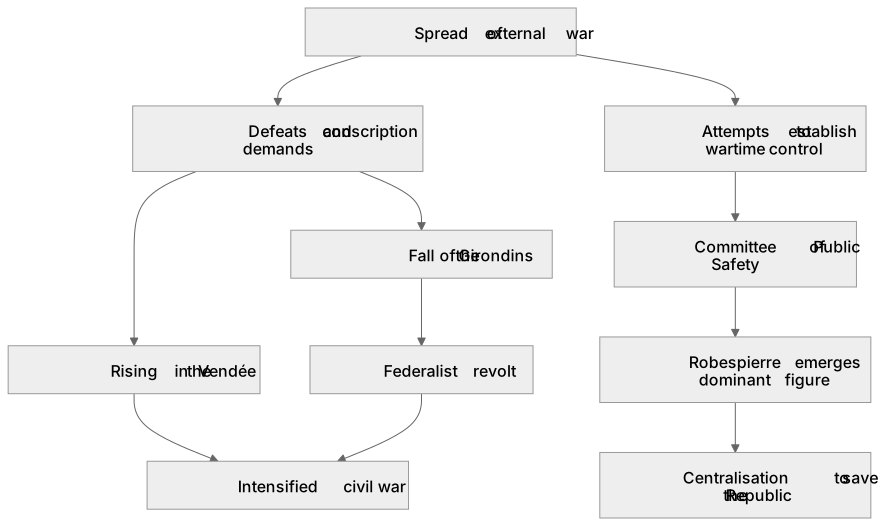
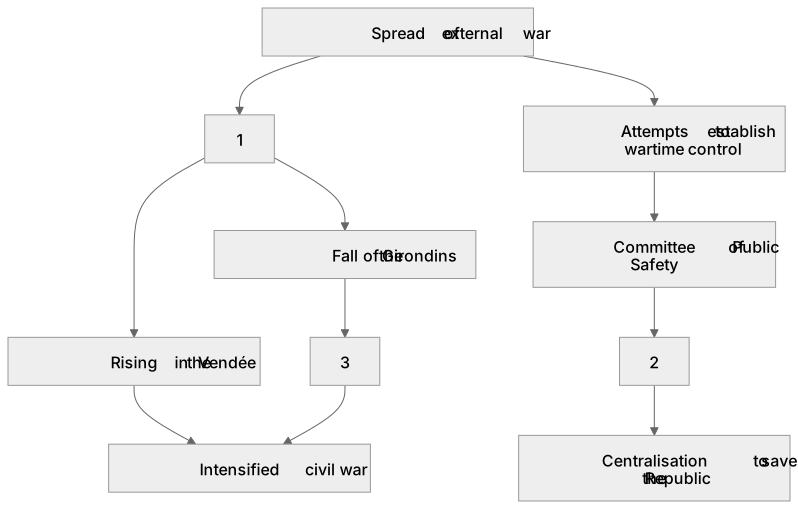
In 1793, France faced severe crises of internal and external war. The spread of war against the First Coalition brought defeats and conscription demands, which triggered the rising in the Vendée, a massive royalist and Catholic rebellion. The Convention made attempts to establish wartime control by creating the Committee of Public Safety. Robespierre emerged as a dominant figure, advocating centralisation to save the Republic. Blamed for military failures and opposing sans-culottes demands, moderate deputies suffered the fall of the Girondins in June 1793 after a popular uprising. This purge directly sparked the Federalist revolt in provincial cities like Lyon, where local leaders rebelled against the radicalised, Paris-dominated Jacobin government, intensifying the civil war.
What earns the marks
- Explain how the spread of external war and conscription levies provoked the rising in the Vendée.
- Evaluate the effectiveness of the institutions created to establish wartime control, such as the Committee of Public Safety.
- Analyse the role of Robespierre in centralising power and responding to internal and external threats.
- Assess the causes of the fall of the Girondins and how their purge triggered the Federalist revolt.
Common mistakes and how to put them right
Confusing the rising in the Vendée with the Federalist revolt.
Put it right: The Vendée was a royalist, Catholic peasant uprising against conscription, whereas the Federalist revolt was a provincial republican protest against the Jacobin purge of the Girondins.
Assuming Robespierre was a dictator from the start of the Republic.
Put it right: Robespierre's power grew gradually through his influence in the Jacobin Club and his later appointment to the Committee of Public Safety in July 1793.
Stating the Federalist revolt was an attempt to restore the monarchy.
Put it right: The Federalist rebels were primarily republicans who opposed the centralisation of power in Paris and the influence of the sans-culottes.
Exam tips
- Connect the external military crises directly to the radicalisation of internal politics and the creation of emergency wartime controls.
- Use the fall of the Girondins to demonstrate the growing power of the Parisian sans-culottes over the National Convention.
- Contrast the motivations behind the Vendée uprising and the Federalist revolt to show the complex nature of internal opposition.
Try the lesson
The start of the 2H France in Revolution, 1774–1815 (A-level only) – The emergence and spread of the Terror, September 1792–1795: Internal and external war: the spread of war; the rising in the Vendée; attempts to establish wartime control; Robespierre; the fall of the Girondins and the Federalist revolt lesson, made from checked teaching notes for this specification point.
Have a go first
Which of the following actions by the National Convention was the primary catalyst for the outbreak of the counter-revolutionary rising in the Vendée in March 1793?
Listen
In 1793, France faced severe crises of internal and external war. The spread of war against the First Coalition brought defeats and conscription demands, which triggered the rising in the Vendée, a massive royalist and Catholic rebellion. The Convention made attempts to establish wartime control by creating the Committee of Public Safety. Robespierre emerged as a dominant figure, advocating centralisation to save the Republic. Blamed for military failures and opposing sans-culottes demands, moderate deputies suffered the fall of the Girondins in June 1793 after a popular uprising. This purge directly sparked the Federalist revolt in provincial cities like Lyon, where local leaders rebelled against the radicalised, Paris-dominated Jacobin government, intensifying the civil war. A strong answer earns marks for these points. Explain how the spread of external war and conscription levies provoked the rising in the Vendée. Evaluate the effectiveness of the institutions created to establish wartime control, such as the Committee of Public Safety. Analyse the role of Robespierre in centralising power and responding to internal and external threats. Assess the causes of the fall of the Girondins and how their purge triggered the Federalist revolt. A common slip: Confusing the rising in the Vendée with the Federalist revolt. Instead, The Vendée was a royalist, Catholic peasant uprising against conscription, whereas the Federalist revolt was a provincial republican protest against the Jacobin purge of the Girondins. Exam tip: Connect the external military crises directly to the radicalisation of internal politics and the creation of emergency wartime controls.
See it
Key words
Say what each word means before you turn the card.
War and diplomacy
Try answering aloud or in your head before turning the card.
Popular protest
Try answering aloud or in your head before turning the card.
Centralisation of power
Try answering aloud or in your head before turning the card.
Ideological extremism
Try answering aloud or in your head before turning the card.
See every definition
- War and diplomacy
- France faced severe crises of internal and external war, and the spread of war against the First Coalition brought defeats and conscription demands.
- Popular protest
- Conscription demands triggered the rising in the Vendée, a massive royalist and Catholic rebellion, and a popular uprising led to the fall of the Girondins.
- Centralisation of power
- Robespierre emerged as a dominant figure, advocating centralisation to save the Republic, and the Federalist rebels opposed the centralisation of power in Paris.
- Ideological extremism
- The Federalist revolt saw local leaders in provincial cities rebel against the radicalised, Paris-dominated Jacobin government, intensifying the civil war.
Label the diagram
Some boxes have lost their names. Pick the right name for each number.
1Box 1
2Box 2
3Box 3
There is more to this lesson
The full lesson goes on to check your understanding and help you earn the marks. Create a free account to carry on, with your progress saved.
A week of Premium from your first lesson · Then the free plan continues · No card, no charge
Test your understanding of 2H France in Revolution, 1774–1815 (A-level only) – The emergence and spread of the Terror, September 1792–1795: Internal and external war: the spread of war; the rising in the Vendée; attempts to establish wartime control; Robespierre; the fall of the Girondins and the Federalist revolt
Active recall beats re-reading. Take an instant quiz now to test what you’ve learned and lock it into long-term memory.
A week of Premium from your first lesson · Then the free plan continues · No card, no charge