AQA · A-Level · History
Course version: 7042 · Version from Sept 2017
The spread of the Terror: executions; the influence of Robespierre and the…
Full specification wording
2H France in Revolution, 1774–1815 (A-level only) – The emergence and spread of the Terror, September 1792–1795: The spread of the Terror: executions; the influence of Robespierre and the sans culottes; the role of the CPS; Robespierre's fall and the collapse of the Terror
The Terror spread rapidly as the Committee of Public Safety (CPS), guided by Maximilien Robespierre, centralised power.
Checked against the AQA 7042 specification (opens in a new tab) on .
- Point 4 of 4
- 4 key terms
Study notes
From the checked teaching notes for this specification point.
The idea
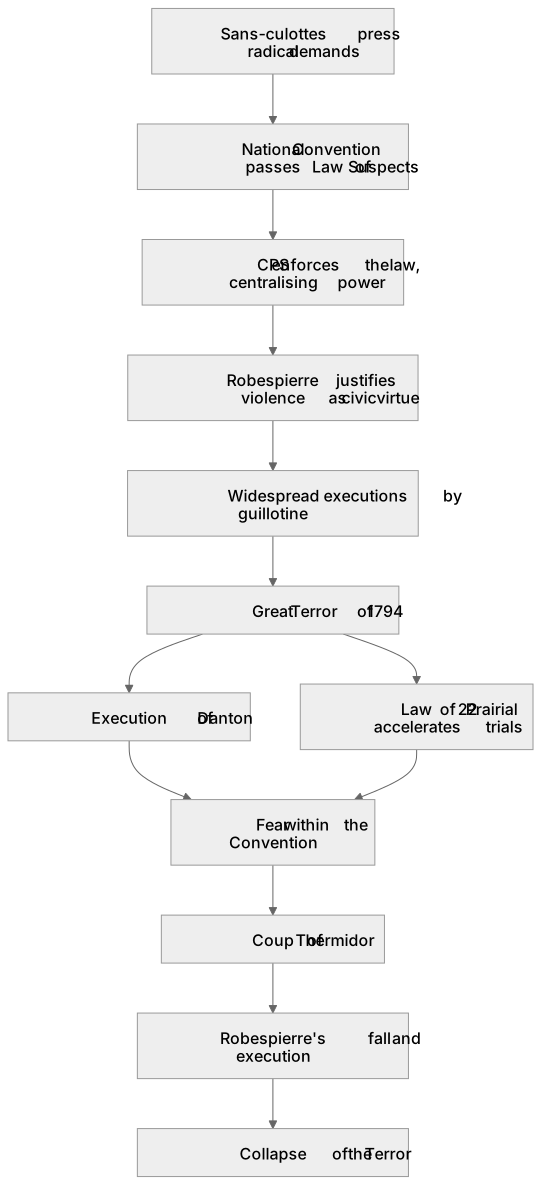
The Terror spread rapidly as the Committee of Public Safety (CPS), guided by Maximilien Robespierre, centralised power. Driven by the radical demands of the Parisian sans-culottes, the National Convention passed the Law of Suspects, which the CPS enforced. This led to widespread executions by guillotine. Robespierre justified this violence as necessary for civic virtue. However, the Great Terror of 1794 alienated his supporters. The execution of Danton, coupled with the Law of 22 Prairial accelerating trials, created pervasive fear within the Convention. This culminated in the coup of Thermidor; Robespierre's fall and execution dismantled the CPS's dictatorial apparatus, triggering the rapid collapse of the Terror.
What earns the marks
- Analyse the role of the Committee of Public Safety (CPS) as the executive engine of the Terror, centralising authority.
- Evaluate the ideological and political influence of Robespierre in justifying state violence through the concept of 'virtue'.
- Assess the pressure exerted by the sans-culottes on the Convention and the CPS to implement radical economic and punitive measures.
- Explain the causes of the Thermidorian Reaction, focusing on how the Law of 22 Prairial and the execution of political factions led to Robespierre's downfall.
Common mistakes and how to put them right
Claiming Robespierre was a dictator who single-handedly orchestrated the Terror.
Put it right: Explain that Robespierre was one of twelve members of the CPS and relied on the support of the sans-culottes and the Convention until Thermidor.
Viewing the sans-culottes merely as a mindless mob.
Put it right: Recognise the sans-culottes as a distinct political force with specific economic grievances and ideological goals that actively shaped CPS policy.
Assuming the Terror ended immediately and peacefully upon Robespierre's death.
Put it right: Note that while the institutional Terror collapsed, it was followed by the violent White Terror against former Jacobins.
Exam tips
- Contrast the ideological motivations of Robespierre with the pragmatic, survival-driven actions of the CPS and the Convention.
- Use specific legislation, such as the Law of Suspects and the Law of 22 Prairial, to demonstrate how the machinery of the Terror escalated.
- When discussing the collapse of the Terror, evaluate whether it was driven more by the removal of external military threats or by internal political self-preservation.
Try the lesson
The start of the 2H France in Revolution, 1774–1815 (A-level only) – The emergence and spread of the Terror, September 1792–1795: The spread of the Terror: executions; the influence of Robespierre and the sans culottes; the role of the CPS; Robespierre's fall and the collapse of the Terror lesson, made from checked teaching notes for this specification point.
Have a go first
Which body was granted extensive executive powers in 1793 and effectively directed the Reign of Terror?
Listen
The Terror spread rapidly as the Committee of Public Safety (CPS), guided by Maximilien Robespierre, centralised power. Driven by the radical demands of the Parisian sans-culottes, the National Convention passed the Law of Suspects, which the CPS enforced. This led to widespread executions by guillotine. Robespierre justified this violence as necessary for civic virtue. However, the Great Terror of 1794 alienated his supporters. The execution of Danton, coupled with the Law of 22 Prairial accelerating trials, created pervasive fear within the Convention. This culminated in the coup of Thermidor; Robespierre's fall and execution dismantled the CPS's dictatorial apparatus, triggering the rapid collapse of the Terror. A strong answer earns marks for these points. Analyse the role of the Committee of Public Safety (CPS) as the executive engine of the Terror, centralising authority. Evaluate the ideological and political influence of Robespierre in justifying state violence through the concept of 'virtue'. Assess the pressure exerted by the sans-culottes on the Convention and the CPS to implement radical economic and punitive measures. Explain the causes of the Thermidorian Reaction, focusing on how the Law of 22 Prairial and the execution of political factions led to Robespierre's downfall. A common slip: Claiming Robespierre was a dictator who single-handedly orchestrated the Terror. Instead, Explain that Robespierre was one of twelve members of the CPS and relied on the support of the sans-culottes and the Convention until Thermidor. Exam tip: Contrast the ideological motivations of Robespierre with the pragmatic, survival-driven actions of the CPS and the Convention.
See it
Key words
Say what each word means before you turn the card.
Ideology vs pragmatism
Try answering aloud or in your head before turning the card.
Popular radicalism and crowd action
Try answering aloud or in your head before turning the card.
The mechanics of state terror
Try answering aloud or in your head before turning the card.
Political factionalism and purges
Try answering aloud or in your head before turning the card.
See every definition
- Ideology vs pragmatism
- Contrasting the ideological motivations of Robespierre with the pragmatic, survival-driven actions of the CPS and the Convention.
- Popular radicalism and crowd action
- The pressure exerted by the sans-culottes on the Convention and the CPS to implement radical economic and punitive measures.
- The mechanics of state terror
- The CPS enforced the Law of Suspects, leading to widespread executions by guillotine, with the Law of 22 Prairial accelerating trials.
- Political factionalism and purges
- The execution of Danton and other political factions created pervasive fear within the Convention, culminating in the coup of Thermidor.
Label the diagram
Some boxes have lost their names. Pick the right name for each number.
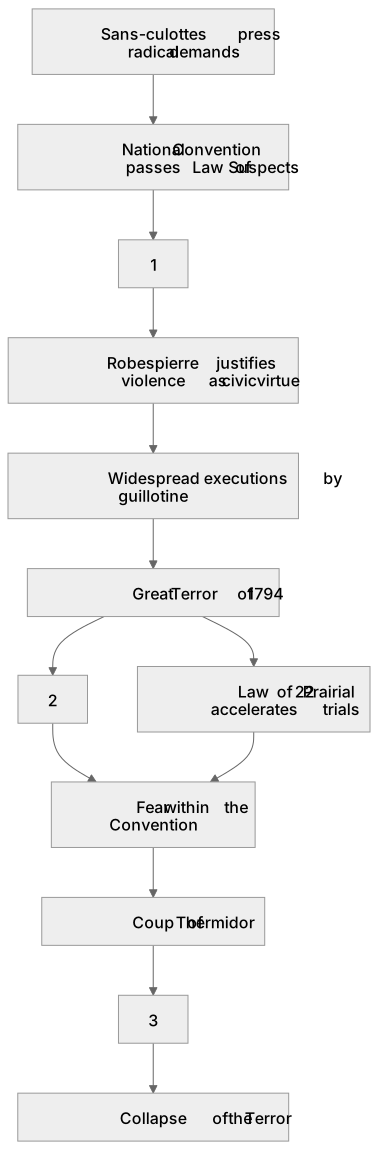
1Box 1
2Box 2
3Box 3
There is more to this lesson
The full lesson goes on to check your understanding and help you earn the marks. Create a free account to carry on, with your progress saved.
A week of Premium from your first lesson · Then the free plan continues · No card, no charge
Test your understanding of 2H France in Revolution, 1774–1815 (A-level only) – The emergence and spread of the Terror, September 1792–1795: The spread of the Terror: executions; the influence of Robespierre and the sans culottes; the role of the CPS; Robespierre's fall and the collapse of the Terror
Active recall beats re-reading. Take an instant quiz now to test what you’ve learned and lock it into long-term memory.
A week of Premium from your first lesson · Then the free plan continues · No card, no charge