AQA · A-Level · History
Course version: 7042 · Version from Sept 2017
The progress of the war: the levée en masse and the coming of the Terror
Full specification wording
2H France in Revolution, 1774–1815 (A-level only) – The emergence and spread of the Terror, September 1792–1795: The progress of the war: the levée en masse and the coming of the Terror
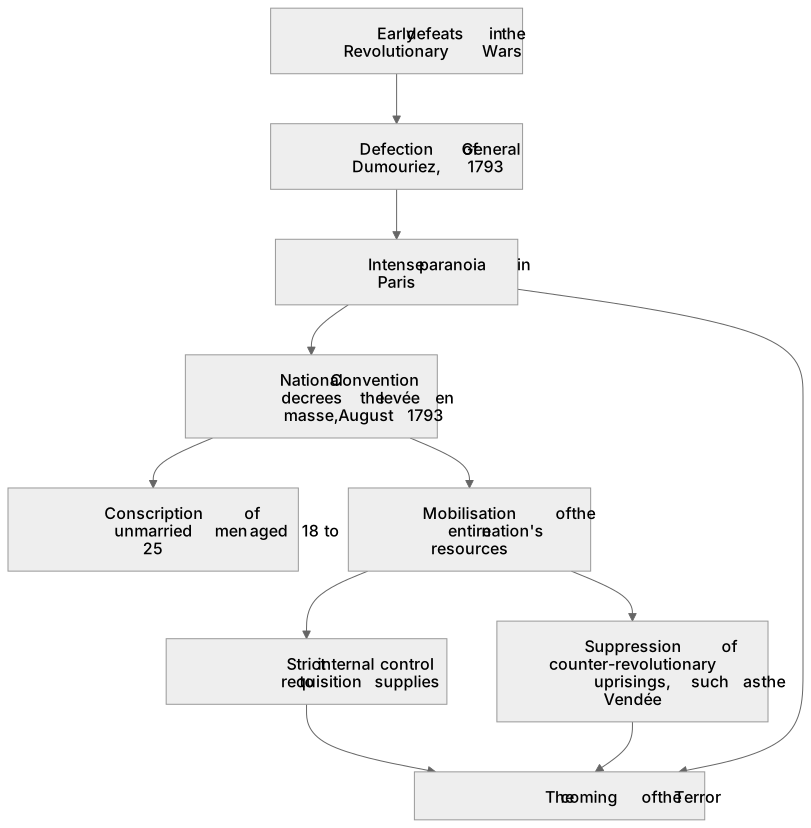
Early defeats in the Revolutionary Wars and the defection of General Dumouriez in 1793 created intense paranoia in Paris.
Checked against the AQA 7042 specification (opens in a new tab) on .
- Point 3 of 4
- 3 key terms
Study notes
From the checked teaching notes for this specification point.
The idea
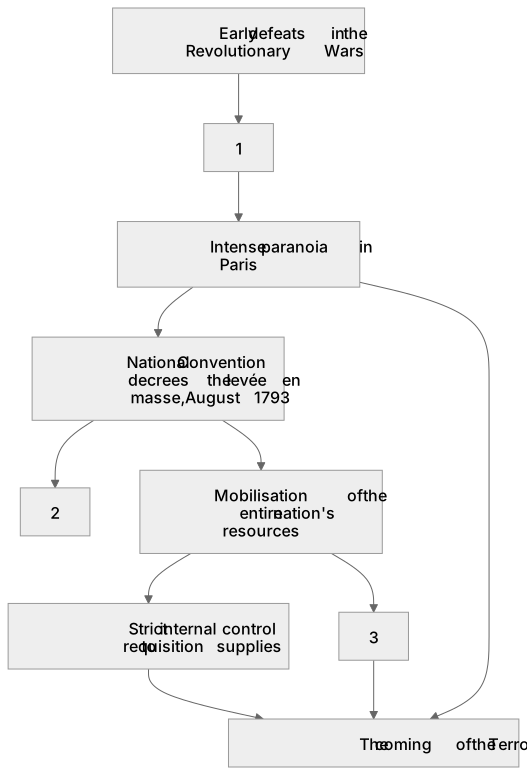
Early defeats in the Revolutionary Wars and the defection of General Dumouriez in 1793 created intense paranoia in Paris. To combat the First Coalition, the National Convention decreed the levée en masse in August 1793. This unprecedented policy conscripted unmarried men aged 18 to 25, mobilising the entire nation's resources for the war effort. Enforcing this massive state intervention required strict internal control to requisition supplies and suppress counter-revolutionary uprisings, such as the rebellion in the Vendée. The existential threat of the war and the logistical demands of the levée en masse directly precipitated the coming of the Terror, as the government adopted extreme measures to ensure national survival.
What earns the marks
- Explain the military context of 1793, including the threat posed by the First Coalition and internal rebellions.
- Define the levée en masse as a policy of total war that mobilised human and material resources, not just a military draft.
- Analyse the link between military crisis and political radicalisation, showing how fear of defeat justified emergency powers.
- Evaluate how the logistical demands of supplying a massive conscript army necessitated coercive economic and political measures, leading to the Terror.
Common mistakes and how to put them right
Confusing the levée en masse with earlier, smaller-scale conscription efforts.
Put it right: Specify that the August 1793 levée en masse was a unique decree of total national mobilisation, distinct from the February 1793 levy of 300,000 men.
Treating the war and the Terror as unconnected events.
Put it right: Explicitly link the military crisis and the need to enforce the levée en masse to the centralisation of power and the implementation of the Terror.
Assuming the levée en masse only affected soldiers.
Put it right: Emphasise that it mobilised the entire population, including women making tents and children making lint, representing the birth of total war.
Exam tips
- Use the levée en masse as a primary example when arguing that external threats drove internal radicalisation.
- Connect the demands of the war effort to the economic grievances of the sans-culottes to build a multi-causal argument for the Terror.
- Assess the extent to which the Terror was a pragmatic response to military necessity versus an ideological purge.
Try the lesson
The start of the 2H France in Revolution, 1774–1815 (A-level only) – The emergence and spread of the Terror, September 1792–1795: The progress of the war: the levée en masse and the coming of the Terror lesson, made from checked teaching notes for this specification point.
Have a go first
What was the primary purpose of the levée en masse decreed by the National Convention in August 1793?
Listen
Early defeats in the Revolutionary Wars and the defection of General Dumouriez in 1793 created intense paranoia in Paris. To combat the First Coalition, the National Convention decreed the levée en masse in August 1793. This unprecedented policy conscripted unmarried men aged 18 to 25, mobilising the entire nation's resources for the war effort. Enforcing this massive state intervention required strict internal control to requisition supplies and suppress counter-revolutionary uprisings, such as the rebellion in the Vendée. The existential threat of the war and the logistical demands of the levée en masse directly precipitated the coming of the Terror, as the government adopted extreme measures to ensure national survival. A strong answer earns marks for these points. Explain the military context of 1793, including the threat posed by the First Coalition and internal rebellions. Define the levée en masse as a policy of total war that mobilised human and material resources, not just a military draft. Analyse the link between military crisis and political radicalisation, showing how fear of defeat justified emergency powers. Evaluate how the logistical demands of supplying a massive conscript army necessitated coercive economic and political measures, leading to the Terror. A common slip: Confusing the levée en masse with earlier, smaller-scale conscription efforts. Instead, Specify that the August 1793 levée en masse was a unique decree of total national mobilisation, distinct from the February 1793 levy of 300,000 men. Exam tip: Use the levée en masse as a primary example when arguing that external threats drove internal radicalisation.
See it
Key words
Say what each word means before you turn the card.
Total war and state mobilisation
Try answering aloud or in your head before turning the card.
External threats vs internal politics
Try answering aloud or in your head before turning the card.
Centralisation of state power
Try answering aloud or in your head before turning the card.
See every definition
- Total war and state mobilisation
- A policy of total war that mobilised human and material resources, not just a military draft, conscripting unmarried men aged 18 to 25 and mobilising the entire nation's resources for the war effort.
- External threats vs internal politics
- Early defeats in the Revolutionary Wars and the defection of General Dumouriez in 1793 created intense paranoia in Paris, while internal control was required to suppress counter-revolutionary uprisings such as the rebellion in the Vendée.
- Centralisation of state power
- Strict internal control to requisition supplies and suppress counter-revolutionary uprisings, with the government adopting extreme measures to ensure national survival.
Label the diagram
Some boxes have lost their names. Pick the right name for each number.
1Box 1
2Box 2
3Box 3
There is more to this lesson
The full lesson goes on to check your understanding and help you earn the marks. Create a free account to carry on, with your progress saved.
A week of Premium from your first lesson · Then the free plan continues · No card, no charge
Test your understanding of 2H France in Revolution, 1774–1815 (A-level only) – The emergence and spread of the Terror, September 1792–1795: The progress of the war: the levée en masse and the coming of the Terror
Active recall beats re-reading. Take an instant quiz now to test what you’ve learned and lock it into long-term memory.
A week of Premium from your first lesson · Then the free plan continues · No card, no charge