AQA · A-Level · History
Course version: 7042 · Version from Sept 2017
The attempts to establish a constitutional monarchy: church reforms;…
Full specification wording
2H France in Revolution, 1774–1815 (A-level only) – The experiment in constitutional monarchy, 1789–1792: The attempts to establish a constitutional monarchy: church reforms; political, judicial and administrative reforms; economic and social change
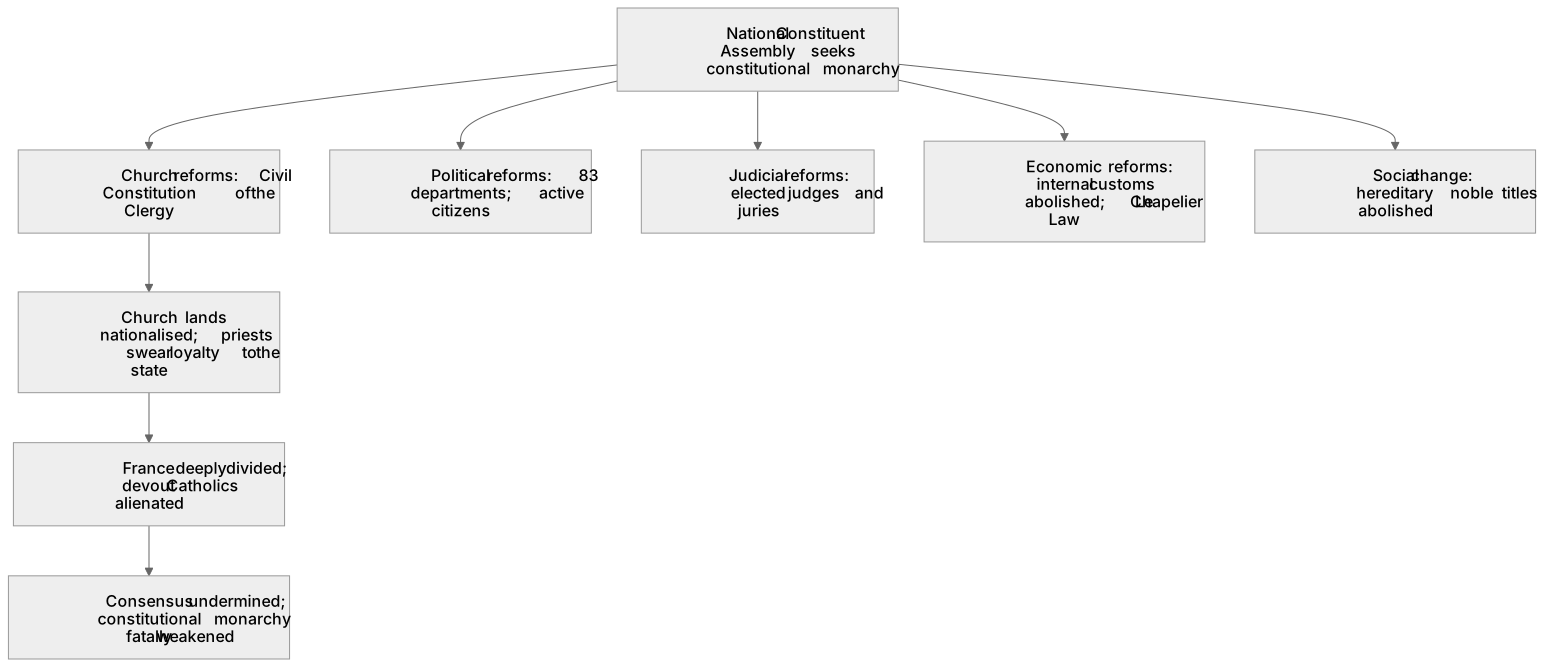
The National Constituent Assembly sought to build a constitutional monarchy through sweeping reforms.
Checked against the AQA 7042 specification (opens in a new tab) on .
- Point 2 of 4
- 4 key terms
Study notes
From the checked teaching notes for this specification point.
The idea
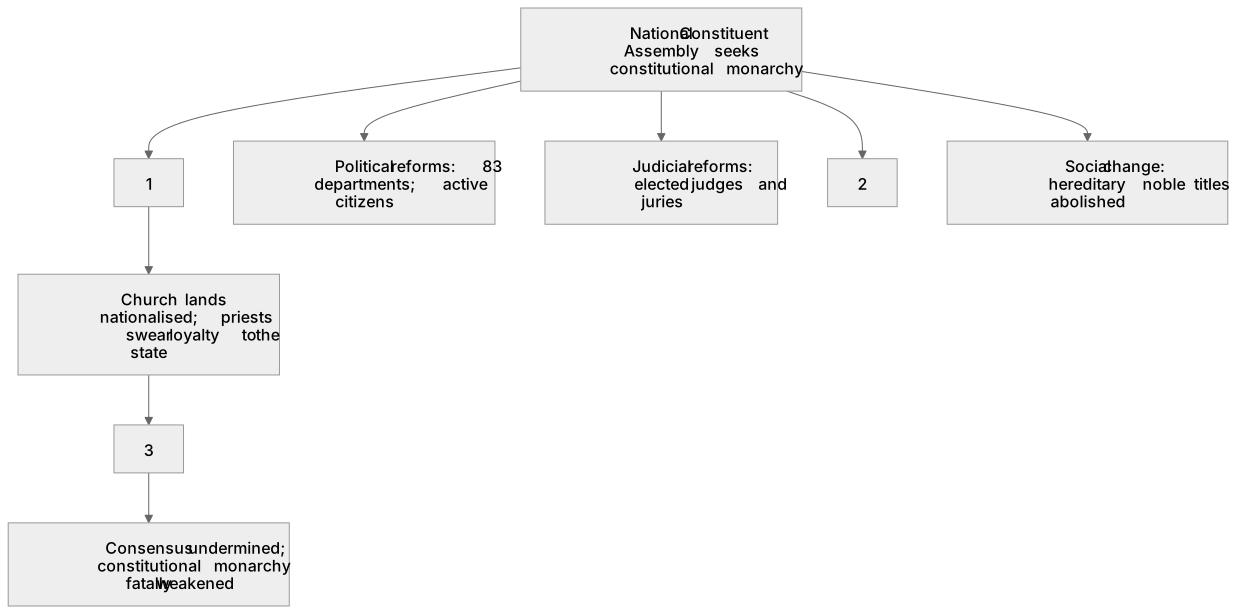
The National Constituent Assembly sought to build a constitutional monarchy through sweeping reforms. Politically, power was decentralised into 83 departments, and voting was restricted to tax-paying 'active citizens'. Judicial reforms introduced elected judges and juries, replacing arbitrary royal justice. Economically, internal customs barriers were abolished, and the Le Chapelier Law banned trade unions to promote free trade. Socially, hereditary noble titles were abolished. Crucially, church reforms, notably the Civil Constitution of the Clergy, nationalised church lands and forced priests to swear loyalty to the state. This deeply divided France, alienating devout Catholics and fatally undermining the consensus needed for the new regime to survive.
What earns the marks
- Evaluate the impact of the Civil Constitution of the Clergy on the stability of the constitutional monarchy.
- Analyse the distinction between 'active' and 'passive' citizens in the new political framework.
- Assess the effectiveness of administrative decentralisation into 83 departments.
- Explain the economic rationale and social consequences of the Le Chapelier Law and the abolition of internal tariffs.
Common mistakes and how to put them right
Claiming the Assembly introduced universal suffrage.
Put it right by explaining the property qualifications that created 'active' and 'passive' citizens.
Viewing church reforms purely as an attack on religion.
Put it right by explaining the financial motivation behind nationalising church lands to back the assignats.
Assuming the King had no power in the new constitution.
Put it right by detailing his suspensive veto and role as head of the executive.
Exam tips
- Argue how the Civil Constitution of the Clergy acted as a turning point that fractured support for the revolution.
- Contrast the liberal economic reforms, which benefited the bourgeoisie, with the social realities faced by the urban poor.
- Use the administrative division into 83 departments as evidence of the Assembly's desire to dismantle the old absolutist structures.
Try the lesson
The start of the 2H France in Revolution, 1774–1815 (A-level only) – The experiment in constitutional monarchy, 1789–1792: The attempts to establish a constitutional monarchy: church reforms; political, judicial and administrative reforms; economic and social change lesson, made from checked teaching notes for this specification point.
Have a go first
Which significant reform was introduced by the Civil Constitution of the Clergy in July 1790?
Listen
The National Constituent Assembly sought to build a constitutional monarchy through sweeping reforms. Politically, power was decentralised into 83 departments, and voting was restricted to tax-paying 'active citizens'. Judicial reforms introduced elected judges and juries, replacing arbitrary royal justice. Economically, internal customs barriers were abolished, and the Le Chapelier Law banned trade unions to promote free trade. Socially, hereditary noble titles were abolished. Crucially, church reforms, notably the Civil Constitution of the Clergy, nationalised church lands and forced priests to swear loyalty to the state. This deeply divided France, alienating devout Catholics and fatally undermining the consensus needed for the new regime to survive. A strong answer earns marks for these points. Evaluate the impact of the Civil Constitution of the Clergy on the stability of the constitutional monarchy. Analyse the distinction between 'active' and 'passive' citizens in the new political framework. Assess the effectiveness of administrative decentralisation into 83 departments. Explain the economic rationale and social consequences of the Le Chapelier Law and the abolition of internal tariffs. A common slip: Claiming the Assembly introduced universal suffrage. Instead, explaining the property qualifications that created 'active' and 'passive' citizens. Exam tip: Argue how the Civil Constitution of the Clergy acted as a turning point that fractured support for the revolution.
See it
Key words
Say what each word means before you turn the card.
Decentralisation of power
Try answering aloud or in your head before turning the card.
Secularisation and state control
Try answering aloud or in your head before turning the card.
Bourgeois dominance
Try answering aloud or in your head before turning the card.
Constitutionalism
Try answering aloud or in your head before turning the card.
See every definition
- Decentralisation of power
- Power was decentralised into 83 departments, dismantling the old absolutist structures.
- Secularisation and state control
- Church reforms, notably the Civil Constitution of the Clergy, nationalised church lands and forced priests to swear loyalty to the state.
- Bourgeois dominance
- Voting was restricted to tax-paying 'active citizens', and liberal economic reforms benefited the bourgeoisie.
- Constitutionalism
- The National Constituent Assembly sought to build a constitutional monarchy through sweeping reforms.
Label the diagram
Some boxes have lost their names. Pick the right name for each number.
1Box 1
2Box 2
3Box 3
There is more to this lesson
The full lesson goes on to check your understanding and help you earn the marks. Create a free account to carry on, with your progress saved.
A week of Premium from your first lesson · Then the free plan continues · No card, no charge
Test your understanding of 2H France in Revolution, 1774–1815 (A-level only) – The experiment in constitutional monarchy, 1789–1792: The attempts to establish a constitutional monarchy: church reforms; political, judicial and administrative reforms; economic and social change
Active recall beats re-reading. Take an instant quiz now to test what you’ve learned and lock it into long-term memory.
A week of Premium from your first lesson · Then the free plan continues · No card, no charge