AQA · A-Level · History
Course version: 7042 · Version from Sept 2017
Political change: Napoleon's consolidation of power and establishment of…
Full specification wording
2H France in Revolution, 1774–1815 (A-level only) – The impact of Napoleon's rule on France, 1799–1815: Political change: Napoleon's consolidation of power and establishment of Emperor status; constitutional developments
Napoleon transformed the French Republic into an autocratic Empire through calculated constitutional developments.
Checked against the AQA 7042 specification (opens in a new tab) on .
- Point 1 of 4
- 4 key terms
Study notes
From the checked teaching notes for this specification point.
The idea
Napoleon transformed the French Republic into an autocratic Empire through calculated constitutional developments. Following the 1799 Coup of Brumaire, the Constitution of Year VIII established the Consulate, masking his dictatorship behind democratic facades like universal male suffrage. He consolidated power by purging opponents, utilising the senatus-consultum to bypass legislative bodies, and securing the Life Consulate in 1802. This political change culminated in 1804 with the Constitution of Year XII, which established his Emperor status. By crowning himself, Napoleon signified that his authority derived from his own merit and military success rather than divine right, effectively ending the First Republic.
What earns the marks
- Explain the transition from First Consul to Consul for Life in 1802 and finally to Emperor in 1804 as a gradual consolidation of executive power.
- Analyse the role of plebiscites in providing a veneer of democratic legitimacy to Napoleon's constitutional changes.
- Evaluate the emasculation of legislative bodies, such as the Tribunate and the Legislative Body, through the use of the senatus-consultum.
- Assess the significance of the 1804 coronation in establishing Emperor status and creating a new hereditary dynasty to deter Royalist plots.
Common mistakes and how to put them right
Claiming Napoleon became Emperor immediately after the 1799 Coup of Brumaire.
Put it right by detailing the intermediate stages of First Consul and Consul for Life.
Stating that the legislative bodies had genuine power under the Consulate.
Put it right by explaining how Napoleon bypassed them using the Senate and senatus-consultum.
Assuming plebiscites were entirely free and fair democratic elections.
Put it right by noting they were heavily manipulated and rigged to show overwhelming support.
Exam tips
- Trace the specific constitutional documents (Years VIII, X, and XII) to demonstrate precise knowledge of how political change was legally codified.
- When evaluating Napoleon's consolidation of power, contrast the democratic appearance of his reforms with their autocratic reality.
- Link the establishment of Emperor status to the context of Royalist assassination plots, such as the Cadoudal conspiracy, which provided the pretext for hereditary rule.
Try the lesson
The start of the 2H France in Revolution, 1774–1815 (A-level only) – The impact of Napoleon's rule on France, 1799–1815: Political change: Napoleon's consolidation of power and establishment of Emperor status; constitutional developments lesson, made from checked teaching notes for this specification point.
Have a go first
Which constitutional development formally established Napoleon Bonaparte as Emperor of the French?
Listen
Napoleon transformed the French Republic into an autocratic Empire through calculated constitutional developments. Following the 1799 Coup of Brumaire, the Constitution of Year VIII established the Consulate, masking his dictatorship behind democratic facades like universal male suffrage. He consolidated power by purging opponents, utilising the senatus-consultum to bypass legislative bodies, and securing the Life Consulate in 1802. This political change culminated in 1804 with the Constitution of Year XII, which established his Emperor status. By crowning himself, Napoleon signified that his authority derived from his own merit and military success rather than divine right, effectively ending the First Republic. A strong answer earns marks for these points. Explain the transition from First Consul to Consul for Life in 1802 and finally to Emperor in 1804 as a gradual consolidation of executive power. Analyse the role of plebiscites in providing a veneer of democratic legitimacy to Napoleon's constitutional changes. Evaluate the emasculation of legislative bodies, such as the Tribunate and the Legislative Body, through the use of the senatus-consultum. Assess the significance of the 1804 coronation in establishing Emperor status and creating a new hereditary dynasty to deter Royalist plots. A common slip: Claiming Napoleon became Emperor immediately after the 1799 Coup of Brumaire. Instead, detailing the intermediate stages of First Consul and Consul for Life. Exam tip: Trace the specific constitutional documents (Years VIII, X, and XII) to demonstrate precise knowledge of how political change was legally codified.
See it
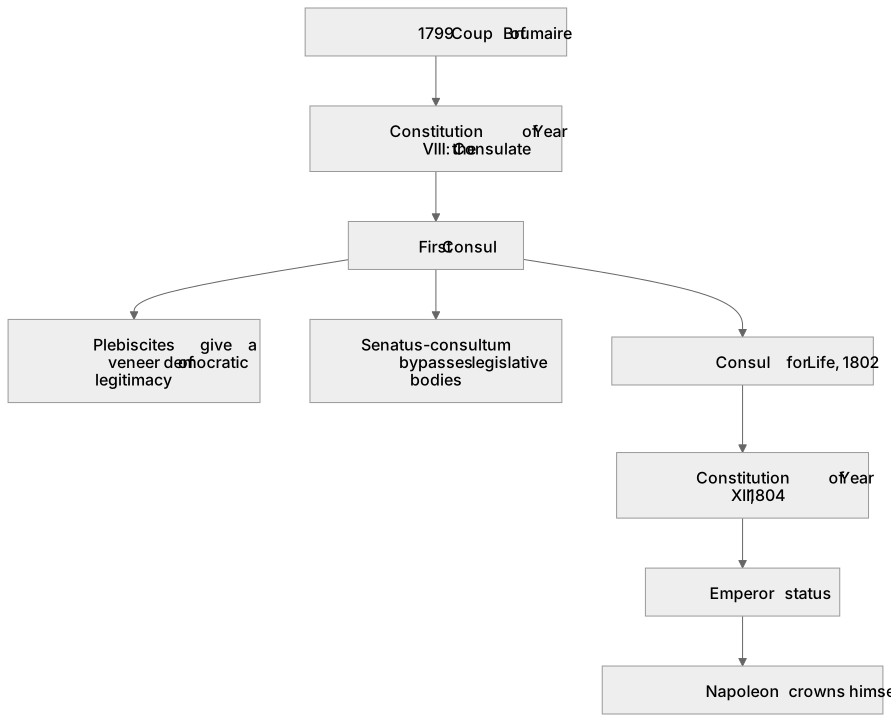
Put the events in order
Put these events in the order they happened, earliest first.
- 1. Coup of Brumaire and establishment of the Consulate
- 2. Constitution of Year XII establishes Emperor status
- 3. Napoleon secures the Life Consulate
Key words
Say what each word means before you turn the card.
Autocracy and Dictatorship
Try answering aloud or in your head before turning the card.
Constitutional Reform
Try answering aloud or in your head before turning the card.
Legitimacy and Propaganda
Try answering aloud or in your head before turning the card.
Political Opposition
Try answering aloud or in your head before turning the card.
See every definition
- Autocracy and Dictatorship
- Napoleon transformed the French Republic into an autocratic Empire, masking his dictatorship behind democratic facades.
- Constitutional Reform
- Calculated constitutional developments, from the Constitution of Year VIII to the Constitution of Year XII, codified political change.
- Legitimacy and Propaganda
- Plebiscites provided a veneer of democratic legitimacy to Napoleon's constitutional changes, though they were heavily manipulated and rigged.
- Political Opposition
- Napoleon consolidated power by purging opponents and emasculating legislative bodies such as the Tribunate and the Legislative Body.
Label the diagram
Some boxes have lost their names. Pick the right name for each number.
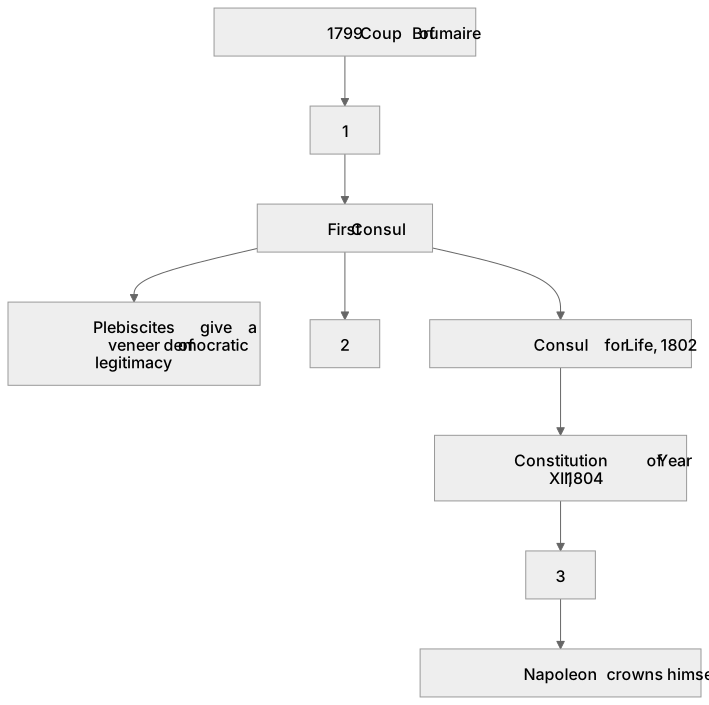
1Box 1
2Box 2
3Box 3
There is more to this lesson
The full lesson goes on to check your understanding and help you earn the marks. Create a free account to carry on, with your progress saved.
A week of Premium from your first lesson · Then the free plan continues · No card, no charge
Test your understanding of 2H France in Revolution, 1774–1815 (A-level only) – The impact of Napoleon's rule on France, 1799–1815: Political change: Napoleon's consolidation of power and establishment of Emperor status; constitutional developments
Active recall beats re-reading. Take an instant quiz now to test what you’ve learned and lock it into long-term memory.
A week of Premium from your first lesson · Then the free plan continues · No card, no charge