AQA · A-Level · History
Course version: 7042 · Version from Sept 2017
Social change: class distinctions and titles; education and attitude to…
Full specification wording
2H France in Revolution, 1774–1815 (A-level only) – The impact of Napoleon's rule on France, 1799–1815: Social change: class distinctions and titles; education and attitude to women; censorship and propaganda; the position of the Church; the Concordat and its aftermath
Napoleon engineered profound social change to ensure state loyalty.
Checked against the AQA 7042 specification (opens in a new tab) on .
- Point 2 of 4
- 4 key terms
Study notes
From the checked teaching notes for this specification point.
The idea
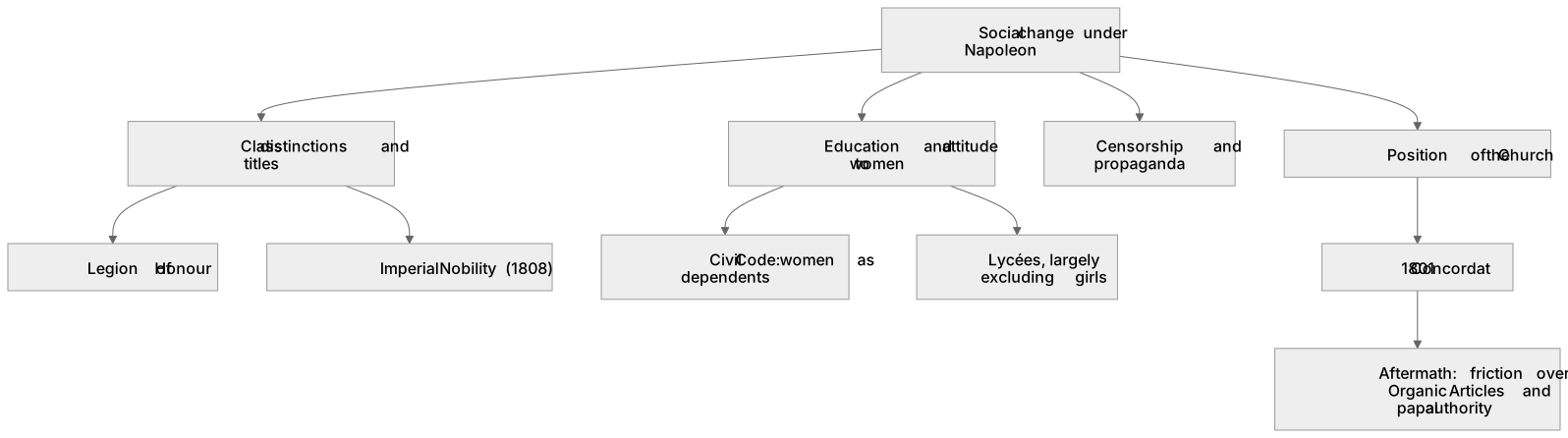
Napoleon engineered profound social change to ensure state loyalty. He redefined class distinctions by creating the Legion of Honour and the Imperial Nobility (1808), rewarding service over birthright. His attitude to women was patriarchal, codified in the Civil Code which made them dependents. Education reforms focused on creating loyal civil servants through lycées, largely excluding girls. Censorship and propaganda were weaponised to control public opinion, heavily restricting newspapers. Crucially, he altered the position of the Church through the 1801 Concordat, reconciling the state with Catholicism to heal revolutionary divisions, though its aftermath saw ongoing friction over the Organic Articles and papal authority.
What earns the marks
- Analyse how the creation of the Imperial Nobility and Legion of Honour established new class distinctions based on merit and military service rather than ancient lineage.
- Evaluate the impact of the Civil Code on women, noting the reversal of revolutionary gains and the legal enforcement of patriarchal authority.
- Assess the purpose of educational reforms, specifically the lycées and the Imperial University, in indoctrinating youth and providing capable administrators.
- Examine the mechanisms of censorship and propaganda, such as the reduction of Parisian newspapers and the use of bulletins and art to cultivate a personality cult.
- Explain the political motivations behind the 1801 Concordat and how the subsequent Organic Articles maintained state control over the Church.
Common mistakes and how to put them right
Stating that Napoleon restored the old Bourbon nobility.
Put it right by explaining he created a new Imperial Nobility based on service to the state, though some émigrés were included.
Claiming the Concordat made Catholicism the official state religion.
Put it right by specifying it was recognised only as the religion of the majority of Frenchmen, maintaining religious pluralism.
Assuming Napoleon's education system was universal.
Put it right by noting it was heavily biased towards middle-class boys and military or administrative training, neglecting female and working-class education.
Exam tips
- Link social policies directly to Napoleon's desire for political control and stability, showing how social change served his autocratic ambitions.
- Use the 1801 Concordat as a prime example of Napoleon compromising on revolutionary ideals to achieve pragmatic domestic peace.
- When discussing censorship, reference specific methods like the reduction of political journals in Paris from 73 to 4 to demonstrate precise knowledge.
Try the lesson
The start of the 2H France in Revolution, 1774–1815 (A-level only) – The impact of Napoleon's rule on France, 1799–1815: Social change: class distinctions and titles; education and attitude to women; censorship and propaganda; the position of the Church; the Concordat and its aftermath lesson, made from checked teaching notes for this specification point.
Have a go first
What was the primary outcome of the Concordat of 1801 regarding the position of the Catholic Church in France?
Listen
Napoleon engineered profound social change to ensure state loyalty. He redefined class distinctions by creating the Legion of Honour and the Imperial Nobility (1808), rewarding service over birthright. His attitude to women was patriarchal, codified in the Civil Code which made them dependents. Education reforms focused on creating loyal civil servants through lycées, largely excluding girls. Censorship and propaganda were weaponised to control public opinion, heavily restricting newspapers. Crucially, he altered the position of the Church through the 1801 Concordat, reconciling the state with Catholicism to heal revolutionary divisions, though its aftermath saw ongoing friction over the Organic Articles and papal authority. A strong answer earns marks for these points. Analyse how the creation of the Imperial Nobility and Legion of Honour established new class distinctions based on merit and military service rather than ancient lineage. Evaluate the impact of the Civil Code on women, noting the reversal of revolutionary gains and the legal enforcement of patriarchal authority. Assess the purpose of educational reforms, specifically the lycées and the Imperial University, in indoctrinating youth and providing capable administrators. Examine the mechanisms of censorship and propaganda, such as the reduction of Parisian newspapers and the use of bulletins and art to cultivate a personality cult. A common slip: Stating that Napoleon restored the old Bourbon nobility. Instead, explaining he created a new Imperial Nobility based on service to the state, though some émigrés were included. Exam tip: Link social policies directly to Napoleon's desire for political control and stability, showing how social change served his autocratic ambitions.
See it
Key words
Say what each word means before you turn the card.
Social Hierarchy and Meritocracy
Try answering aloud or in your head before turning the card.
Gender and Patriarchy
Try answering aloud or in your head before turning the card.
State Control and Indoctrination
Try answering aloud or in your head before turning the card.
Religion and State Relations
Try answering aloud or in your head before turning the card.
See every definition
- Social Hierarchy and Meritocracy
- Napoleon redefined class distinctions by creating the Legion of Honour and the Imperial Nobility, rewarding service over birthright.
- Gender and Patriarchy
- His attitude to women was patriarchal, codified in the Civil Code which made them dependents.
- State Control and Indoctrination
- Censorship and propaganda were weaponised to control public opinion, heavily restricting newspapers, while education reforms focused on creating loyal civil servants through lycées.
- Religion and State Relations
- He altered the position of the Church through the 1801 Concordat, reconciling the state with Catholicism to heal revolutionary divisions, though its aftermath saw ongoing friction over the Organic Articles and papal authority.
Label the diagram
Some boxes have lost their names. Pick the right name for each number.
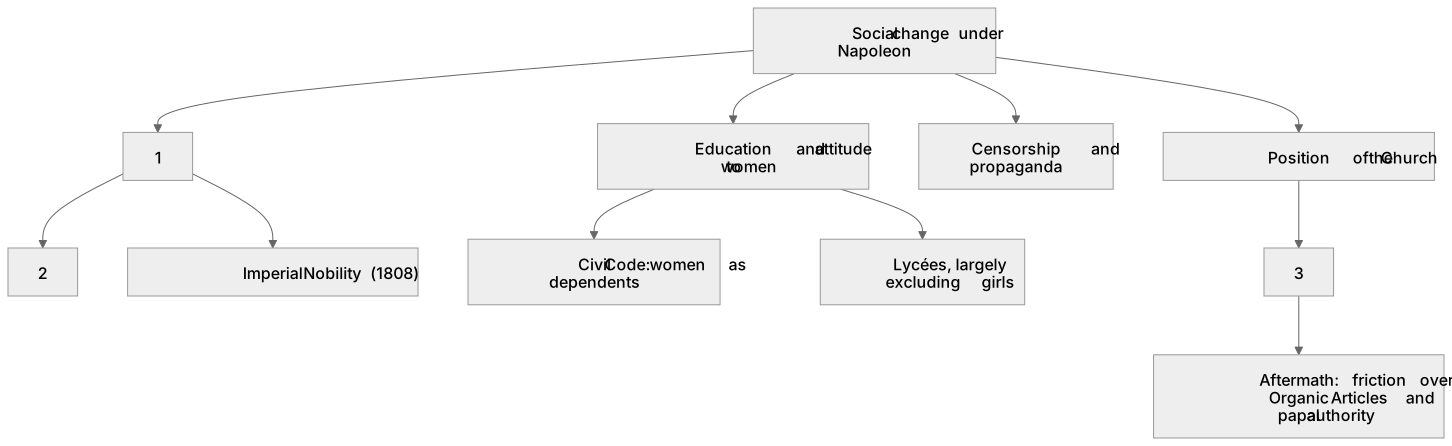
1Box 1
2Box 2
3Box 3
There is more to this lesson
The full lesson goes on to check your understanding and help you earn the marks. Create a free account to carry on, with your progress saved.
A week of Premium from your first lesson · Then the free plan continues · No card, no charge
Test your understanding of 2H France in Revolution, 1774–1815 (A-level only) – The impact of Napoleon's rule on France, 1799–1815: Social change: class distinctions and titles; education and attitude to women; censorship and propaganda; the position of the Church; the Concordat and its aftermath
Active recall beats re-reading. Take an instant quiz now to test what you’ve learned and lock it into long-term memory.
A week of Premium from your first lesson · Then the free plan continues · No card, no charge