AQA · A-Level · History
Course version: 7042 · Version from Sept 2017
A Nation Divided, c1845–1877 – Attempts to maintain the Union, c1845–1854:…
Full specification wording
2J America: A Nation Divided, c1845–1877 – Attempts to maintain the Union, c1845–1854: Reactions against abolitionism in the South; political leaders such as Jefferson Davis; popular literature and the press
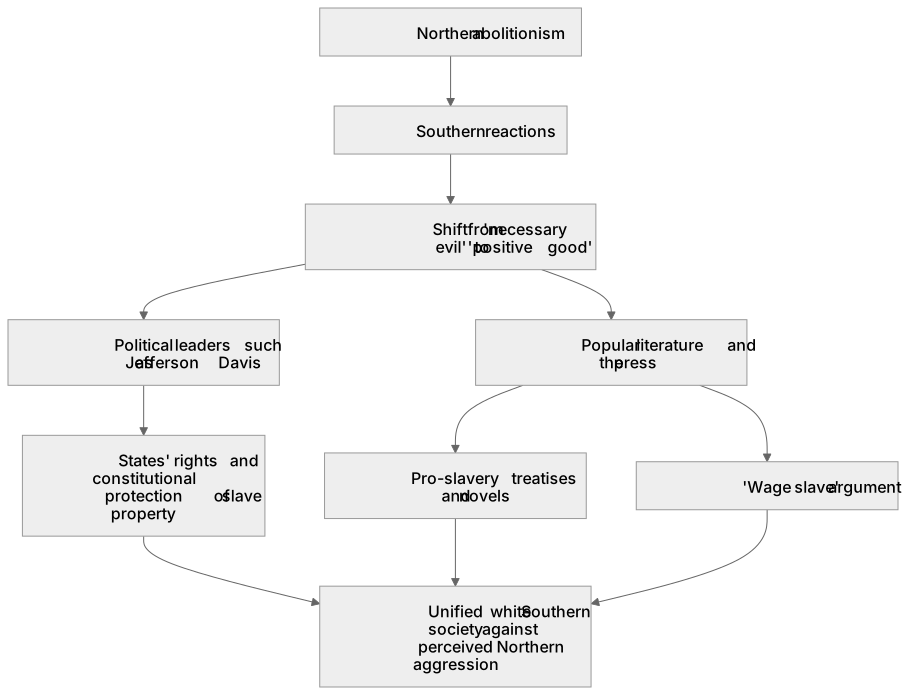
Southern reactions to Northern abolitionism transformed from apologetic defences of slavery as a 'necessary evil' to aggressive assertions of it as a 'positive good'.
Checked against the AQA 7042 specification (opens in a new tab) on .
- Point 4 of 4
- 4 key terms
Study notes
From the checked teaching notes for this specification point.
The idea
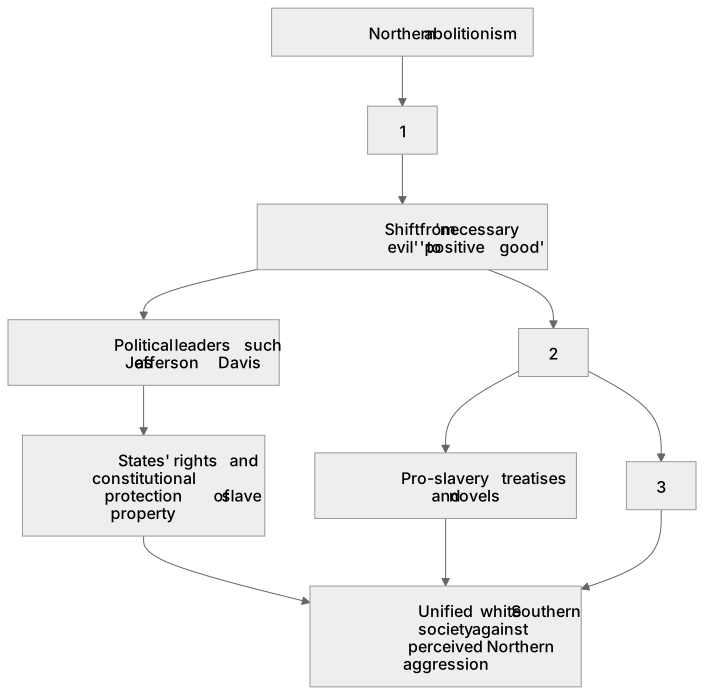
Southern reactions to Northern abolitionism transformed from apologetic defences of slavery as a 'necessary evil' to aggressive assertions of it as a 'positive good'. Political leaders like Jefferson Davis fiercely defended states' rights and the constitutional protection of slave property, arguing that Northern interference threatened Southern economic survival and social order. This political stance was heavily supported by Southern popular literature and the press, which published pro-slavery treatises and novels. Writers like George Fitzhugh used the press to contrast the paternalistic care supposedly provided to enslaved people with the harsh conditions of Northern 'wage slaves', thereby unifying white Southern society against perceived Northern aggression and abolitionist literature.
What earns the marks
- Analyse the shift in Southern rhetoric from defending slavery as a 'necessary evil' to promoting it as a 'positive good' in response to abolitionism.
- Evaluate the role of political leaders like Jefferson Davis in articulating the constitutional and states' rights arguments to protect the institution of slavery.
- Assess how Southern popular literature and the press actively countered Northern abolitionist texts by publishing pro-slavery novels and essays.
- Explain the use of the 'wage slave' argument by Southern writers to critique Northern industrial capitalism and defend the paternalistic ideology of slavery.
Common mistakes and how to put them right
Treating the Southern reaction as purely defensive.
Put it right by noting the aggressive ideological shift towards promoting slavery as a beneficial institution for all.
Assuming Jefferson Davis only became relevant during the Civil War.
Put it right: He was a crucial political voice defending Southern interests and slavery in the Senate during the 1850s.
Overlooking the role of the Southern press; failing to mention how local newspapers and literature actively censored abolitionist materials while disseminating pro-slavery propaganda.
Exam tips
- Reference the concept of 'paternalism' when discussing how Southern literature and press attempted to justify slavery morally against abolitionist attacks.
- Use Jefferson Davis as a prime example of how Southern politicians utilised constitutional arguments, specifically the Fifth Amendment regarding property, to counter abolitionism.
- Contrast Southern pro-slavery literature, such as 'Anti-Tom' novels, directly with Northern abolitionist works to demonstrate the cultural war preceding the military conflict.
Try the lesson
The start of the 2J America: A Nation Divided, c1845–1877 – Attempts to maintain the Union, c1845–1854: Reactions against abolitionism in the South; political leaders such as Jefferson Davis; popular literature and the press lesson, made from checked teaching notes for this specification point.
Have a go first
Which Southern political leader became a prominent defender of slavery and states' rights, strongly reacting against Northern abolitionism before eventually becoming President of the Confederacy?
Listen
Southern reactions to Northern abolitionism transformed from apologetic defences of slavery as a 'necessary evil' to aggressive assertions of it as a 'positive good'. Political leaders like Jefferson Davis fiercely defended states' rights and the constitutional protection of slave property, arguing that Northern interference threatened Southern economic survival and social order. This political stance was heavily supported by Southern popular literature and the press, which published pro-slavery treatises and novels. Writers like George Fitzhugh used the press to contrast the paternalistic care supposedly provided to enslaved people with the harsh conditions of Northern 'wage slaves', thereby unifying white Southern society against perceived Northern aggression and abolitionist literature. A strong answer earns marks for these points. Analyse the shift in Southern rhetoric from defending slavery as a 'necessary evil' to promoting it as a 'positive good' in response to abolitionism. Evaluate the role of political leaders like Jefferson Davis in articulating the constitutional and states' rights arguments to protect the institution of slavery. Assess how Southern popular literature and the press actively countered Northern abolitionist texts by publishing pro-slavery novels and essays. Explain the use of the 'wage slave' argument by Southern writers to critique Northern industrial capitalism and defend the paternalistic ideology of slavery. A common slip: Treating the Southern reaction as purely defensive. Instead, noting the aggressive ideological shift towards promoting slavery as a beneficial institution for all. Exam tip: Reference the concept of 'paternalism' when discussing how Southern literature and press attempted to justify slavery morally against abolitionist attacks.
See it
Key words
Say what each word means before you turn the card.
Pro-slavery ideology
Try answering aloud or in your head before turning the card.
States' rights
Try answering aloud or in your head before turning the card.
Paternalism
Try answering aloud or in your head before turning the card.
'Wage slave' argument
Try answering aloud or in your head before turning the card.
See every definition
- Pro-slavery ideology
- Aggressive assertions that slavery is a 'positive good' rather than a 'necessary evil', promoted in response to Northern abolitionism.
- States' rights
- Constitutional arguments fiercely defended by political leaders such as Jefferson Davis against Northern interference.
- Paternalism
- The paternalistic care supposedly provided to enslaved people, contrasted by Southern writers with the harsh conditions of Northern 'wage slaves'.
- 'Wage slave' argument
- A critique of Northern industrial capitalism used by Southern writers to defend the paternalistic ideology of slavery.
Label the diagram
Some boxes have lost their names. Pick the right name for each number.
1Box 1
2Box 2
3Box 3
There is more to this lesson
The full lesson goes on to check your understanding and help you earn the marks. Create a free account to carry on, with your progress saved.
A week of Premium from your first lesson · Then the free plan continues · No card, no charge
Test your understanding of 2J America: A Nation Divided, c1845–1877 – Attempts to maintain the Union, c1845–1854: Reactions against abolitionism in the South; political leaders such as Jefferson Davis; popular literature and the press
Active recall beats re-reading. Take an instant quiz now to test what you’ve learned and lock it into long-term memory.
A week of Premium from your first lesson · Then the free plan continues · No card, no charge