AQA · A-Level · History
Course version: 7042 · Version from Sept 2017
A Nation Divided, c1845–1877 – Attempts to maintain the Union, c1845–1854:…
Full specification wording
2J America: A Nation Divided, c1845–1877 – Attempts to maintain the Union, c1845–1854: The growth of abolitionist sentiment in the North: political leaders such as William Seward; activists such as John Brown; popular literature and the press; the cultural and economic influence of European immigrants arriving in the northern states
Northern abolitionism's growth was driven by diverse forces.
Checked against the AQA 7042 specification (opens in a new tab) on .
- Point 3 of 4
Study notes
From the checked teaching notes for this specification point.
The idea
Northern abolitionism's growth was driven by diverse forces. Political leaders like William Seward articulated the 'higher law' doctrine, mainstreaming anti-slavery rhetoric in Congress. Activists such as John Brown adopted militant tactics, believing violence was necessary to purge the sin of slavery. Popular literature, notably Harriet Beecher Stowe’s Uncle Tom's Cabin, and the abolitionist press emotionally mobilised the Northern public. Furthermore, the influx of European immigrants culturally reinforced free-labour ideals and economically transformed the North. While the Northern textile industry remained dependent on Southern cotton, this demographic shift increased political opposition to the expansion of the 'Slave Power'.
What earns the marks
- Evaluate the role of political figures like William Seward in shifting anti-slavery arguments from radical fringes to mainstream political discourse.
- Analyse the impact of militant activists like John Brown in escalating sectional tensions and polarising public opinion on abolitionist methods.
- Assess the influence of popular literature, specifically Uncle Tom's Cabin, in generating widespread moral outrage against slavery among Northern citizens.
- Explain how European immigration bolstered the Northern economy and culturally reinforced the 'free labour' ideology, contrasting with Southern slave labour.
Common mistakes and how to put them right
Assuming all Northerners were abolitionists.
Put it right: In reality, many opposed slavery's expansion for economic reasons rather than moral abolitionism.
Conflating the methods of different abolitionists.
Put it right: William Seward used political and legal avenues, whereas John Brown advocated for and utilised armed insurrection.
Ignoring the economic impact of immigrants; failing to recognise that European immigrants provided a massive free-labour force that bolstered Northern opposition to the expansion of slavery, even though Northern textiles still relied on Southern cotton.
Exam tips
- Use William Seward's 'higher law' speech as a specific example of how abolitionist sentiment permeated formal political institutions.
- Contrast the gradualist or political approaches of figures like Seward with the immediate, violent methods of activists like John Brown to show the spectrum of abolitionism.
- Link the cultural background of European immigrants, many of whom were fleeing oppressive regimes, to their embrace of the Republican Party's 'free soil, free labour, free men' ideology.
Try the lesson
The start of the 2J America: A Nation Divided, c1845–1877 – Attempts to maintain the Union, c1845–1854: The growth of abolitionist sentiment in the North: political leaders such as William Seward; activists such as John Brown; popular literature and the press; the cultural and economic influence of European immigrants arriving in the northern states lesson, made from checked teaching notes for this specification point.
Have a go first
Which Northern political leader became a prominent voice for abolitionist sentiment, famously arguing that there was a "higher law" than the Constitution regarding slavery?
Listen
Northern abolitionism's growth was driven by diverse forces. Political leaders like William Seward articulated the 'higher law' doctrine, mainstreaming anti-slavery rhetoric in Congress. Activists such as John Brown adopted militant tactics, believing violence was necessary to purge the sin of slavery. Popular literature, notably Harriet Beecher Stowe’s Uncle Tom's Cabin, and the abolitionist press emotionally mobilised the Northern public. Furthermore, the influx of European immigrants culturally reinforced free-labour ideals and economically transformed the North. While the Northern textile industry remained dependent on Southern cotton, this demographic shift increased political opposition to the expansion of the 'Slave Power'. A strong answer earns marks for these points. Evaluate the role of political figures like William Seward in shifting anti-slavery arguments from radical fringes to mainstream political discourse. Analyse the impact of militant activists like John Brown in escalating sectional tensions and polarising public opinion on abolitionist methods. Assess the influence of popular literature, specifically Uncle Tom's Cabin, in generating widespread moral outrage against slavery among Northern citizens. Explain how European immigration bolstered the Northern economy and culturally reinforced the 'free labour' ideology, contrasting with Southern slave labour. Exam tip: Use William Seward's 'higher law' speech as a specific example of how abolitionist sentiment permeated formal political institutions.
See it
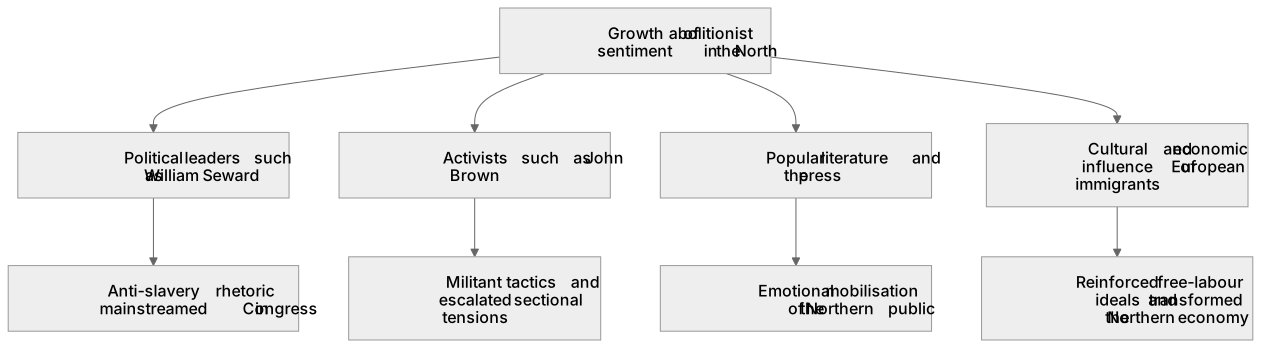
Label the diagram
Some boxes have lost their names. Pick the right name for each number.
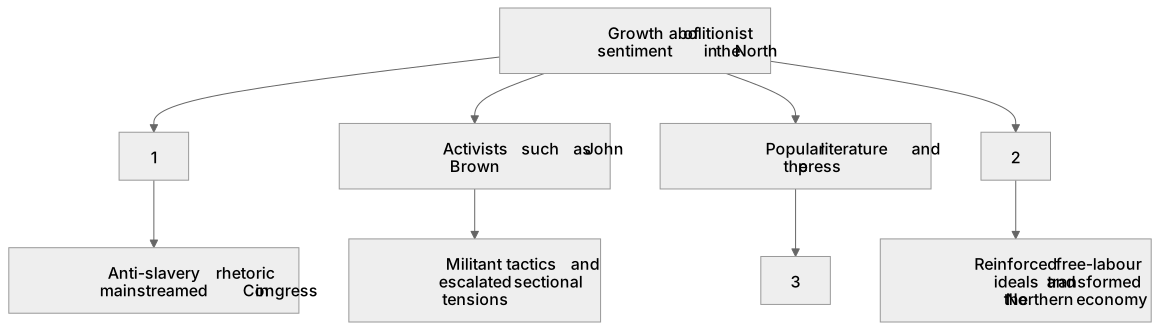
1Box 1
2Box 2
3Box 3
There is more to this lesson
The full lesson goes on to check your understanding and help you earn the marks. Create a free account to carry on, with your progress saved.
A week of Premium from your first lesson · Then the free plan continues · No card, no charge
Test your understanding of 2J America: A Nation Divided, c1845–1877 – Attempts to maintain the Union, c1845–1854: The growth of abolitionist sentiment in the North: political leaders such as William Seward; activists such as John Brown; popular literature and the press; the cultural and economic influence of European immigrants arriving in the northern states
Active recall beats re-reading. Take an instant quiz now to test what you’ve learned and lock it into long-term memory.
A week of Premium from your first lesson · Then the free plan continues · No card, no charge