AQA · A-Level · History
Course version: 7042 · Version from Sept 2017
A Nation Divided, c1845–1877 – Attempts to maintain the Union, c1845–1854:…
Full specification wording
2J America: A Nation Divided, c1845–1877 – Attempts to maintain the Union, c1845–1854: Westward expansion and its impact on North and South: the ideas of Manifest Destiny; controversy over the new territories acquired by victory over Mexico
The concept of Manifest Destiny—the belief that God ordained the United States to expand across North America—drove rapid westward expansion in the 1840s.
Checked against the AQA 7042 specification (opens in a new tab) on .
- Point 1 of 4
- 4 key terms
Study notes
From the checked teaching notes for this specification point.
The idea
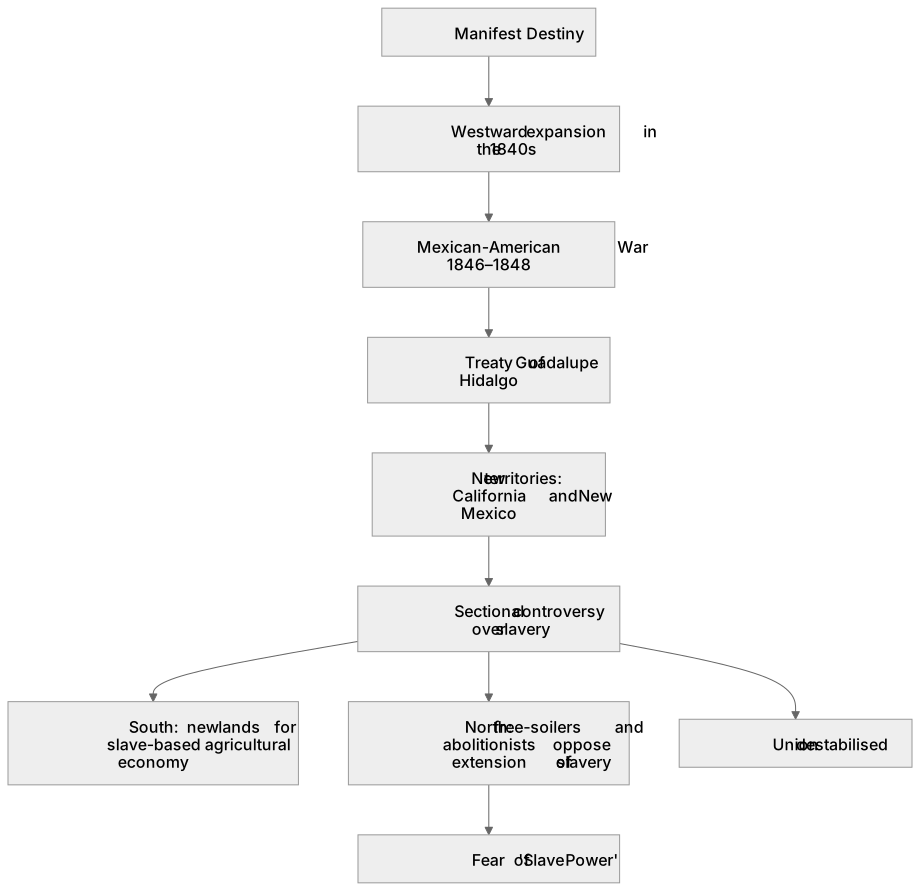
The concept of Manifest Destiny—the belief that God ordained the United States to expand across North America—drove rapid westward expansion in the 1840s. This expansion profoundly impacted both the North and South by reigniting debates over the spread of slavery. Following the US victory in the Mexican-American War (1846–1848), the Treaty of Guadalupe Hidalgo ceded vast new territories, including California and New Mexico, to the United States. This acquisition created intense sectional controversy. Southern politicians viewed the new lands as essential for the expansion of their slave-based agricultural economy, while Northern free-soilers and abolitionists fiercely opposed the extension of slavery, fearing the political dominance of a 'Slave Power'. This territorial dispute fundamentally destabilised the Union.
What earns the marks
- Explain the ideological roots of Manifest Destiny and its role in justifying the Mexican-American War.
- Analyse the differing economic and political motivations of the North and South regarding westward expansion.
- Evaluate the impact of the Treaty of Guadalupe Hidalgo and the Mexican Cession on sectional tensions.
- Assess how the acquisition of new territories disrupted the balance of power established by the Missouri Compromise.
Common mistakes and how to put them right
Assuming Manifest Destiny was exclusively a Southern ideology.
Put it right: Recognise that Manifest Destiny was a nationalistic concept supported by many Northerners, though they often envisioned the expansion of free labour rather than slavery.
Confusing the Mexican Cession with the Louisiana Purchase.
Put it right: Ensure you specifically discuss the territories acquired from Mexico in 1848, such as California and New Mexico, when addressing this period.
Stating that all Northerners opposed westward expansion.
Put it right: Clarify that most Northerners supported expansion but opposed the extension of slavery into the newly acquired territories.
Exam tips
- Use the term 'Slave Power' to describe Northern fears of disproportionate Southern political influence in the federal government.
- Link the ideological concept of Manifest Destiny directly to the practical political crises it caused regarding the admission of new states.
- When discussing the impact on the North and South, contrast the Southern desire for new plantation lands with the Northern free-soil movement.
Try the lesson
The start of the 2J America: A Nation Divided, c1845–1877 – Attempts to maintain the Union, c1845–1854: Westward expansion and its impact on North and South: the ideas of Manifest Destiny; controversy over the new territories acquired by victory over Mexico lesson, made from checked teaching notes for this specification point.
Have a go first
Which of the following best describes the core belief of 'Manifest Destiny' in the 1840s?
Listen
The concept of Manifest Destiny—the belief that God ordained the United States to expand across North America—drove rapid westward expansion in the 1840s. This expansion profoundly impacted both the North and South by reigniting debates over the spread of slavery. Following the US victory in the Mexican-American War (1846–1848), the Treaty of Guadalupe Hidalgo ceded vast new territories, including California and New Mexico, to the United States. This acquisition created intense sectional controversy. Southern politicians viewed the new lands as essential for the expansion of their slave-based agricultural economy, while Northern free-soilers and abolitionists fiercely opposed the extension of slavery, fearing the political dominance of a 'Slave Power'. This territorial dispute fundamentally destabilised the Union. A strong answer earns marks for these points. Explain the ideological roots of Manifest Destiny and its role in justifying the Mexican-American War. Analyse the differing economic and political motivations of the North and South regarding westward expansion. Evaluate the impact of the Treaty of Guadalupe Hidalgo and the Mexican Cession on sectional tensions. Assess how the acquisition of new territories disrupted the balance of power established by the Missouri Compromise. A common slip: Assuming Manifest Destiny was exclusively a Southern ideology. Instead, Recognise that Manifest Destiny was a nationalistic concept supported by many Northerners, though they often envisioned the expansion of free labour rather than slavery. Exam tip: Use the term 'Slave Power' to describe Northern fears of disproportionate Southern political influence in the federal government.
See it
Key words
Say what each word means before you turn the card.
Manifest Destiny
Try answering aloud or in your head before turning the card.
Sectional controversy
Try answering aloud or in your head before turning the card.
Slave Power
Try answering aloud or in your head before turning the card.
Free-soilers
Try answering aloud or in your head before turning the card.
See every definition
- Manifest Destiny
- The belief that God ordained the United States to expand across North America, driving rapid westward expansion in the 1840s.
- Sectional controversy
- Intense dispute between North and South created by the acquisition of vast new territories from Mexico, reigniting debates over the spread of slavery.
- Slave Power
- Northern fears of the disproportionate Southern political influence in the federal government that extension of slavery might bring.
- Free-soilers
- Northern opponents of the extension of slavery into the newly acquired territories, who supported expansion but not slavery within it.
Label the diagram
Some boxes have lost their names. Pick the right name for each number.
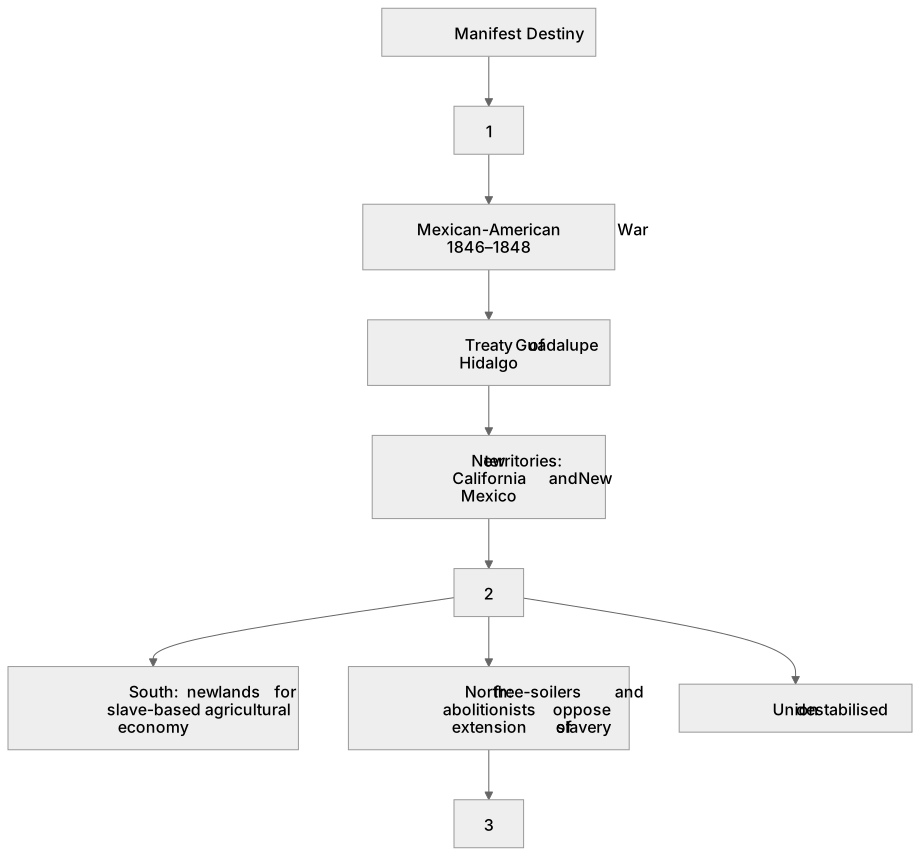
1Box 1
2Box 2
3Box 3
There is more to this lesson
The full lesson goes on to check your understanding and help you earn the marks. Create a free account to carry on, with your progress saved.
A week of Premium from your first lesson · Then the free plan continues · No card, no charge
Test your understanding of 2J America: A Nation Divided, c1845–1877 – Attempts to maintain the Union, c1845–1854: Westward expansion and its impact on North and South: the ideas of Manifest Destiny; controversy over the new territories acquired by victory over Mexico
Active recall beats re-reading. Take an instant quiz now to test what you’ve learned and lock it into long-term memory.
A week of Premium from your first lesson · Then the free plan continues · No card, no charge