AQA · A-Level · History
Course version: 7042 · Version from Sept 2017
A Nation Divided, c1845–1877 – Attempts to maintain the Union, c1845–1854:…
Full specification wording
2J America: A Nation Divided, c1845–1877 – Attempts to maintain the Union, c1845–1854: Attempts at political compromise: the Wilmot Proviso; the role of personalities such as Zachary Taylor, Stephen Douglas and Henry Clay; the Compromise of 1850; Texas and California; the Fugitive Slave Law
The Wilmot Proviso (1846) attempted to ban slavery in territories acquired from Mexico, sparking a crisis that necessitated political compromise.
Checked against the AQA 7042 specification (opens in a new tab) on .
- Point 2 of 4
- 3 key terms
Study notes
From the checked teaching notes for this specification point.
The idea
The Wilmot Proviso (1846) attempted to ban slavery in territories acquired from Mexico, sparking a crisis that necessitated political compromise. Henry Clay, the 'Great Pacificator', proposed an omnibus bill to resolve the status of California and Texas, but faced opposition from President Zachary Taylor, who wanted California admitted immediately as a free state. Following Taylor's death, Stephen Douglas successfully passed the Compromise of 1850 by breaking Clay's bill into separate measures. This admitted California as a free state, settled the Texas boundary dispute, and introduced a stringent Fugitive Slave Law. While the compromise temporarily preserved the Union, the harsh new Fugitive Slave Law deeply alienated Northerners, ultimately exacerbating the sectional divide it aimed to heal.
What earns the marks
- Explain the significance of the Wilmot Proviso in exposing the deep sectional divide over slavery in the territories.
- Evaluate the contrasting roles of Henry Clay in proposing the Compromise of 1850 and Stephen Douglas in successfully passing it.
- Analyse the impact of Zachary Taylor's presidency and his unexpected death on the passage of the compromise measures.
- Assess the specific provisions of the Compromise of 1850, particularly the admission of California and the Texas boundary settlement.
- Examine the profound Northern backlash against the Fugitive Slave Law and its role in increasing sectional hostility.
Common mistakes and how to put them right
Claiming the Wilmot Proviso became law.
Put it right: State clearly that the Wilmot Proviso passed the House of Representatives but repeatedly failed in the Senate, serving as a catalyst for debate rather than legislation.
Attributing the final passage of the Compromise of 1850 solely to Henry Clay.
Put it right: Emphasise that Stephen Douglas was responsible for passing the compromise by dividing Clay's failed omnibus bill into individual components.
Stating that the Compromise of 1850 permanently resolved sectional tensions.
Put it right: Argue that it was merely an armistice; the Fugitive Slave Law in particular inflamed Northern abolitionist sentiment and worsened long-term relations.
Exam tips
- Contrast the legislative strategies of Henry Clay (omnibus bill) and Stephen Douglas (individual bills) to demonstrate a nuanced understanding of congressional politics.
- Highlight the Fugitive Slave Law as the most controversial element of the Compromise of 1850, using it to explain why the compromise ultimately failed to prevent conflict.
- Discuss how the admission of California as a free state permanently tipped the balance of power in the Senate against the South.
Try the lesson
The start of the 2J America: A Nation Divided, c1845–1877 – Attempts to maintain the Union, c1845–1854: Attempts at political compromise: the Wilmot Proviso; the role of personalities such as Zachary Taylor, Stephen Douglas and Henry Clay; the Compromise of 1850; Texas and California; the Fugitive Slave Law lesson, made from checked teaching notes for this specification point.
Have a go first
What was the primary objective of the Wilmot Proviso introduced in Congress in 1846?
Listen
The Wilmot Proviso (1846) attempted to ban slavery in territories acquired from Mexico, sparking a crisis that necessitated political compromise. Henry Clay, the 'Great Pacificator', proposed an omnibus bill to resolve the status of California and Texas, but faced opposition from President Zachary Taylor, who wanted California admitted immediately as a free state. Following Taylor's death, Stephen Douglas successfully passed the Compromise of 1850 by breaking Clay's bill into separate measures. This admitted California as a free state, settled the Texas boundary dispute, and introduced a stringent Fugitive Slave Law. While the compromise temporarily preserved the Union, the harsh new Fugitive Slave Law deeply alienated Northerners, ultimately exacerbating the sectional divide it aimed to heal. A strong answer earns marks for these points. Explain the significance of the Wilmot Proviso in exposing the deep sectional divide over slavery in the territories. Evaluate the contrasting roles of Henry Clay in proposing the Compromise of 1850 and Stephen Douglas in successfully passing it. Analyse the impact of Zachary Taylor's presidency and his unexpected death on the passage of the compromise measures. Assess the specific provisions of the Compromise of 1850, particularly the admission of California and the Texas boundary settlement. A common slip: Claiming the Wilmot Proviso became law. Instead, State clearly that the Wilmot Proviso passed the House of Representatives but repeatedly failed in the Senate, serving as a catalyst for debate rather than legislation. Exam tip: Contrast the legislative strategies of Henry Clay (omnibus bill) and Stephen Douglas (individual bills) to demonstrate a nuanced understanding of congressional politics.
See it
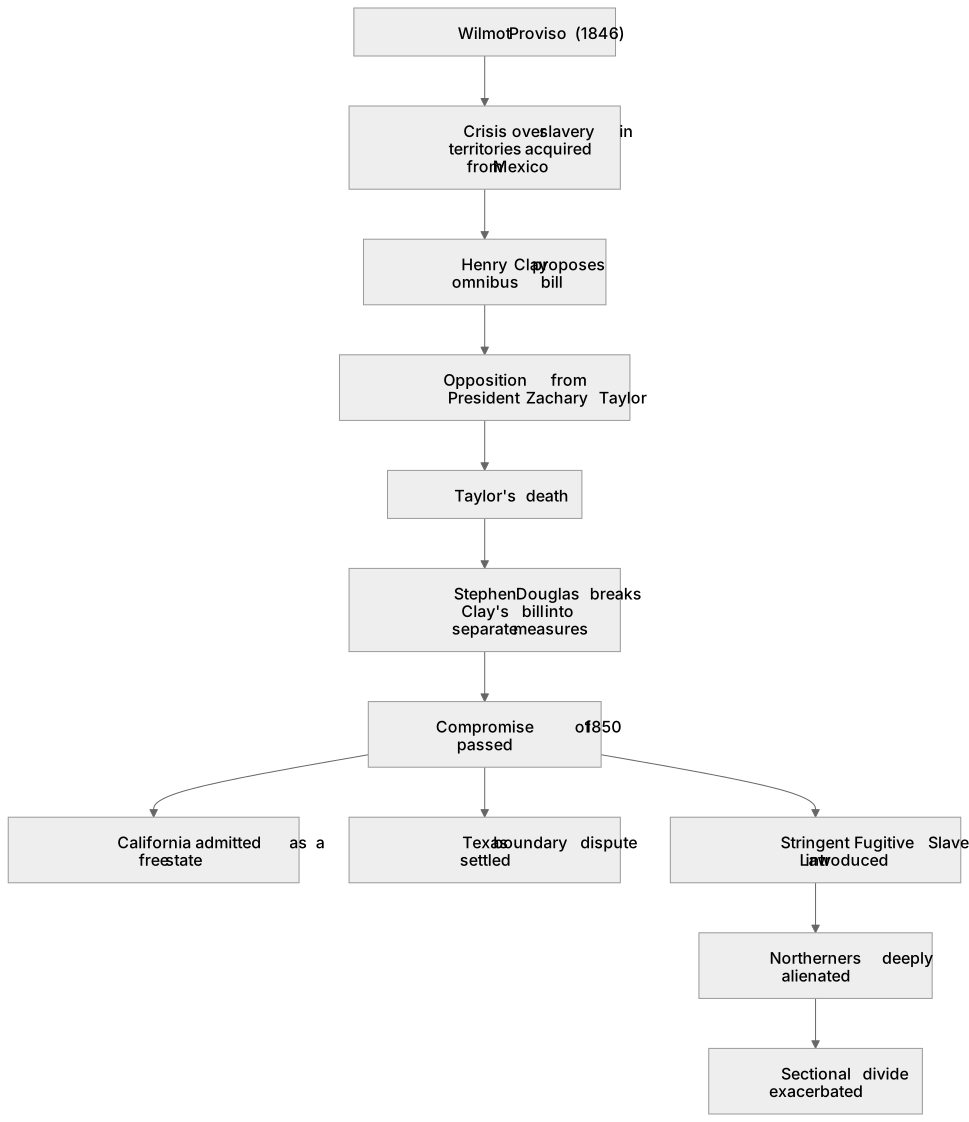
Key words
Say what each word means before you turn the card.
Compromise and Conflict
Try answering aloud or in your head before turning the card.
Slavery and Abolitionism
Try answering aloud or in your head before turning the card.
Political Leadership
Try answering aloud or in your head before turning the card.
See every definition
- Compromise and Conflict
- Political compromise was attempted through measures such as the Compromise of 1850, yet the harsh new Fugitive Slave Law deeply alienated Northerners and exacerbated the sectional divide it aimed to heal.
- Slavery and Abolitionism
- The Wilmot Proviso attempted to ban slavery in territories acquired from Mexico, sparking a crisis that necessitated political compromise.
- Political Leadership
- Henry Clay proposed an omnibus bill, Zachary Taylor opposed it wanting California admitted immediately as a free state, and Stephen Douglas passed the Compromise of 1850 by breaking Clay's bill into separate measures.
Label the diagram
Some boxes have lost their names. Pick the right name for each number.
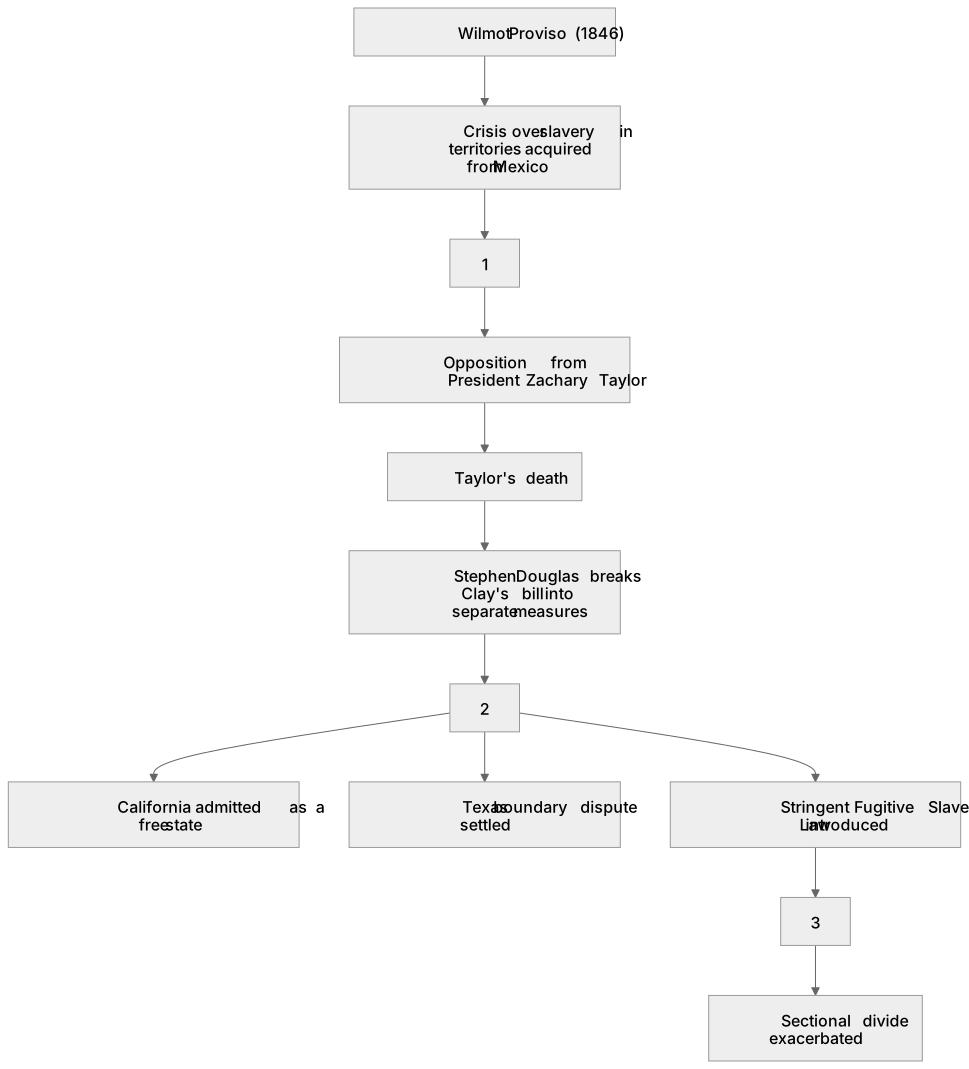
1Box 1
2Box 2
3Box 3
There is more to this lesson
The full lesson goes on to check your understanding and help you earn the marks. Create a free account to carry on, with your progress saved.
A week of Premium from your first lesson · Then the free plan continues · No card, no charge
Test your understanding of 2J America: A Nation Divided, c1845–1877 – Attempts to maintain the Union, c1845–1854: Attempts at political compromise: the Wilmot Proviso; the role of personalities such as Zachary Taylor, Stephen Douglas and Henry Clay; the Compromise of 1850; Texas and California; the Fugitive Slave Law
Active recall beats re-reading. Take an instant quiz now to test what you’ve learned and lock it into long-term memory.
A week of Premium from your first lesson · Then the free plan continues · No card, no charge