AQA · A-Level · History
Course version: 7042 · Version from Sept 2017
A Nation Divided, c1845–1877 – Radical Reconstruction, 1867–1877 (A-level…
Full specification wording
2J America: A Nation Divided, c1845–1877 – Radical Reconstruction, 1867–1877 (A-level only): Resistance to Radical Reconstruction in the South: Southern Democrats and ‘Redeemers’; the Ku Klux Klan; the issue of voter registration
Resistance to Radical Reconstruction in the South was multifaceted, driven by a desire to restore white supremacy.
Checked against the AQA 7042 specification (opens in a new tab) on .
- Point 3 of 4
Study notes
From the checked teaching notes for this specification point.
The idea
Resistance to Radical Reconstruction in the South was multifaceted, driven by a desire to restore white supremacy. Southern Democrats, often styling themselves as 'Redeemers', sought to oust Republican coalition governments and 'redeem' their states from perceived northern and African-American dominance. This political resistance was brutally enforced by paramilitary groups like the Ku Klux Klan, who used terror, lynching, and intimidation to suppress Republican support. A central battleground was the issue of voter registration; despite the Fifteenth Amendment, white southerners employed violence, economic coercion, and later legislative loopholes to prevent African-Americans from registering and exercising their newly granted franchise, effectively undermining Radical Reconstruction.
What earns the marks
- Explain the political aims of the 'Redeemers' in dismantling Republican state governments in the South.
- Analyse the methods used by the Ku Klux Klan, including violence and intimidation, to suppress the African-American and white Republican vote.
- Evaluate the effectiveness of Southern Democratic resistance in regaining political control of southern states by the mid-1870s.
- Assess the specific tactics used to obstruct African-American voter registration, such as physical threats at polls and economic blackmail by white employers.
Common mistakes and how to put them right
Confusing 'Redeemers' with Radical Republicans.
Put it right: Redeemers were conservative Southern Democrats seeking to end Reconstruction, not enforce it.
Stating that African-Americans completely stopped voting immediately after the Civil War.
Put it right: They voted in large numbers during early Radical Reconstruction until resistance and intimidation severely curtailed their registration.
Exam tips
- Use specific examples of Klan violence, such as the Colfax Massacre, to illustrate the extreme nature of resistance to voter registration.
- Link the political goals of the Southern Democrats directly to the violent methods of the KKK to show how political and social resistance intertwined.
- When discussing voter registration, explicitly mention the Fifteenth Amendment to demonstrate understanding of the constitutional context being resisted.
Try the lesson
The start of the 2J America: A Nation Divided, c1845–1877 – Radical Reconstruction, 1867–1877 (A-level only): Resistance to Radical Reconstruction in the South: Southern Democrats and ‘Redeemers’; the Ku Klux Klan; the issue of voter registration lesson, made from checked teaching notes for this specification point.
Have a go first
What was the primary political goal of the Southern 'Redeemers' during the period of Radical Reconstruction?
Listen
Resistance to Radical Reconstruction in the South was multifaceted, driven by a desire to restore white supremacy. Southern Democrats, often styling themselves as 'Redeemers', sought to oust Republican coalition governments and 'redeem' their states from perceived northern and African-American dominance. This political resistance was brutally enforced by paramilitary groups like the Ku Klux Klan, who used terror, lynching, and intimidation to suppress Republican support. A central battleground was the issue of voter registration; despite the Fifteenth Amendment, white southerners employed violence, economic coercion, and later legislative loopholes to prevent African-Americans from registering and exercising their newly granted franchise, effectively undermining Radical Reconstruction. A strong answer earns marks for these points. Explain the political aims of the 'Redeemers' in dismantling Republican state governments in the South. Analyse the methods used by the Ku Klux Klan, including violence and intimidation, to suppress the African-American and white Republican vote. Evaluate the effectiveness of Southern Democratic resistance in regaining political control of southern states by the mid-1870s. Assess the specific tactics used to obstruct African-American voter registration, such as physical threats at polls and economic blackmail by white employers. Exam tip: Use specific examples of Klan violence, such as the Colfax Massacre, to illustrate the extreme nature of resistance to voter registration.
See it
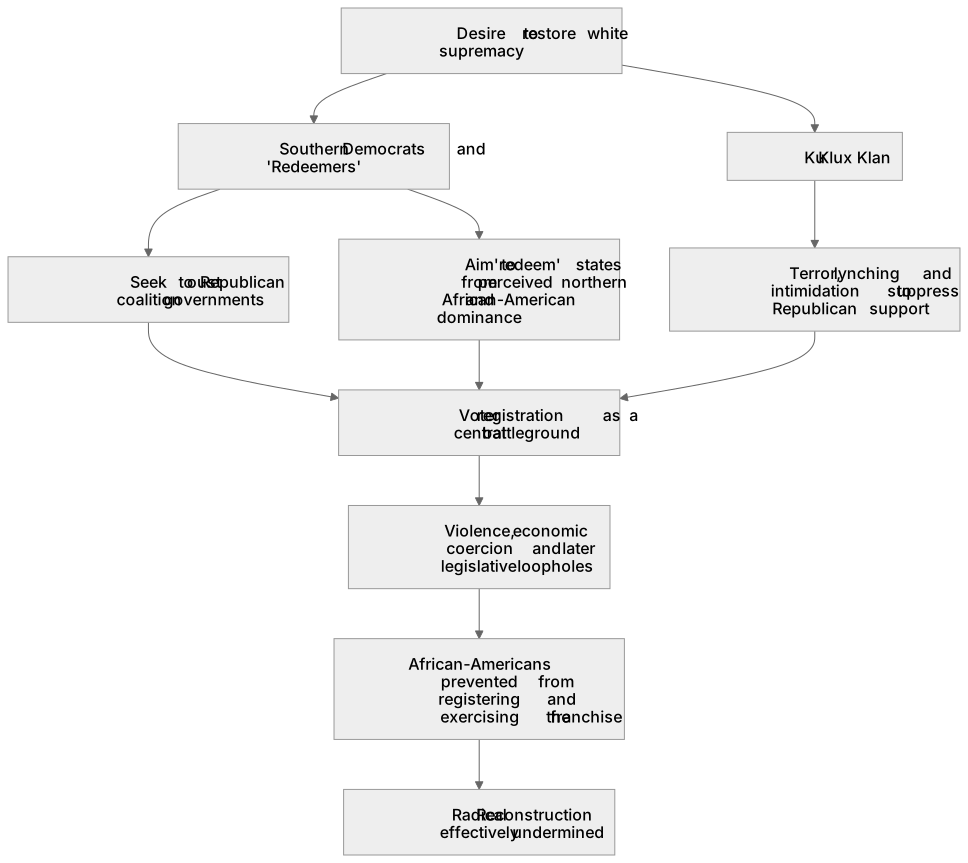
Label the diagram
Some boxes have lost their names. Pick the right name for each number.
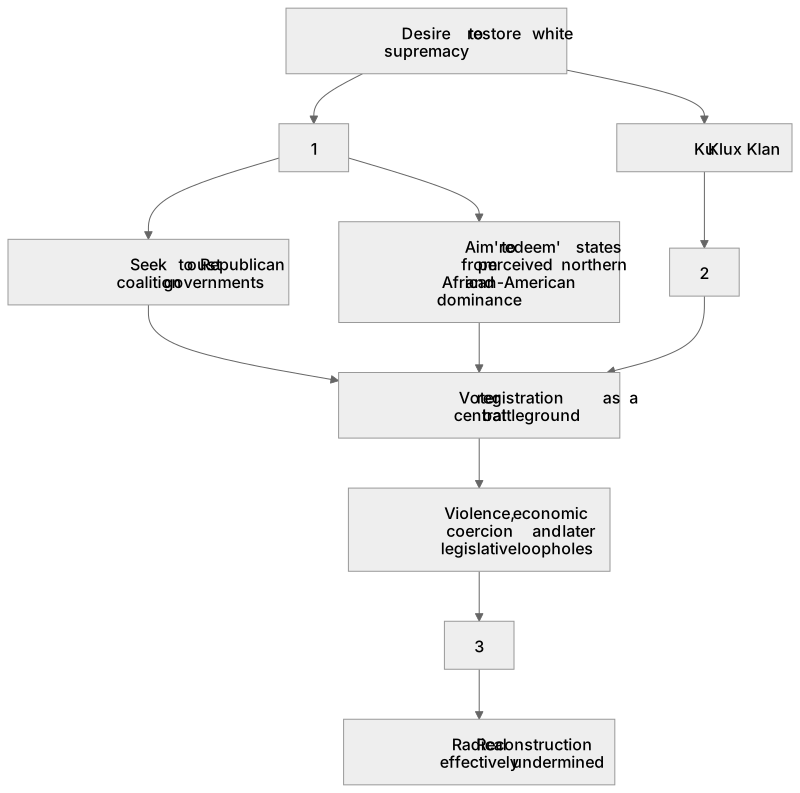
1Box 1
2Box 2
3Box 3
There is more to this lesson
The full lesson goes on to check your understanding and help you earn the marks. Create a free account to carry on, with your progress saved.
A week of Premium from your first lesson · Then the free plan continues · No card, no charge
Test your understanding of 2J America: A Nation Divided, c1845–1877 – Radical Reconstruction, 1867–1877 (A-level only): Resistance to Radical Reconstruction in the South: Southern Democrats and ‘Redeemers’; the Ku Klux Klan; the issue of voter registration
Active recall beats re-reading. Take an instant quiz now to test what you’ve learned and lock it into long-term memory.
A week of Premium from your first lesson · Then the free plan continues · No card, no charge