AQA · A-Level · History
Course version: 7042 · Version from Sept 2017
A Nation Divided, c1845–1877 – The outbreak of Civil War, 1854–1861:…
Full specification wording
2J America: A Nation Divided, c1845–1877 – The outbreak of Civil War, 1854–1861: ‘Bleeding Kansas’: the de-stabilisation of the balance between North and South
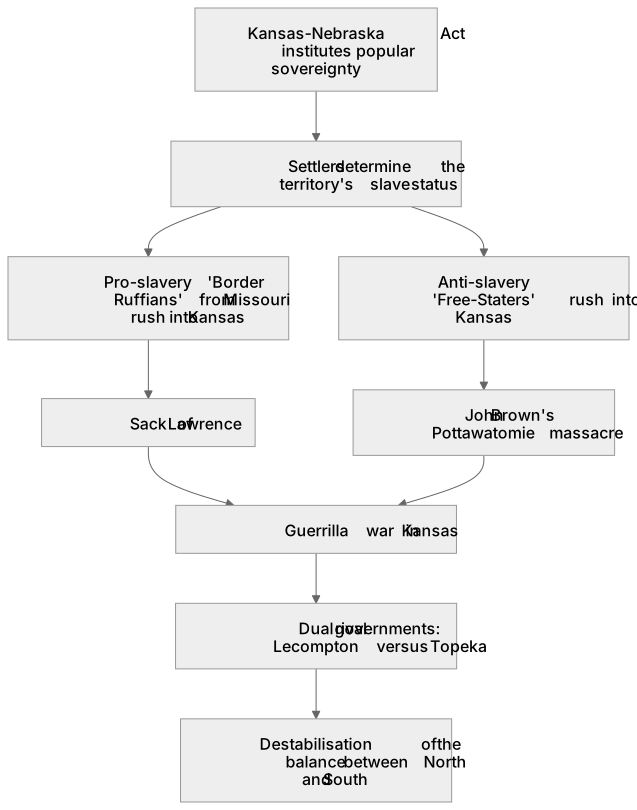
‘Bleeding Kansas’ (1854–1859) erupted when the Kansas-Nebraska Act instituted popular sovereignty, allowing settlers to determine the territory's slave status.
Checked against the AQA 7042 specification (opens in a new tab) on .
- Point 1 of 4
- 3 key terms
Study notes
From the checked teaching notes for this specification point.
The idea
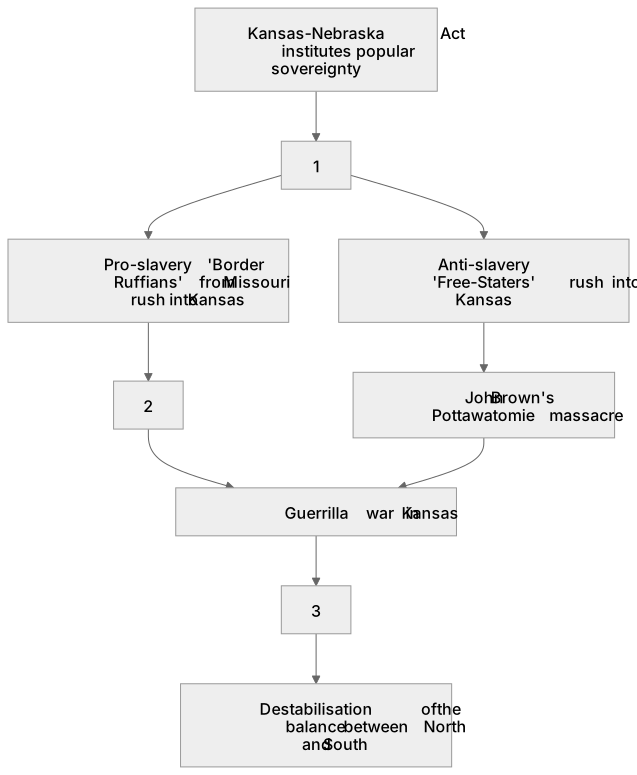
‘Bleeding Kansas’ (1854–1859) erupted when the Kansas-Nebraska Act instituted popular sovereignty, allowing settlers to determine the territory's slave status. This triggered a rush of pro-slavery 'Border Ruffians' from Missouri and anti-slavery 'Free-Staters' into Kansas, leading to violent clashes such as the Sack of Lawrence and John Brown's Pottawatomie massacre. This guerrilla war fatally destabilised the delicate political balance between the North and South. It shattered the illusion that popular sovereignty could peacefully resolve the slavery expansion debate, radicalised both sections, and provided potent propaganda that accelerated the breakdown of national political relations, pushing the nation closer to civil war.
What earns the marks
- Explain the concept of popular sovereignty and how it directly caused the influx of rival factions into Kansas.
- Detail specific violent events, such as the Sack of Lawrence by pro-slavery forces and the retaliatory Pottawatomie massacre by John Brown.
- Analyse how the existence of dual, rival governments in Kansas (Lecompton versus Topeka) exacerbated national political divisions.
- Evaluate the impact of 'Bleeding Kansas' on the national balance of power, specifically how it fuelled sectionalism and deepened the divide between Northern Republicans and Southern Democrats.
Common mistakes and how to put them right
Claiming 'Bleeding Kansas' was a formal military conflict between the Union and the Confederacy.
Put it right: Describe it as a localised guerrilla conflict between pro-slavery and anti-slavery settlers prior to the Civil War.
Stating that Kansas immediately entered the Union as a slave state.
Put it right: Note that Kansas experienced years of disputed territorial governments before finally being admitted as a free state in 1861.
Attributing the collapse of the Whig Party to 'Bleeding Kansas'.
Put it right: Clarify that the Whig Party collapsed primarily due to the Kansas-Nebraska Act of 1854, before the worst violence in Kansas occurred.
Exam tips
- Use specific examples of violence, like the Pottawatomie massacre, to illustrate the failure of popular sovereignty.
- Link the events in Kansas to the wider national political destabilisation, showing how local violence inflamed national sectional tensions.
- Discuss the role of the press in exaggerating the violence, which further polarised Northern and Southern public opinion.
Try the lesson
The start of the 2J America: A Nation Divided, c1845–1877 – The outbreak of Civil War, 1854–1861: ‘Bleeding Kansas’: the de-stabilisation of the balance between North and South lesson, made from checked teaching notes for this specification point.
Have a go first
Which aspect of the events known as 'Bleeding Kansas' most directly contributed to the de-stabilisation of the political balance between the North and the South?
Listen
Bleeding Kansas’ (1854–1859) erupted when the Kansas-Nebraska Act instituted popular sovereignty, allowing settlers to determine the territory's slave status. This triggered a rush of pro-slavery 'Border Ruffians' from Missouri and anti-slavery 'Free-Staters' into Kansas, leading to violent clashes such as the Sack of Lawrence and John Brown's Pottawatomie massacre. This guerrilla war fatally destabilised the delicate political balance between the North and South. It shattered the illusion that popular sovereignty could peacefully resolve the slavery expansion debate, radicalised both sections, and provided potent propaganda that accelerated the breakdown of national political relations, pushing the nation closer to civil war. A strong answer earns marks for these points. Explain the concept of popular sovereignty and how it directly caused the influx of rival factions into Kansas. Detail specific violent events, such as the Sack of Lawrence by pro-slavery forces and the retaliatory Pottawatomie massacre by John Brown. Analyse how the existence of dual, rival governments in Kansas (Lecompton versus Topeka) exacerbated national political divisions. Evaluate the impact of 'Bleeding Kansas' on the national balance of power, specifically how it fuelled sectionalism and deepened the divide between Northern Republicans and Southern Democrats. A common slip: Claiming 'Bleeding Kansas' was a formal military conflict between the Union and the Confederacy. Instead, Describe it as a localised guerrilla conflict between pro-slavery and anti-slavery settlers prior to the Civil War. Exam tip: Use specific examples of violence, like the Pottawatomie massacre, to illustrate the failure of popular sovereignty.
See it
Key words
Say what each word means before you turn the card.
Popular Sovereignty
Try answering aloud or in your head before turning the card.
Sectionalism
Try answering aloud or in your head before turning the card.
Political Violence
Try answering aloud or in your head before turning the card.
See every definition
- Popular Sovereignty
- A principle instituted by the Kansas-Nebraska Act allowing settlers to determine the territory's slave status.
- Sectionalism
- The deepening divide between the North and South that 'Bleeding Kansas' fuelled.
- Political Violence
- Violent clashes such as the Sack of Lawrence and John Brown's Pottawatomie massacre between pro-slavery and anti-slavery settlers.
Label the diagram
Some boxes have lost their names. Pick the right name for each number.
1Box 1
2Box 2
3Box 3
There is more to this lesson
The full lesson goes on to check your understanding and help you earn the marks. Create a free account to carry on, with your progress saved.
A week of Premium from your first lesson · Then the free plan continues · No card, no charge
Test your understanding of 2J America: A Nation Divided, c1845–1877 – The outbreak of Civil War, 1854–1861: ‘Bleeding Kansas’: the de-stabilisation of the balance between North and South
Active recall beats re-reading. Take an instant quiz now to test what you’ve learned and lock it into long-term memory.
A week of Premium from your first lesson · Then the free plan continues · No card, no charge