AQA · A-Level · History
Course version: 7042 · Version from Sept 2017
A Nation Divided, c1845–1877 – The outbreak of Civil War, 1854–1861: The…
Full specification wording
2J America: A Nation Divided, c1845–1877 – The outbreak of Civil War, 1854–1861: The emergence of the Republican Party: the political impact of the controversy over the Kansas-Nebraska Act; the spread of Republican parties across northern states; the elections of 1856; key personalities including Lincoln, Seward and Chase
The Republican Party emerged in 1854 as a direct political impact of the Kansas-Nebraska Act, which outraged Northerners by repealing the Missouri Compromise.
Checked against the AQA 7042 specification (opens in a new tab) on .
- Point 2 of 4
Study notes
From the checked teaching notes for this specification point.
The idea
The Republican Party emerged in 1854 as a direct political impact of the Kansas-Nebraska Act, which outraged Northerners by repealing the Missouri Compromise. Formed as a coalition of former Whigs, Free-Soilers, and anti-slavery Democrats, the party rapidly spread across northern states, uniting behind a 'Free Soil, Free Labor, Free Men' ideology. In the 1856 elections, Republican candidate John C. Frémont performed strongly, demonstrating the party's viability as a purely sectional Northern force. Key personalities shaped its trajectory: William H. Seward provided prominent leadership, Salmon P. Chase articulated its anti-slavery constitutional arguments, and Abraham Lincoln emerged as a moderate, unifying voice against slavery's expansion.
What earns the marks
- Explain how the passage of the Kansas-Nebraska Act acted as the catalyst for the formation of the Republican Party.
- Trace the rapid spread of the Republican Party across northern states as a sectional response to perceived 'Slave Power' aggression.
- Analyse the significance of the 1856 presidential election, noting how Frémont's success established the Republicans as the main rival to the Democrats.
- Assess the distinct contributions of key personalities: Seward's radical reputation, Chase's legal arguments, and Lincoln's moderate appeal.
Common mistakes and how to put them right
Asserting that the early Republican Party campaigned for the immediate abolition of slavery everywhere.
Put it right: Clarify that their primary platform was 'Free Soil'—preventing the expansion of slavery into new western territories.
Confusing the roles of Seward, Chase, and Lincoln in the 1850s.
Put it right: Distinguish Seward as the early frontrunner and radical voice, Chase as the staunch anti-slavery advocate, and Lincoln as the rising moderate.
Stating the Republicans won the 1856 election.
Put it right: Note that Democrat James Buchanan won in 1856, but the Republicans' strong showing proved they were a formidable Northern political force.
Exam tips
- Emphasise the Republican Party's nature as a purely sectional party, contrasting it with the national appeal of the Democrats.
- When discussing the 1856 election, focus on the electoral map to demonstrate the stark geographical divide between the North and South.
- Use the differing views of Lincoln, Seward, and Chase to demonstrate that the early Republican Party was a broad coalition rather than a monolithic group.
Try the lesson
The start of the 2J America: A Nation Divided, c1845–1877 – The outbreak of Civil War, 1854–1861: The emergence of the Republican Party: the political impact of the controversy over the Kansas-Nebraska Act; the spread of Republican parties across northern states; the elections of 1856; key personalities including Lincoln, Seward and Chase lesson, made from checked teaching notes for this specification point.
Have a go first
Which legislative event served as the primary catalyst for the emergence of the Republican Party across northern states?
Listen
The Republican Party emerged in 1854 as a direct political impact of the Kansas-Nebraska Act, which outraged Northerners by repealing the Missouri Compromise. Formed as a coalition of former Whigs, Free-Soilers, and anti-slavery Democrats, the party rapidly spread across northern states, uniting behind a 'Free Soil, Free Labor, Free Men' ideology. In the 1856 elections, Republican candidate John C. Frémont performed strongly, demonstrating the party's viability as a purely sectional Northern force. Key personalities shaped its trajectory: William H. Seward provided prominent leadership, Salmon P. Chase articulated its anti-slavery constitutional arguments, and Abraham Lincoln emerged as a moderate, unifying voice against slavery's expansion. A strong answer earns marks for these points. Explain how the passage of the Kansas-Nebraska Act acted as the catalyst for the formation of the Republican Party. Trace the rapid spread of the Republican Party across northern states as a sectional response to perceived 'Slave Power' aggression. Analyse the significance of the 1856 presidential election, noting how Frémont's success established the Republicans as the main rival to the Democrats. Assess the distinct contributions of key personalities: Seward's radical reputation, Chase's legal arguments, and Lincoln's moderate appeal. A common slip: Asserting that the early Republican Party campaigned for the immediate abolition of slavery everywhere. Instead, Clarify that their primary platform was 'Free Soil'—preventing the expansion of slavery into new western territories. Exam tip: Emphasise the Republican Party's nature as a purely sectional party, contrasting it with the national appeal of the Democrats.
See it
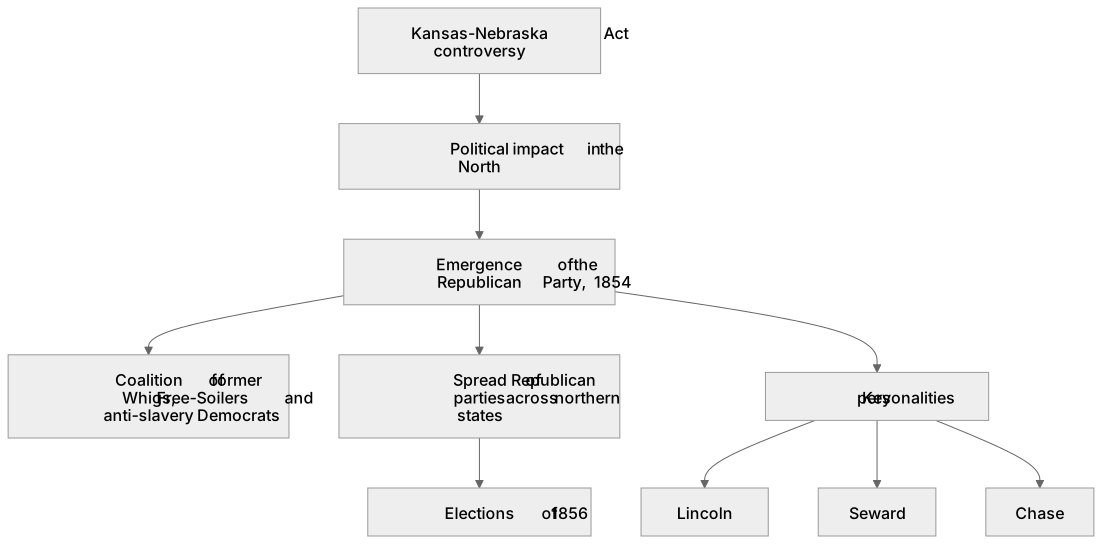
Label the diagram
Some boxes have lost their names. Pick the right name for each number.
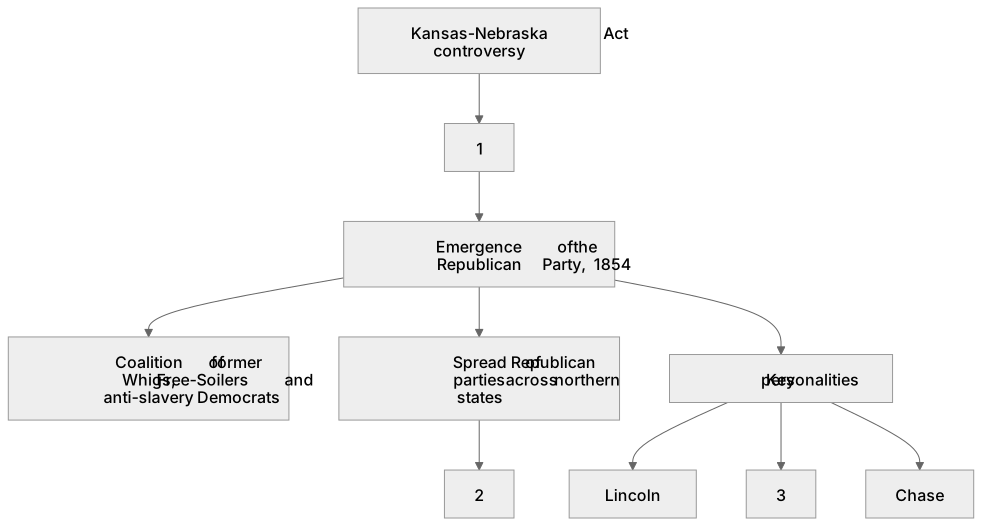
1Box 1
2Box 2
3Box 3
There is more to this lesson
The full lesson goes on to check your understanding and help you earn the marks. Create a free account to carry on, with your progress saved.
A week of Premium from your first lesson · Then the free plan continues · No card, no charge
Test your understanding of 2J America: A Nation Divided, c1845–1877 – The outbreak of Civil War, 1854–1861: The emergence of the Republican Party: the political impact of the controversy over the Kansas-Nebraska Act; the spread of Republican parties across northern states; the elections of 1856; key personalities including Lincoln, Seward and Chase
Active recall beats re-reading. Take an instant quiz now to test what you’ve learned and lock it into long-term memory.
A week of Premium from your first lesson · Then the free plan continues · No card, no charge