AQA · A-Level · History
Course version: 7042 · Version from Sept 2017
A Nation Divided, c1845–1877 – The outbreak of Civil War, 1854–1861: The…
Full specification wording
2J America: A Nation Divided, c1845–1877 – The outbreak of Civil War, 1854–1861: The drive for secession of the South: the presidential election of 1860; southern political leaders and proclamation of the Confederacy; outbreak of hostilities
The drive for Southern secession culminated with the pivotal presidential election of 1860.
Checked against the AQA 7042 specification (opens in a new tab) on .
- Point 4 of 4
- 4 key terms
Study notes
From the checked teaching notes for this specification point.
The idea
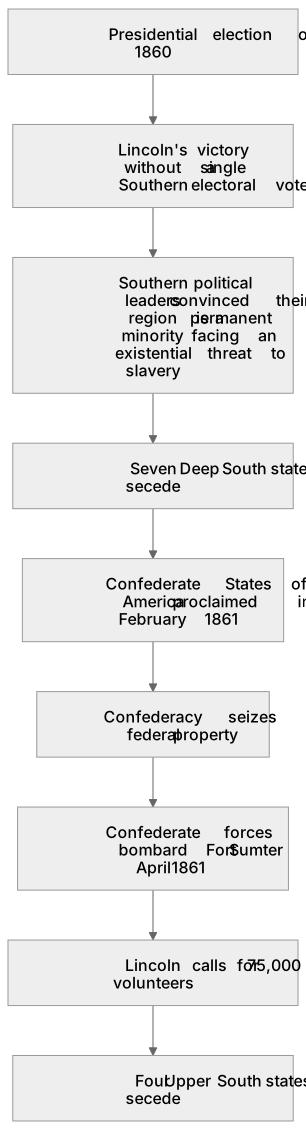
The drive for Southern secession culminated with the pivotal presidential election of 1860. Abraham Lincoln’s victory, achieved without a single Southern electoral vote, convinced Southern political leaders that their region had become a permanent minority facing an existential threat to slavery. Led by 'fire-eaters' and prominent figures like Jefferson Davis, seven Deep South states seceded, proclaiming the Confederate States of America in February 1861. The crisis escalated as the Confederacy seized federal property. The final outbreak of hostilities occurred in April 1861 when Confederate forces bombarded Fort Sumter in South Carolina, prompting Lincoln to call for 75,000 volunteers, which subsequently drove four Upper South states to secede.
What earns the marks
- Analyse the electoral map of the 1860 presidential election to demonstrate the purely sectional nature of Lincoln's victory.
- Evaluate the motivations and rhetoric of Southern political leaders in justifying secession as a defence of states' rights and slavery.
- Detail the formation of the Confederacy in Montgomery, including the drafting of its constitution and the election of Jefferson Davis.
- Examine the sequence of events leading to the outbreak of hostilities at Fort Sumter and the failure of last-minute compromises like the Crittenden Compromise.
Common mistakes and how to put them right
Stating that all slave states seceded immediately after Lincoln's election.
Put it right: Four Upper South states only seceded after the outbreak of hostilities at Fort Sumter.
Claiming Lincoln campaigned on the immediate abolition of slavery.
Put it right: His 1860 platform only opposed the expansion of slavery into new territories.
Confusing the initial Confederacy of seven states with the final Confederacy of eleven states.
Put it right: The distinction is crucial for understanding the timeline of secession.
Exam tips
- Emphasise the demographic and electoral shifts that made a Republican victory possible in 1860 without Southern support.
- Analyse the secession ordinances of the Deep South states to provide primary evidence that the protection of slavery was the central motive.
- Discuss Lincoln's strategic handling of the Fort Sumter crisis, forcing the Confederacy to fire the first shots of the war.
Try the lesson
The start of the 2J America: A Nation Divided, c1845–1877 – The outbreak of Civil War, 1854–1861: The drive for secession of the South: the presidential election of 1860; southern political leaders and proclamation of the Confederacy; outbreak of hostilities lesson, made from checked teaching notes for this specification point.
Have a go first
Which outcome of the 1860 presidential election served as the immediate catalyst for the secession of the first seven Southern states?
Listen
The drive for Southern secession culminated with the pivotal presidential election of 1860. Abraham Lincoln’s victory, achieved without a single Southern electoral vote, convinced Southern political leaders that their region had become a permanent minority facing an existential threat to slavery. Led by 'fire-eaters' and prominent figures like Jefferson Davis, seven Deep South states seceded, proclaiming the Confederate States of America in February 1861. The crisis escalated as the Confederacy seized federal property. The final outbreak of hostilities occurred in April 1861 when Confederate forces bombarded Fort Sumter in South Carolina, prompting Lincoln to call for 75,000 volunteers, which subsequently drove four Upper South states to secede. A strong answer earns marks for these points. Analyse the electoral map of the 1860 presidential election to demonstrate the purely sectional nature of Lincoln's victory. Evaluate the motivations and rhetoric of Southern political leaders in justifying secession as a defence of states' rights and slavery. Detail the formation of the Confederacy in Montgomery, including the drafting of its constitution and the election of Jefferson Davis. Examine the sequence of events leading to the outbreak of hostilities at Fort Sumter and the failure of last-minute compromises like the Crittenden Compromise. Exam tip: Emphasise the demographic and electoral shifts that made a Republican victory possible in 1860 without Southern support.
See it
Key words
Say what each word means before you turn the card.
Secession and States' Rights
Try answering aloud or in your head before turning the card.
Leadership and Decision Making
Try answering aloud or in your head before turning the card.
Outbreak of War
Try answering aloud or in your head before turning the card.
Electoral Politics
Try answering aloud or in your head before turning the card.
See every definition
- Secession and States' Rights
- The drive for the South to leave the Union, justified by Southern political leaders as a defence of states' rights and slavery.
- Leadership and Decision Making
- The role of Southern political leaders, including 'fire-eaters' and prominent figures like Jefferson Davis, in orchestrating secession and forming the Confederacy.
- Outbreak of War
- The final outbreak of hostilities in April 1861 when Confederate forces bombarded Fort Sumter, prompting Lincoln to call for volunteers.
- Electoral Politics
- The pivotal presidential election of 1860, in which Lincoln's victory without a single Southern electoral vote convinced Southern leaders they were a permanent minority.
Label the diagram
Some boxes have lost their names. Pick the right name for each number.
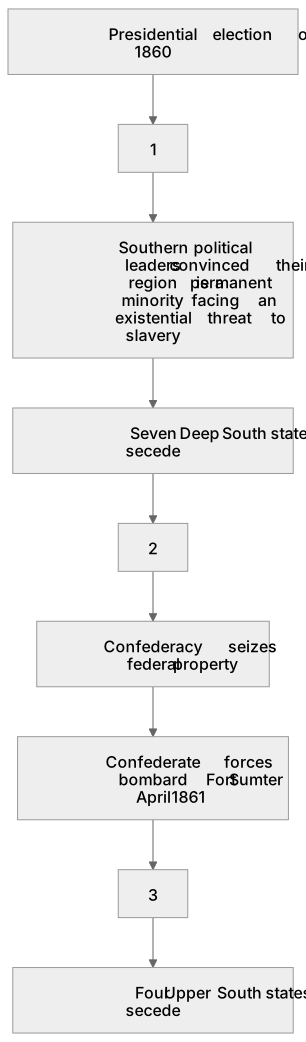
1Box 1
2Box 2
3Box 3
There is more to this lesson
The full lesson goes on to check your understanding and help you earn the marks. Create a free account to carry on, with your progress saved.
A week of Premium from your first lesson · Then the free plan continues · No card, no charge
Test your understanding of 2J America: A Nation Divided, c1845–1877 – The outbreak of Civil War, 1854–1861: The drive for secession of the South: the presidential election of 1860; southern political leaders and proclamation of the Confederacy; outbreak of hostilities
Active recall beats re-reading. Take an instant quiz now to test what you’ve learned and lock it into long-term memory.
A week of Premium from your first lesson · Then the free plan continues · No card, no charge