AQA · A-Level · History
Course version: 7042 · Version from Sept 2017
A Nation Divided, c1845–1877 – The outbreak of Civil War, 1854–1861:…
Full specification wording
2J America: A Nation Divided, c1845–1877 – The outbreak of Civil War, 1854–1861: Hardening of positions: the Dred Scott decision; the Lincoln-Douglas debates; Harper’s Ferry; local conflicts; the split in the Democratic Party
Between 1857 and 1860, sectional tensions hardened irreversibly.
Checked against the AQA 7042 specification (opens in a new tab) on .
- Point 3 of 4
Study notes
From the checked teaching notes for this specification point.
The idea
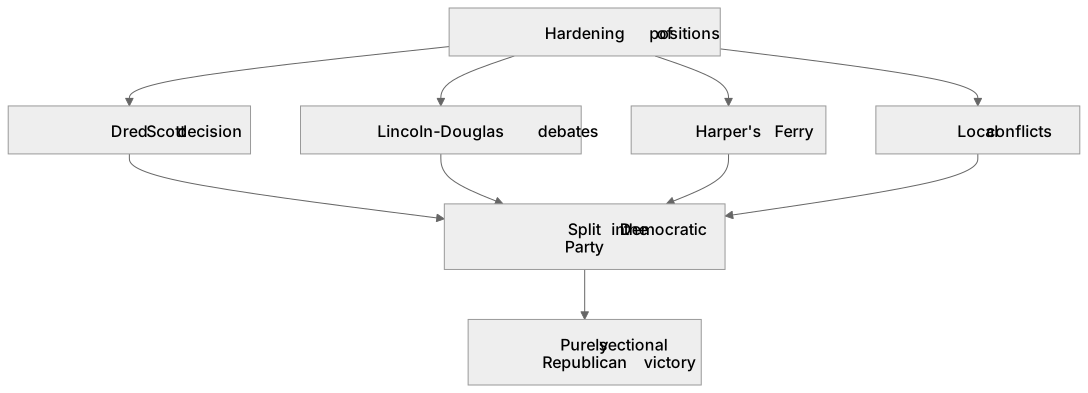
Between 1857 and 1860, sectional tensions hardened irreversibly. The 1857 Dred Scott Supreme Court decision outraged Northerners by ruling that Congress could not ban slavery in territories and that African Americans were not citizens. The 1858 Lincoln-Douglas debates elevated Abraham Lincoln to national prominence, highlighting the moral divide over slavery's expansion. John Brown’s 1859 raid on Harper’s Ferry terrified the South, convincing many that Northerners actively sought violent slave rebellions. Meanwhile, local conflicts like 'Bleeding Kansas' demonstrated the failure of popular sovereignty, normalising violence. Ultimately, the ideological chasm caused the split in the Democratic Party in 1860, destroying the last national political institution and paving the way for a purely sectional Republican victory.
What earns the marks
- Explain the constitutional implications of the Dred Scott decision and its impact on the Missouri Compromise.
- Analyse the Freeport Doctrine from the Lincoln-Douglas debates and its role in alienating Southern Democrats from Stephen Douglas.
- Evaluate the psychological impact of John Brown's raid on Harper's Ferry on Southern fears of Northern-sponsored abolitionist terrorism.
- Assess how local conflicts, particularly the ongoing violence in Kansas, undermined trust in democratic compromises.
- Trace the fragmentation of the Democratic Party at the 1860 Charleston and Baltimore conventions into Northern and Southern factions.
Common mistakes and how to put them right
Claiming the Lincoln-Douglas debates were for the presidency.
Put it right: They were actually for the 1858 Illinois Senate seat.
Stating that John Brown's raid was a military success.
Put it right: It was a tactical failure but a massive ideological catalyst.
Assuming the Democratic Party split solely over Lincoln's election.
Put it right: The split occurred before the election, largely over the federal slave code and popular sovereignty.
Exam tips
- Link the Dred Scott decision to the rise of the 'Slave Power conspiracy' narrative in the North.
- Use the Lincoln-Douglas debates to demonstrate how moderate positions on slavery became increasingly untenable.
- When discussing Harper's Ferry, contrast the Northern mourning of John Brown with the Southern outrage to highlight the cultural schism.
Try the lesson
The start of the 2J America: A Nation Divided, c1845–1877 – The outbreak of Civil War, 1854–1861: Hardening of positions: the Dred Scott decision; the Lincoln-Douglas debates; Harper’s Ferry; local conflicts; the split in the Democratic Party lesson, made from checked teaching notes for this specification point.
Have a go first
What was the primary ruling of the Supreme Court in the 1857 Dred Scott decision regarding the status of African Americans?
Listen
Between 1857 and 1860, sectional tensions hardened irreversibly. The 1857 Dred Scott Supreme Court decision outraged Northerners by ruling that Congress could not ban slavery in territories and that African Americans were not citizens. The 1858 Lincoln-Douglas debates elevated Abraham Lincoln to national prominence, highlighting the moral divide over slavery's expansion. John Brown’s 1859 raid on Harper’s Ferry terrified the South, convincing many that Northerners actively sought violent slave rebellions. Meanwhile, local conflicts like 'Bleeding Kansas' demonstrated the failure of popular sovereignty, normalising violence. Ultimately, the ideological chasm caused the split in the Democratic Party in 1860, destroying the last national political institution and paving the way for a purely sectional Republican victory. A strong answer earns marks for these points. Explain the constitutional implications of the Dred Scott decision and its impact on the Missouri Compromise. Analyse the Freeport Doctrine from the Lincoln-Douglas debates and its role in alienating Southern Democrats from Stephen Douglas. Evaluate the psychological impact of John Brown's raid on Harper's Ferry on Southern fears of Northern-sponsored abolitionist terrorism. Assess how local conflicts, particularly the ongoing violence in Kansas, undermined trust in democratic compromises. Exam tip: Link the Dred Scott decision to the rise of the 'Slave Power conspiracy' narrative in the North.
See it
Put the events in order
Put these events in the order they happened, earliest first.
- 1. Split in the Democratic Party destroys the last national political institution
- 2. Dred Scott Supreme Court decision outrages Northerners
- 3. John Brown's raid on Harper's Ferry terrifies the South
- 4. Lincoln-Douglas debates elevate Abraham Lincoln to national prominence
Label the diagram
Some boxes have lost their names. Pick the right name for each number.
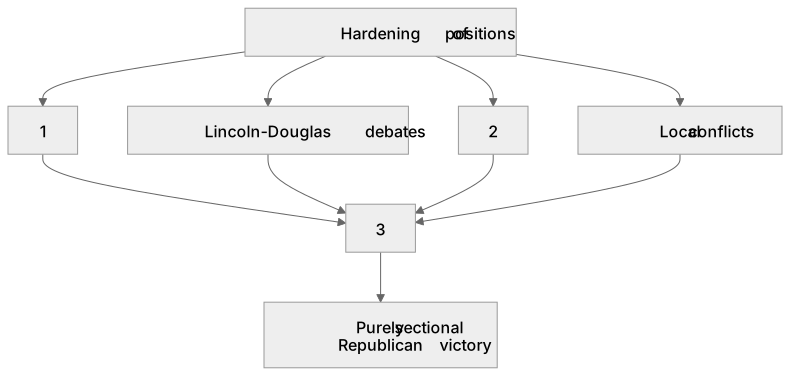
1Box 1
2Box 2
3Box 3
There is more to this lesson
The full lesson goes on to check your understanding and help you earn the marks. Create a free account to carry on, with your progress saved.
A week of Premium from your first lesson · Then the free plan continues · No card, no charge
Test your understanding of 2J America: A Nation Divided, c1845–1877 – The outbreak of Civil War, 1854–1861: Hardening of positions: the Dred Scott decision; the Lincoln-Douglas debates; Harper’s Ferry; local conflicts; the split in the Democratic Party
Active recall beats re-reading. Take an instant quiz now to test what you’ve learned and lock it into long-term memory.
A week of Premium from your first lesson · Then the free plan continues · No card, no charge