AQA · A-Level · History
Course version: 7042 · Version from Sept 2017
A Nation Divided, c1845–1877 – The War, 1861–1865 (A-level only): The…
Full specification wording
2J America: A Nation Divided, c1845–1877 – The War, 1861–1865 (A-level only): The strengths and weaknesses of the Unionist cause: military resources; political and military leadership; economic and geographical factors; relations with foreign powers
The Union possessed overwhelming economic and demographic strengths, boasting 22 million citizens against the South's 9 million, alongside most of the nation's industrial capacity and railways.
Checked against the AQA 7042 specification (opens in a new tab) on .
- Point 2 of 4
- 4 key terms
Study notes
From the checked teaching notes for this specification point.
The idea
The Union possessed overwhelming economic and demographic strengths, boasting 22 million citizens against the South's 9 million, alongside most of the nation's industrial capacity and railways. Militarily, they initially struggled with cautious leadership under generals like McClellan and the geographical burden of conquering a vast, hostile territory. Politically, Abraham Lincoln proved a masterful leader, skillfully managing cabinet rivalries to maintain Northern morale. Economically, the North's diverse infrastructure easily sustained a prolonged war. In foreign relations, the Union successfully deterred British and French intervention, aided by the Emancipation Proclamation which aligned their cause with anti-slavery sentiment abroad.
What earns the marks
- Analyse the Union's overwhelming demographic and economic advantages, including superior industrial output, financial infrastructure, and railway mileage.
- Evaluate the evolution of Union military leadership, from early caution and high turnover to the effective, relentless strategies of Grant and Sherman.
- Assess Abraham Lincoln's political leadership, focusing on his ability to manage factions, sustain public support, and strategically time the Emancipation Proclamation.
- Explain the geographical disadvantages faced by the Union, specifically the necessity of invading, occupying, and pacifying a massive Southern landmass.
- Examine Union diplomatic successes, particularly Secretary of State William Seward's efforts to prevent European recognition of the Confederacy.
Common mistakes and how to put them right
Assuming Union military leadership was uniformly poor until Grant.
Put it right: Officers like George Thomas achieved significant successes earlier in the war.
Believing the North's economic superiority guaranteed a quick victory.
Put it right: The geographical challenge of invading the South negated many early material advantages.
Stating that the Union fought solely to end slavery from 1861.
Put it right: Lincoln's initial political and diplomatic priority was preserving the Union, with emancipation becoming a war aim later.
Exam tips
- Contrast Lincoln's flexible and pragmatic political leadership with Jefferson Davis's more rigid approach to highlight Union strengths.
- Discuss how the Union's naval superiority enabled the Anaconda Plan, slowly strangling the Southern economy.
- When discussing foreign relations, explain how the Union used the threat of war with the United States to keep Britain and France neutral.
Try the lesson
The start of the 2J America: A Nation Divided, c1845–1877 – The War, 1861–1865 (A-level only): The strengths and weaknesses of the Unionist cause: military resources; political and military leadership; economic and geographical factors; relations with foreign powers lesson, made from checked teaching notes for this specification point.
Have a go first
Which of the following represents a major economic and military resource advantage held by the Union at the start of the Civil War?
Listen
The Union possessed overwhelming economic and demographic strengths, boasting 22 million citizens against the South's 9 million, alongside most of the nation's industrial capacity and railways. Militarily, they initially struggled with cautious leadership under generals like McClellan and the geographical burden of conquering a vast, hostile territory. Politically, Abraham Lincoln proved a masterful leader, skillfully managing cabinet rivalries to maintain Northern morale. Economically, the North's diverse infrastructure easily sustained a prolonged war. In foreign relations, the Union successfully deterred British and French intervention, aided by the Emancipation Proclamation which aligned their cause with anti-slavery sentiment abroad. A strong answer earns marks for these points. Analyse the Union's overwhelming demographic and economic advantages, including superior industrial output, financial infrastructure, and railway mileage. Evaluate the evolution of Union military leadership, from early caution and high turnover to the effective, relentless strategies of Grant and Sherman. Assess Abraham Lincoln's political leadership, focusing on his ability to manage factions, sustain public support, and strategically time the Emancipation Proclamation. Explain the geographical disadvantages faced by the Union, specifically the necessity of invading, occupying, and pacifying a massive Southern landmass. Exam tip: Contrast Lincoln's flexible and pragmatic political leadership with Jefferson Davis's more rigid approach to highlight Union strengths.
See it
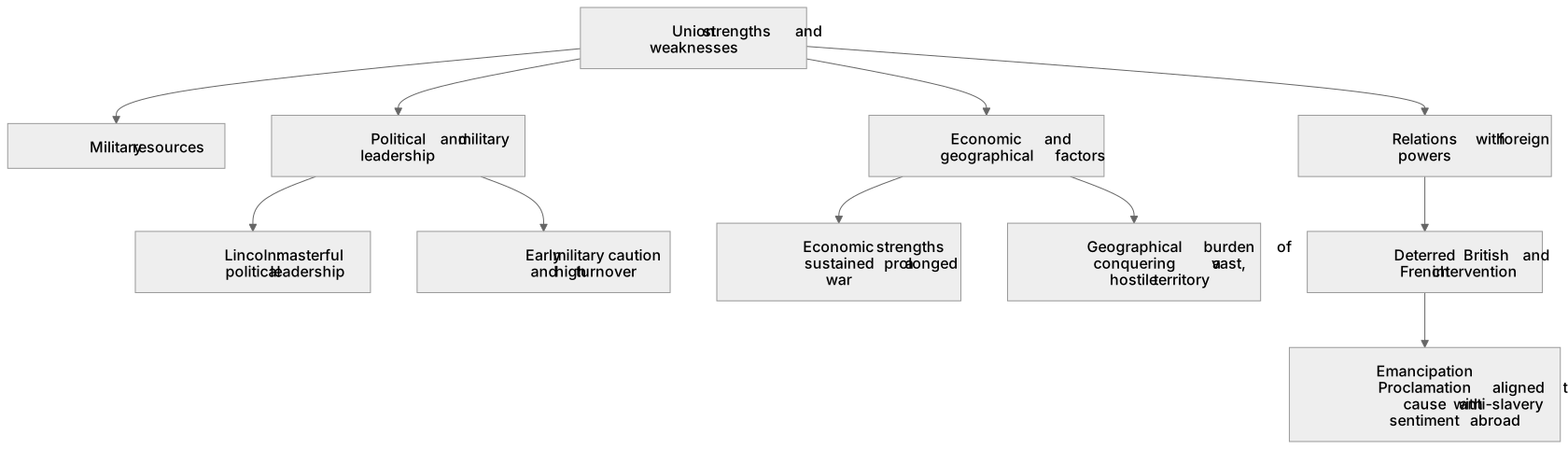
Key words
Say what each word means before you turn the card.
Industrialisation
Try answering aloud or in your head before turning the card.
Political pragmatism
Try answering aloud or in your head before turning the card.
Military adaptation
Try answering aloud or in your head before turning the card.
Strategic geography
Try answering aloud or in your head before turning the card.
See every definition
- Industrialisation
- The North held most of the nation's industrial capacity and railways, giving the Union diverse infrastructure that easily sustained a prolonged war.
- Political pragmatism
- Lincoln's flexible and pragmatic political leadership, managing cabinet rivalries to maintain Northern morale, contrasted with Jefferson Davis's more rigid approach.
- Military adaptation
- Union military leadership evolved from early caution and high turnover to the effective, relentless strategies of Grant and Sherman.
- Strategic geography
- The Union faced the geographical burden of invading, occupying and pacifying a vast, hostile Southern landmass, which negated many early material advantages.
Label the diagram
Some boxes have lost their names. Pick the right name for each number.
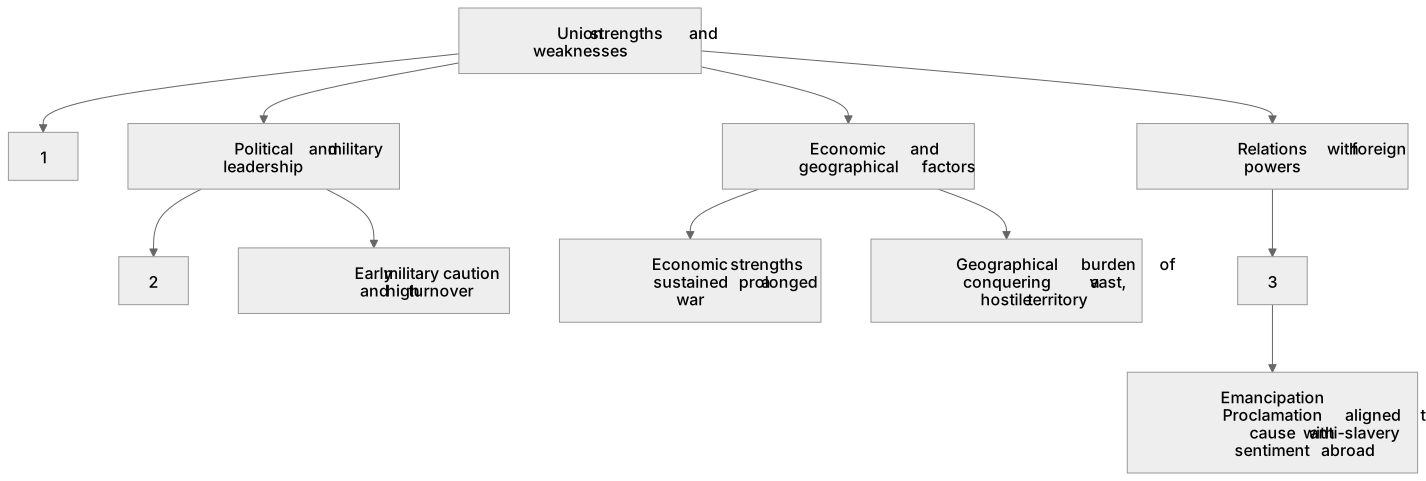
1Box 1
2Box 2
3Box 3
There is more to this lesson
The full lesson goes on to check your understanding and help you earn the marks. Create a free account to carry on, with your progress saved.
A week of Premium from your first lesson · Then the free plan continues · No card, no charge
Test your understanding of 2J America: A Nation Divided, c1845–1877 – The War, 1861–1865 (A-level only): The strengths and weaknesses of the Unionist cause: military resources; political and military leadership; economic and geographical factors; relations with foreign powers
Active recall beats re-reading. Take an instant quiz now to test what you’ve learned and lock it into long-term memory.
A week of Premium from your first lesson · Then the free plan continues · No card, no charge