AQA · A-Level · History
Course version: 7042 · Version from Sept 2017
The Depression and its impact on international relations: the failures of…
Full specification wording
2K International Relations and Global Conflict, c1890–1941 (A-level only) – Attempts at maintaining the peace, 1923–1935: The Depression and its impact on international relations: the failures of the Lausanne and London Conferences on international debts and reparations
The Great Depression destabilised international relations, replacing the cooperative 'Spirit of Locarno' with economic nationalism.
Checked against the AQA 7042 specification (opens in a new tab) on .
- Point 2 of 4
Study notes
From the checked teaching notes for this specification point.
The idea
The Great Depression destabilised international relations, replacing the cooperative 'Spirit of Locarno' with economic nationalism. As global trade collapsed, the system of US loans, German reparations, and Allied war debts broke down. The 1932 Lausanne Conference attempted to address this by effectively cancelling German reparations, but failed to resolve the wider issue of Allied debts to the USA, which Congress refused to forgive. The 1933 London World Economic Conference then sought international agreement on currency stabilisation and trade revival. Its failure, triggered by US President Roosevelt's refusal to stabilise the dollar, marked the end of collective economic diplomacy and accelerated the global drift towards autarky and conflict.
What earns the marks
- Analyse how the Wall Street Crash and subsequent Depression destroyed the economic foundations of the Locarno era.
- Evaluate the outcomes of the 1932 Lausanne Conference, specifically the suspension of reparations and the unresolved tension over Allied war debts to the USA.
- Assess the reasons for the failure of the 1933 London World Economic Conference, focusing on Roosevelt's 'Bombshell Message'.
- Explain how the failure of these conferences led to increased economic nationalism, protectionism, and the rise of aggressive autarkic regimes.
Common mistakes and how to put them right
Claiming the Lausanne Conference successfully resolved all international debt.
Put it right by noting it only suspended German reparations, while the USA still demanded repayment of Allied war debts.
Confusing the aims of the two conferences.
Put it right by specifying that Lausanne (1932) dealt with reparations and war debts, whereas London (1933) focused on broader currency stabilisation and tariff reduction.
Underestimating the role of the USA in the failure of the London Conference.
Put it right: Explicitly linking the conference's collapse to Roosevelt's prioritisation of domestic recovery over international cooperation.
Exam tips
- Use the failure of the London Conference to demonstrate the shift from international cooperation in the 1920s to isolationism in the 1930s.
- Link the economic collapse directly to political extremism, showing how the failure to resolve debts at Lausanne weakened moderate governments, particularly in Weimar Germany.
- When discussing the Depression's impact, explicitly mention the breakdown of the Dawes and Young Plans to show continuity and change in international relations.
Try the lesson
The start of the 2K International Relations and Global Conflict, c1890–1941 (A-level only) – Attempts at maintaining the peace, 1923–1935: The Depression and its impact on international relations: the failures of the Lausanne and London Conferences on international debts and reparations lesson, made from checked teaching notes for this specification point.
Have a go first
What was the primary agreement reached at the Lausanne Conference of 1932 regarding international debts and reparations?
Listen
The Great Depression destabilised international relations, replacing the cooperative 'Spirit of Locarno' with economic nationalism. As global trade collapsed, the system of US loans, German reparations, and Allied war debts broke down. The 1932 Lausanne Conference attempted to address this by effectively cancelling German reparations, but failed to resolve the wider issue of Allied debts to the USA, which Congress refused to forgive. The 1933 London World Economic Conference then sought international agreement on currency stabilisation and trade revival. Its failure, triggered by US President Roosevelt's refusal to stabilise the dollar, marked the end of collective economic diplomacy and accelerated the global drift towards autarky and conflict. A strong answer earns marks for these points. Analyse how the Wall Street Crash and subsequent Depression destroyed the economic foundations of the Locarno era. Evaluate the outcomes of the 1932 Lausanne Conference, specifically the suspension of reparations and the unresolved tension over Allied war debts to the USA. Assess the reasons for the failure of the 1933 London World Economic Conference, focusing on Roosevelt's 'Bombshell Message'. Explain how the failure of these conferences led to increased economic nationalism, protectionism, and the rise of aggressive autarkic regimes. A common slip: Claiming the Lausanne Conference successfully resolved all international debt. Instead, noting it only suspended German reparations, while the USA still demanded repayment of Allied war debts. Exam tip: Use the failure of the London Conference to demonstrate the shift from international cooperation in the 1920s to isolationism in the 1930s.
See it
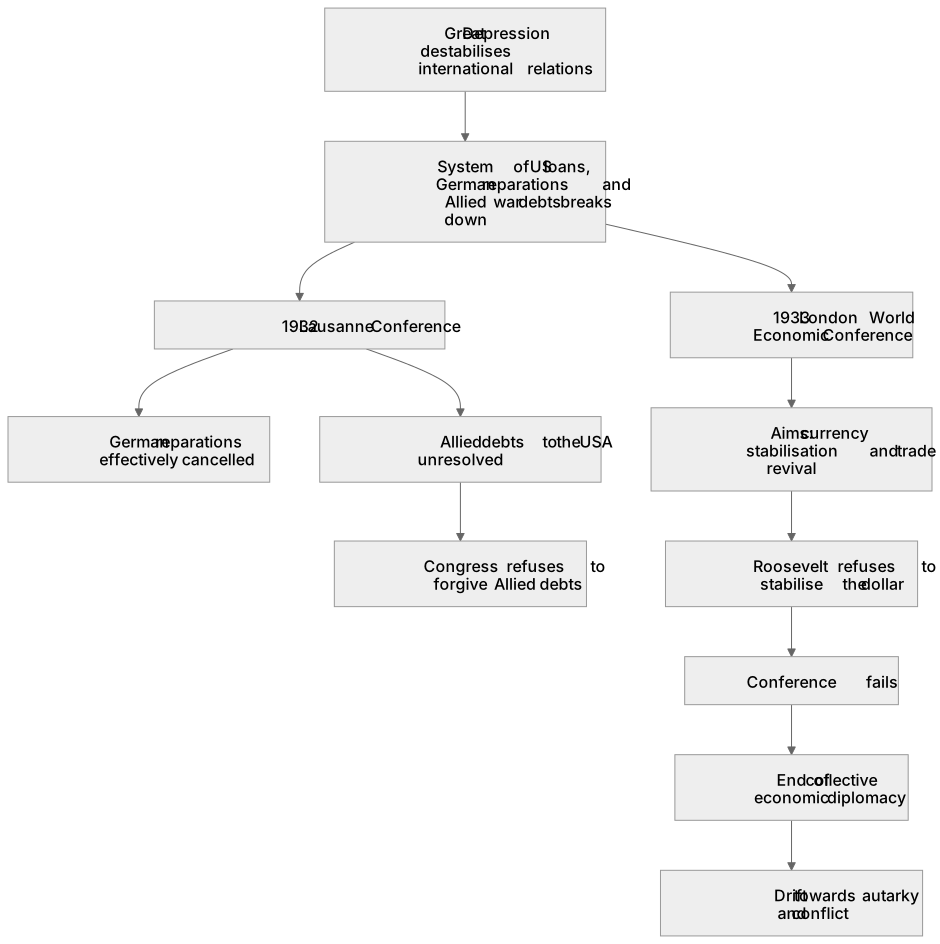
Label the diagram
Some boxes have lost their names. Pick the right name for each number.
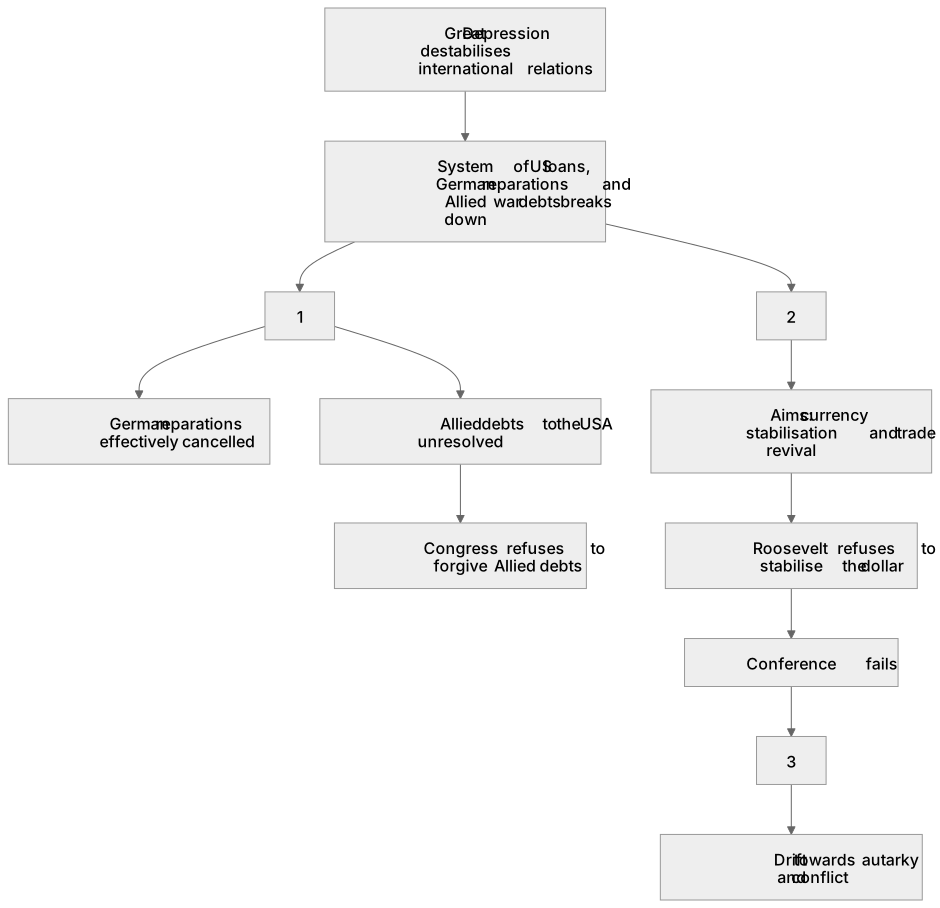
1Box 1
2Box 2
3Box 3
There is more to this lesson
The full lesson goes on to check your understanding and help you earn the marks. Create a free account to carry on, with your progress saved.
A week of Premium from your first lesson · Then the free plan continues · No card, no charge
Test your understanding of 2K International Relations and Global Conflict, c1890–1941 (A-level only) – Attempts at maintaining the peace, 1923–1935: The Depression and its impact on international relations: the failures of the Lausanne and London Conferences on international debts and reparations
Active recall beats re-reading. Take an instant quiz now to test what you’ve learned and lock it into long-term memory.
A week of Premium from your first lesson · Then the free plan continues · No card, no charge