AQA · A-Level · History
Course version: 7042 · Version from Sept 2017
The ‘Spirit of Locarno’: consolidation of the post-war settlement;…
Full specification wording
2K International Relations and Global Conflict, c1890–1941 (A-level only) – Attempts at maintaining the peace, 1923–1935: The ‘Spirit of Locarno’: consolidation of the post-war settlement; attempts at disarmament and conciliation in international relations, including the Dawes Plan, the Geneva Protocol and the Kellogg-Briand Pact
The 'Spirit of Locarno' defines the optimistic era of European diplomacy from 1925 to 1929, aiming to consolidate the post-war settlement through conciliation.
Checked against the AQA 7042 specification (opens in a new tab) on .
- Point 1 of 4
Study notes
From the checked teaching notes for this specification point.
The idea
The 'Spirit of Locarno' defines the optimistic era of European diplomacy from 1925 to 1929, aiming to consolidate the post-war settlement through conciliation. The 1924 Dawes Plan eased German reparations, stabilising the economy with US loans and ending the Ruhr crisis. The 1924 Geneva Protocol attempted to strengthen the League of Nations by making arbitration compulsory, though its failure highlighted ongoing security fears. The 1925 Locarno Treaties secured western borders, fostering goodwill. This culminated in the 1928 Kellogg-Briand Pact, an ambitious but unenforceable attempt at disarmament where 65 nations renounced war as an instrument of national policy, masking underlying international tensions.
What earns the marks
- Assess the impact of the Dawes Plan (1924) on European economic stability and the easing of Franco-German tensions.
- Evaluate the significance of the Locarno Treaties (1925) in consolidating the post-war settlement by guaranteeing Germany's western borders.
- Analyse the failure of the Geneva Protocol (1924) as a missed opportunity for collective security and compulsory arbitration.
- Critique the Kellogg-Briand Pact (1928) as a symbolic gesture of conciliation that lacked enforcement mechanisms for genuine disarmament.
Common mistakes and how to put them right
Confusing the Dawes Plan with the Young Plan.
Put it right by noting the Dawes Plan (1924) provided immediate short-term relief and US loans, whereas the Young Plan (1929) restructured the total debt.
Assuming the Kellogg-Briand Pact achieved actual disarmament.
Put it right by explaining it was a renunciation of war that lacked any military or economic sanctions to enforce peace.
Stating the Geneva Protocol was successfully implemented.
Put it right by identifying that Britain rejected it, leading to its collapse and demonstrating the limits of League authority.
Exam tips
- Use the phrase 'Spirit of Locarno' to evaluate whether the period represented genuine conciliation or merely a temporary illusion of peace funded by US loans.
- Link the Dawes Plan directly to the political success of Locarno, demonstrating how economic stability was a prerequisite for diplomatic progress.
- Contrast the idealistic aims of the Kellogg-Briand Pact with the practical failure to achieve binding disarmament agreements during this period.
Try the lesson
The start of the 2K International Relations and Global Conflict, c1890–1941 (A-level only) – Attempts at maintaining the peace, 1923–1935: The ‘Spirit of Locarno’: consolidation of the post-war settlement; attempts at disarmament and conciliation in international relations, including the Dawes Plan, the Geneva Protocol and the Kellogg-Briand Pact lesson, made from checked teaching notes for this specification point.
Have a go first
What was the primary objective of the Kellogg-Briand Pact signed in 1928?
Listen
The 'Spirit of Locarno' defines the optimistic era of European diplomacy from 1925 to 1929, aiming to consolidate the post-war settlement through conciliation. The 1924 Dawes Plan eased German reparations, stabilising the economy with US loans and ending the Ruhr crisis. The 1924 Geneva Protocol attempted to strengthen the League of Nations by making arbitration compulsory, though its failure highlighted ongoing security fears. The 1925 Locarno Treaties secured western borders, fostering goodwill. This culminated in the 1928 Kellogg-Briand Pact, an ambitious but unenforceable attempt at disarmament where 65 nations renounced war as an instrument of national policy, masking underlying international tensions. A strong answer earns marks for these points. Assess the impact of the Dawes Plan (1924) on European economic stability and the easing of Franco-German tensions. Evaluate the significance of the Locarno Treaties (1925) in consolidating the post-war settlement by guaranteeing Germany's western borders. Analyse the failure of the Geneva Protocol (1924) as a missed opportunity for collective security and compulsory arbitration. Critique the Kellogg-Briand Pact (1928) as a symbolic gesture of conciliation that lacked enforcement mechanisms for genuine disarmament. A common slip: Confusing the Dawes Plan with the Young Plan. Instead, noting the Dawes Plan (1924) provided immediate short-term relief and US loans, whereas the Young Plan (1929) restructured the total debt. Exam tip: Use the phrase 'Spirit of Locarno' to evaluate whether the period represented genuine conciliation or merely a temporary illusion of peace funded by US loans.
See it
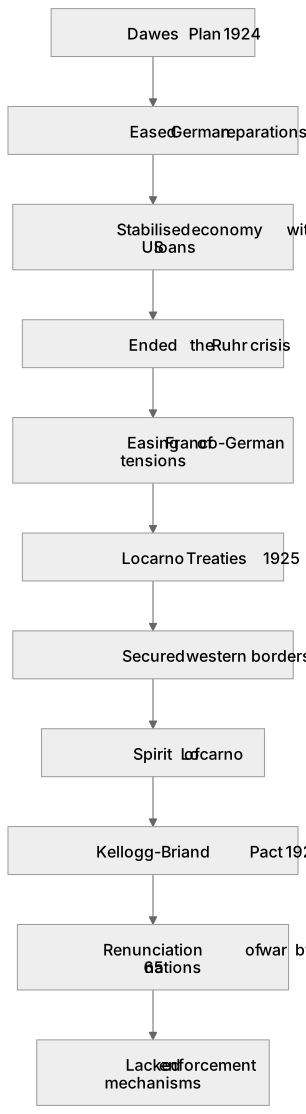
Put the events in order
Put these events in the order they happened, earliest first.
- 1. Dawes Plan eased German reparations and stabilised the economy
- 2. Kellogg-Briand Pact renounced war as an instrument of national policy
- 3. Locarno Treaties secured western borders and fostered goodwill
Label the diagram
Some boxes have lost their names. Pick the right name for each number.
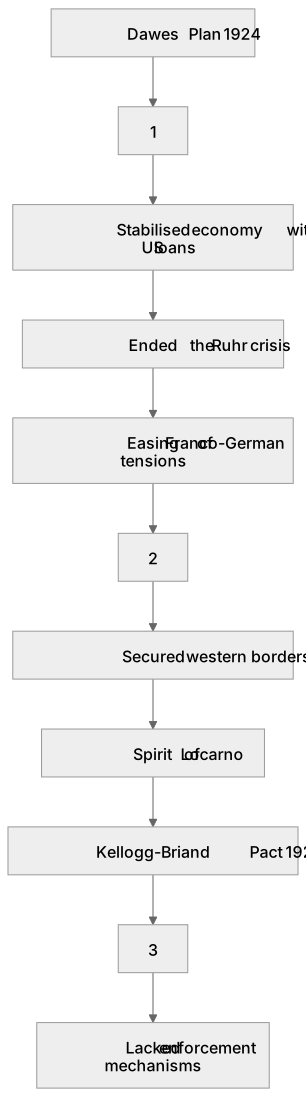
1Box 1
2Box 2
3Box 3
There is more to this lesson
The full lesson goes on to check your understanding and help you earn the marks. Create a free account to carry on, with your progress saved.
A week of Premium from your first lesson · Then the free plan continues · No card, no charge
Test your understanding of 2K International Relations and Global Conflict, c1890–1941 (A-level only) – Attempts at maintaining the peace, 1923–1935: The ‘Spirit of Locarno’: consolidation of the post-war settlement; attempts at disarmament and conciliation in international relations, including the Dawes Plan, the Geneva Protocol and the Kellogg-Briand Pact
Active recall beats re-reading. Take an instant quiz now to test what you’ve learned and lock it into long-term memory.
A week of Premium from your first lesson · Then the free plan continues · No card, no charge