AQA · A-Level · History
Course version: 7042 · Version from Sept 2017
Britain, Germany, France, Russia and Austria-Hungary, c1890–1900: Empires…
Full specification wording
2K International Relations and Global Conflict, c1890–1941 (A-level only) – Great Powers: Britain, Germany, France, Russia and Austria-Hungary, c1890–1900: Empires and rivalries: the ‘Scramble for Africa’; Russo-Austro-Hungarian rivalry in the Balkans; Russia and the Ottoman Empire
Late nineteenth-century imperialism fundamentally destabilised European relations.
Checked against the AQA 7042 specification (opens in a new tab) on .
- Point 3 of 4
Study notes
From the checked teaching notes for this specification point.
The idea
Late nineteenth-century imperialism fundamentally destabilised European relations. The 'Scramble for Africa' saw powers like Britain, France, and Germany aggressively partition the continent, exemplified by the 1898 Fashoda Incident which nearly sparked an Anglo-French war over Sudan. Simultaneously, the declining Ottoman Empire created a dangerous power vacuum in Eastern Europe. Russia sought to exploit this weakness to secure warm-water access through the Straits, directly threatening Ottoman survival. This expansionism clashed violently with Austro-Hungarian interests in the Balkans, as both empires vied for influence over newly independent Slavic states like Serbia, cementing a volatile Russo-Austro-Hungarian rivalry that would eventually ignite global conflict.
What earns the marks
- Explain the economic and strategic motivations driving the 'Scramble for Africa' and how it exacerbated tensions between European powers.
- Analyse the geopolitical significance of the declining Ottoman Empire to Russian strategic aims, particularly regarding access to the Dardanelles.
- Evaluate the causes of Russo-Austro-Hungarian rivalry in the Balkans, focusing on competing imperial ambitions and the influence of Pan-Slavism.
- Assess how imperial disputes in peripheral regions such as Africa and the Balkans influenced the core diplomatic alignments of the Great Powers.
Common mistakes and how to put them right
Assuming the Scramble for Africa only involved Britain and France.
Put it right: Acknowledge the disruptive entry of Germany and Italy into the imperial competition.
Conflating Russian and Austro-Hungarian aims in the Balkans.
Put it right: Distinguish between Russia's Pan-Slavic ideological goals and Austria-Hungary's defensive need to suppress multi-ethnic nationalism.
Treating the Ottoman Empire as entirely passive.
Put it right: Recognise Ottoman diplomatic efforts to play European powers against each other to delay imperial collapse.
Exam tips
- Use specific crises, such as the Fashoda Incident, to illustrate how colonial rivalries in Africa translated into European diplomatic tensions.
- Link Russian ambitions regarding the Ottoman Empire directly to their need for secure, year-round maritime trade routes through the Black Sea Straits.
- When discussing the Balkans, explicitly connect the decline of Ottoman authority to the rise of the Russo-Austro-Hungarian power struggle.
Try the lesson
The start of the 2K International Relations and Global Conflict, c1890–1941 (A-level only) – Great Powers: Britain, Germany, France, Russia and Austria-Hungary, c1890–1900: Empires and rivalries: the ‘Scramble for Africa’; Russo-Austro-Hungarian rivalry in the Balkans; Russia and the Ottoman Empire lesson, made from checked teaching notes for this specification point.
Have a go first
Which of the following best describes the primary geopolitical motivation driving the 'Scramble for Africa' among European Great Powers in the late nineteenth century?
Listen
Late nineteenth-century imperialism fundamentally destabilised European relations. The 'Scramble for Africa' saw powers like Britain, France, and Germany aggressively partition the continent, exemplified by the 1898 Fashoda Incident which nearly sparked an Anglo-French war over Sudan. Simultaneously, the declining Ottoman Empire created a dangerous power vacuum in Eastern Europe. Russia sought to exploit this weakness to secure warm-water access through the Straits, directly threatening Ottoman survival. This expansionism clashed violently with Austro-Hungarian interests in the Balkans, as both empires vied for influence over newly independent Slavic states like Serbia, cementing a volatile Russo-Austro-Hungarian rivalry that would eventually ignite global conflict. A strong answer earns marks for these points. Explain the economic and strategic motivations driving the 'Scramble for Africa' and how it exacerbated tensions between European powers. Analyse the geopolitical significance of the declining Ottoman Empire to Russian strategic aims, particularly regarding access to the Dardanelles. Evaluate the causes of Russo-Austro-Hungarian rivalry in the Balkans, focusing on competing imperial ambitions and the influence of Pan-Slavism. Assess how imperial disputes in peripheral regions such as Africa and the Balkans influenced the core diplomatic alignments of the Great Powers. A common slip: Assuming the Scramble for Africa only involved Britain and France. Instead, acknowledge the disruptive entry of Germany and Italy into the imperial competition. Exam tip: Use specific crises, such as the Fashoda Incident, to illustrate how colonial rivalries in Africa translated into European diplomatic tensions.
See it
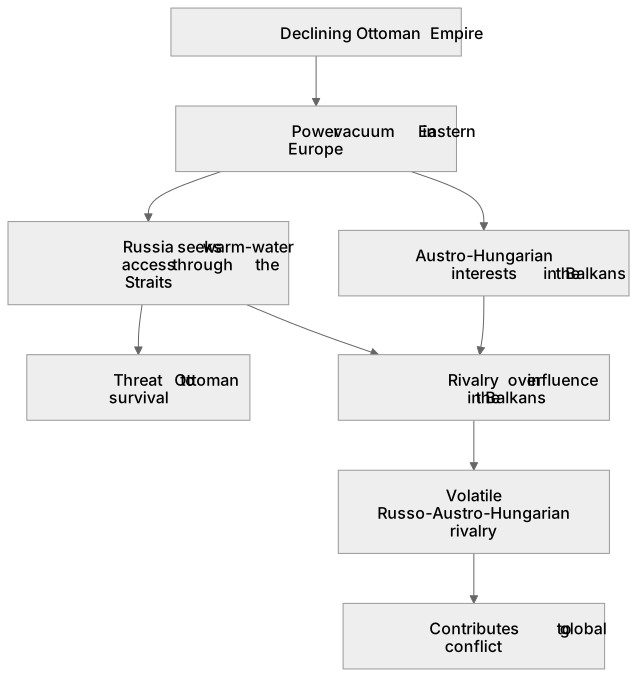
Label the diagram
Some boxes have lost their names. Pick the right name for each number.
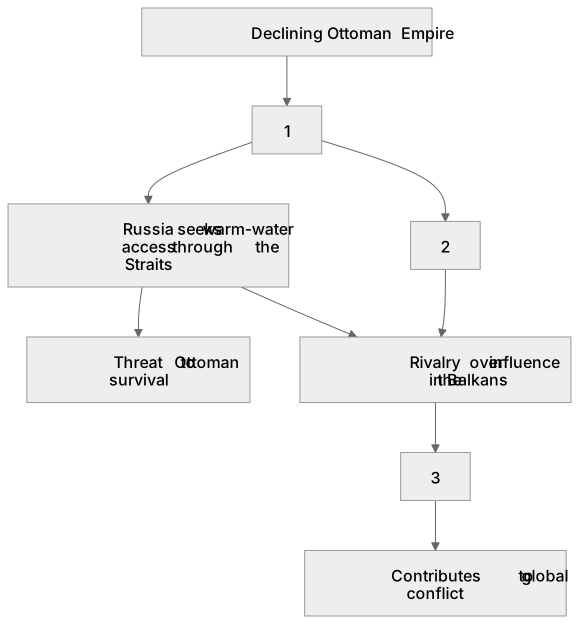
1Box 1
2Box 2
3Box 3
There is more to this lesson
The full lesson goes on to check your understanding and help you earn the marks. Create a free account to carry on, with your progress saved.
A week of Premium from your first lesson · Then the free plan continues · No card, no charge
Test your understanding of 2K International Relations and Global Conflict, c1890–1941 (A-level only) – Great Powers: Britain, Germany, France, Russia and Austria-Hungary, c1890–1900: Empires and rivalries: the ‘Scramble for Africa’; Russo-Austro-Hungarian rivalry in the Balkans; Russia and the Ottoman Empire
Active recall beats re-reading. Take an instant quiz now to test what you’ve learned and lock it into long-term memory.
A week of Premium from your first lesson · Then the free plan continues · No card, no charge