AQA · A-Level · History
Course version: 7042 · Version from Sept 2017
Britain, Germany, France, Russia and Austria-Hungary, c1890–1900: Economic…
Full specification wording
2K International Relations and Global Conflict, c1890–1941 (A-level only) – Great Powers: Britain, Germany, France, Russia and Austria-Hungary, c1890–1900: Economic strengths and armed forces: the erosion of Britain’s economic supremacy; the rise of the German economy; economic reform in Russia; the relative strengths of the armed forces of the Great Powers
By 1900, shifting economic and military power altered international relations.
Checked against the AQA 7042 specification (opens in a new tab) on .
- Point 2 of 4
Study notes
From the checked teaching notes for this specification point.
The idea
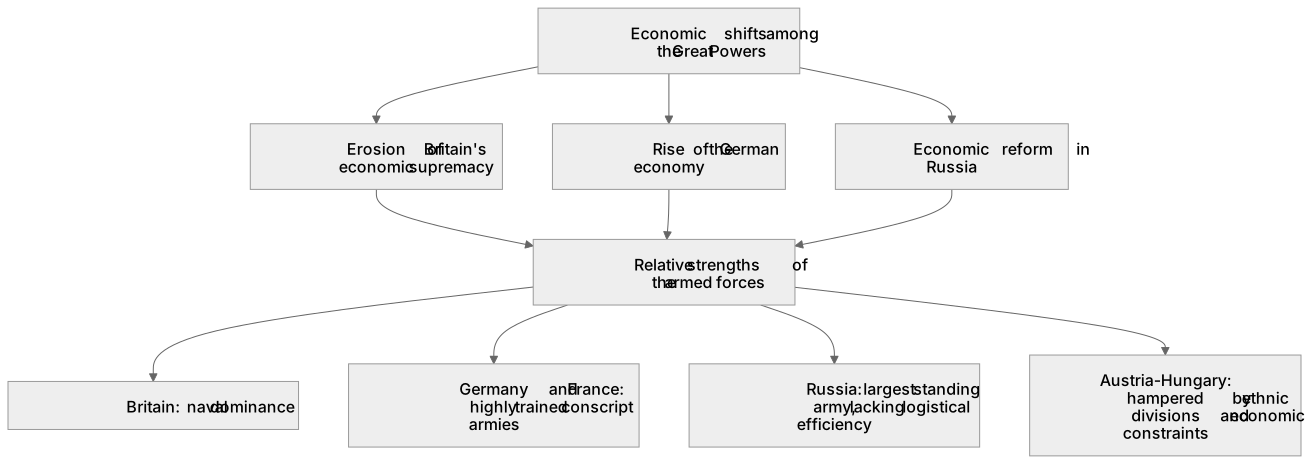
By 1900, shifting economic and military power altered international relations. Britain’s economic supremacy eroded as it lagged in new industries. Conversely, the German economy saw a meteoric rise, surpassing Britain in steel and funding naval expansion. Russia underwent state-sponsored economic reform under Sergei Witte, expanding railways to mobilise its army. The relative strengths of armed forces varied: Britain maintained naval dominance, while Germany and France built highly trained conscript armies. Russia boasted the largest standing army but lacked logistical efficiency. Austria-Hungary's forces were hampered by ethnic divisions and economic constraints. These economic shifts underpinned the military capabilities of the Great Powers.
What earns the marks
- Detail the erosion of Britain's economic supremacy, focusing on its relative decline in manufacturing and new industries compared to emerging powers.
- Explain the rapid industrialisation of Germany, particularly in steel, coal, and chemicals, and how this economic strength funded military expansion.
- Assess Sergei Witte's economic reforms in Russia, highlighting the focus on heavy industry and railway construction.
- Evaluate the connection between a nation's industrial capacity and its ability to sustain and modernise its armed forces.
Common mistakes and how to put them right
Claiming Britain was in absolute economic decline.
Put it right: Clarify that Britain's economy was still growing, but its relative supremacy was eroding as Germany and the USA industrialised faster.
Assuming Russia's large army made it the strongest military power.
Put it right: Point out that despite its size, the Russian army was hampered by poor infrastructure, outdated equipment, and logistical inefficiencies compared to Germany.
Treating economic and military developments as separate issues.
Put it right: Explicitly link economic strength to military capability, such as how Germany's industrial boom enabled the funding of Tirpitz's naval laws.
Ignoring Austria-Hungary when discussing the Great Powers' armed forces.
Put it right: Ensure Austria-Hungary is included, noting how its multi-ethnic composition and slower industrialisation limited its military effectiveness.
Exam tips
- Use specific industrial metrics, such as steel production figures, to illustrate the shifting economic balance between Britain and Germany.
- When discussing Russia, balance the success of Witte's economic reforms with the continuing backwardness of its agricultural sector and military logistics.
- Always link the size and technological advancement of a nation's armed forces back to its underlying economic base.
- Remember to include Austria-Hungary in comparisons of military strength, highlighting the impact of its dual monarchy structure on military cohesion.
Try the lesson
The start of the 2K International Relations and Global Conflict, c1890–1941 (A-level only) – Great Powers: Britain, Germany, France, Russia and Austria-Hungary, c1890–1900: Economic strengths and armed forces: the erosion of Britain’s economic supremacy; the rise of the German economy; economic reform in Russia; the relative strengths of the armed forces of the Great Powers lesson, made from checked teaching notes for this specification point.
Have a go first
Which of the following accurately describes the shifting economic balance between Britain and Germany in the period 1890–1900?
Listen
By 1900, shifting economic and military power altered international relations. Britain’s economic supremacy eroded as it lagged in new industries. Conversely, the German economy saw a meteoric rise, surpassing Britain in steel and funding naval expansion. Russia underwent state-sponsored economic reform under Sergei Witte, expanding railways to mobilise its army. The relative strengths of armed forces varied: Britain maintained naval dominance, while Germany and France built highly trained conscript armies. Russia boasted the largest standing army but lacked logistical efficiency. Austria-Hungary's forces were hampered by ethnic divisions and economic constraints. These economic shifts underpinned the military capabilities of the Great Powers. A strong answer earns marks for these points. Detail the erosion of Britain's economic supremacy, focusing on its relative decline in manufacturing and new industries compared to emerging powers. Explain the rapid industrialisation of Germany, particularly in steel, coal, and chemicals, and how this economic strength funded military expansion. Assess Sergei Witte's economic reforms in Russia, highlighting the focus on heavy industry and railway construction. Compare the relative strengths of the armed forces of the Great Powers, noting Britain's naval supremacy, the large conscript armies of Germany, France, and Russia, and the ethnic and economic challenges facing Austria-Hungary's military. A common slip: Claiming Britain was in absolute economic decline. Instead, Clarify that Britain's economy was still growing, but its relative supremacy was eroding as Germany and the USA industrialised faster. Exam tip: Use specific industrial metrics, such as steel production figures, to illustrate the shifting economic balance between Britain and Germany.
See it
Label the diagram
Some boxes have lost their names. Pick the right name for each number.
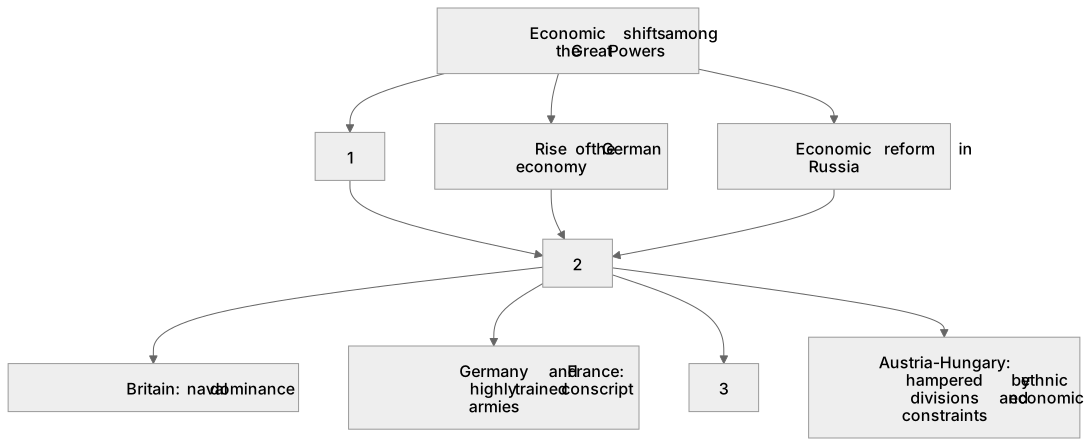
1Box 1
2Box 2
3Box 3
There is more to this lesson
The full lesson goes on to check your understanding and help you earn the marks. Create a free account to carry on, with your progress saved.
A week of Premium from your first lesson · Then the free plan continues · No card, no charge
Test your understanding of 2K International Relations and Global Conflict, c1890–1941 (A-level only) – Great Powers: Britain, Germany, France, Russia and Austria-Hungary, c1890–1900: Economic strengths and armed forces: the erosion of Britain’s economic supremacy; the rise of the German economy; economic reform in Russia; the relative strengths of the armed forces of the Great Powers
Active recall beats re-reading. Take an instant quiz now to test what you’ve learned and lock it into long-term memory.
A week of Premium from your first lesson · Then the free plan continues · No card, no charge