AQA · A-Level · History
Course version: 7042 · Version from Sept 2017
Britain, Germany, France, Russia and Austria-Hungary, c1890–1900: The…
Full specification wording
2K International Relations and Global Conflict, c1890–1941 (A-level only) – Great Powers: Britain, Germany, France, Russia and Austria-Hungary, c1890–1900: The political structures of the Great Powers: liberal democracies in Britain and France and autocracies in Germany, Russia and Austria-Hungary; the effect of political structures on decision-making
Contrasting political systems shaped Great Power decision-making between 1890 and 1900.
Checked against the AQA 7042 specification (opens in a new tab) on .
- Point 1 of 4
- 3 key terms
Study notes
From the checked teaching notes for this specification point.
The idea
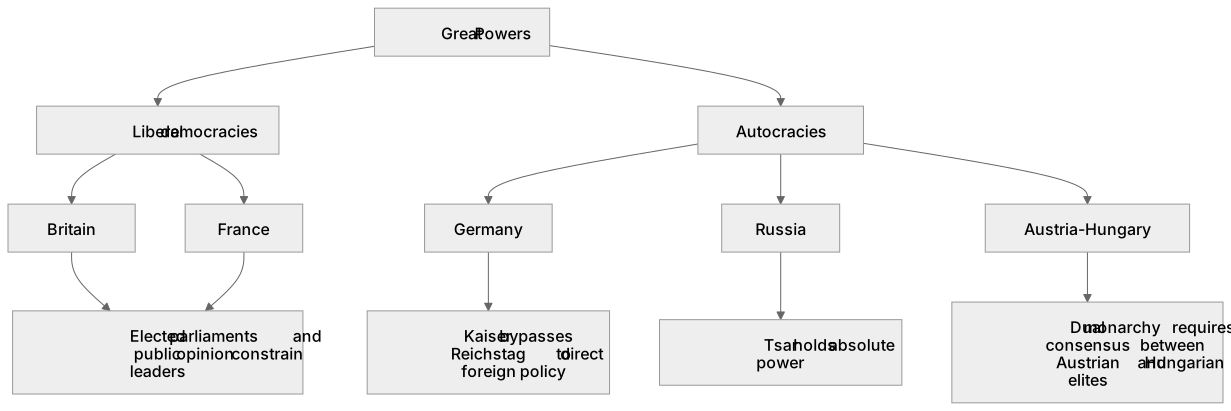
Contrasting political systems shaped Great Power decision-making between 1890 and 1900. Britain and France were liberal democracies; elected parliaments and public opinion constrained leaders. For example, British foreign policy required parliamentary funding, making unpopular expansion difficult. Conversely, Germany, Russia, and Austria-Hungary were autocracies. Tsar Nicholas II held absolute power in Russia, allowing unchecked decisions but risking misjudgements. Germany’s Kaiser Wilhelm II bypassed the Reichstag to direct foreign policy, while Austria-Hungary’s dual monarchy required consensus between Austrian and Hungarian elites, often paralysing action. These structures dictated how each nation managed diplomacy.
What earns the marks
- Identify Britain and France as liberal democracies where foreign policy was influenced by elected assemblies and public opinion.
- Define Russia as an absolute autocracy where the Tsar made unilateral foreign policy decisions without parliamentary constraint.
- Explain Germany's semi-autocratic structure, highlighting the Kaiser's personal control over foreign and military affairs despite the existence of the Reichstag.
- Analyse Austria-Hungary's dual monarchy, noting how the need for agreement between Austrian and Hungarian parliaments complicated and slowed decision-making.
- Evaluate how these political structures affected the speed, aggression, and accountability of diplomatic and military decisions.
Common mistakes and how to put them right
Assuming Germany was a full democracy because it had a Reichstag.
Put it right: Emphasise that the Kaiser retained ultimate control over foreign policy and the military, making it an autocracy in international relations.
Treating Austria-Hungary as a unified autocratic state.
Put it right: Acknowledge the dual monarchy structure where Austrian and Hungarian elites had to agree on foreign policy, often hindering decisive action.
Stating that British and French leaders had total freedom in foreign affairs.
Put it right: Explain that democratic leaders were constrained by the need for parliamentary approval, budgets, and public opinion.
Exam tips
- Link the political structure of a specific Great Power directly to a historical foreign policy decision to demonstrate the effect on decision-making.
- Contrast the speed of autocratic decision-making in Russia with the slower, consensus-driven approach required in Austria-Hungary.
- Use the term 'accountability' when discussing why liberal democracies were sometimes more cautious in their foreign policy ventures than autocracies.
Try the lesson
The start of the 2K International Relations and Global Conflict, c1890–1941 (A-level only) – Great Powers: Britain, Germany, France, Russia and Austria-Hungary, c1890–1900: The political structures of the Great Powers: liberal democracies in Britain and France and autocracies in Germany, Russia and Austria-Hungary; the effect of political structures on decision-making lesson, made from checked teaching notes for this specification point.
Have a go first
How did the political structures of Germany, Russia and Austria-Hungary primarily affect their foreign policy decision-making in the 1890s?
Listen
Contrasting political systems shaped Great Power decision-making between 1890 and 1900. Britain and France were liberal democracies; elected parliaments and public opinion constrained leaders. For example, British foreign policy required parliamentary funding, making unpopular expansion difficult. Conversely, Germany, Russia, and Austria-Hungary were autocracies. Tsar Nicholas II held absolute power in Russia, allowing unchecked decisions but risking misjudgements. Germany’s Kaiser Wilhelm II bypassed the Reichstag to direct foreign policy, while Austria-Hungary’s dual monarchy required consensus between Austrian and Hungarian elites, often paralysing action. These structures dictated how each nation managed diplomacy. A strong answer earns marks for these points. Identify Britain and France as liberal democracies where foreign policy was influenced by elected assemblies and public opinion. Define Russia as an absolute autocracy where the Tsar made unilateral foreign policy decisions without parliamentary constraint. Explain Germany's semi-autocratic structure, highlighting the Kaiser's personal control over foreign and military affairs despite the existence of the Reichstag. Analyse Austria-Hungary's dual monarchy, noting how the need for agreement between Austrian and Hungarian parliaments complicated and slowed decision-making. A common slip: Assuming Germany was a full democracy because it had a Reichstag. Instead, Emphasise that the Kaiser retained ultimate control over foreign policy and the military, making it an autocracy in international relations. Exam tip: Link the political structure of a specific Great Power directly to a historical foreign policy decision to demonstrate the effect on decision-making.
See it
Key words
Say what each word means before you turn the card.
Autocracy vs Democracy
Try answering aloud or in your head before turning the card.
Constitutional Constraints
Try answering aloud or in your head before turning the card.
Foreign Policy Decision-Making
Try answering aloud or in your head before turning the card.
See every definition
- Autocracy vs Democracy
- A contrast between systems where autocratic Great Powers such as Germany, Russia and Austria-Hungary concentrated power, while Britain and France were liberal democracies with elected parliaments and public opinion constraining leaders.
- Constitutional Constraints
- Limits on leaders in liberal democracies, where elected parliaments, public opinion, parliamentary funding and approval restricted foreign policy decisions.
- Foreign Policy Decision-Making
- How each Great Power managed diplomacy, with structures dictating the speed, aggression and accountability of diplomatic and military decisions.
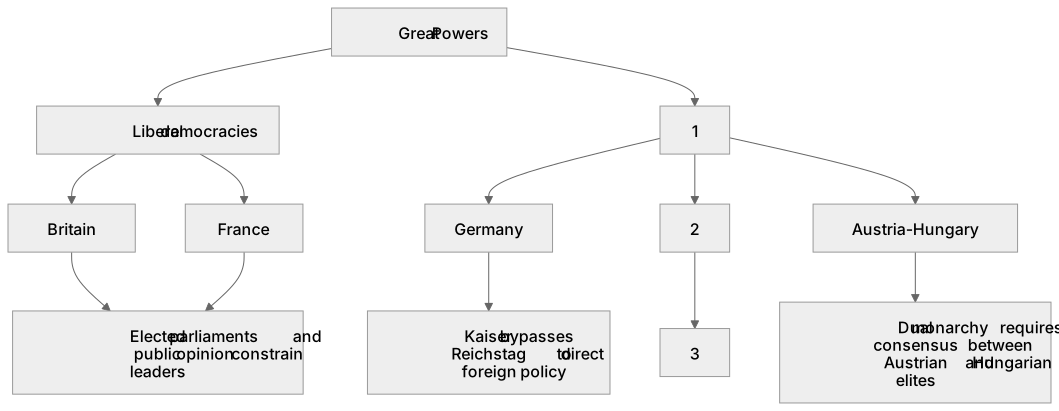
Label the diagram
Some boxes have lost their names. Pick the right name for each number.
1Box 1
2Box 2
3Box 3
There is more to this lesson
The full lesson goes on to check your understanding and help you earn the marks. Create a free account to carry on, with your progress saved.
A week of Premium from your first lesson · Then the free plan continues · No card, no charge
Test your understanding of 2K International Relations and Global Conflict, c1890–1941 (A-level only) – Great Powers: Britain, Germany, France, Russia and Austria-Hungary, c1890–1900: The political structures of the Great Powers: liberal democracies in Britain and France and autocracies in Germany, Russia and Austria-Hungary; the effect of political structures on decision-making
Active recall beats re-reading. Take an instant quiz now to test what you’ve learned and lock it into long-term memory.
A week of Premium from your first lesson · Then the free plan continues · No card, no charge