AQA · A-Level · History
Course version: 7042 · Version from Sept 2017
Challenges to the peace settlement: the consequences of the USA’s return…
Full specification wording
2K International Relations and Global Conflict, c1890–1941 (A-level only) – Second World War, 1917–1941 The end of the First World War and the peace settlement, 1917–1923: Challenges to the peace settlement: the consequences of the USA’s return to isolationism and the League of Nations; the responses to the post-war settlement in France, Britain and Germany
The peace settlement faced immediate challenges, weakened by the USA's return to isolationism.
Checked against the AQA 7042 specification (opens in a new tab) on .
- Point 3 of 4
- 4 key terms
Study notes
From the checked teaching notes for this specification point.
The idea
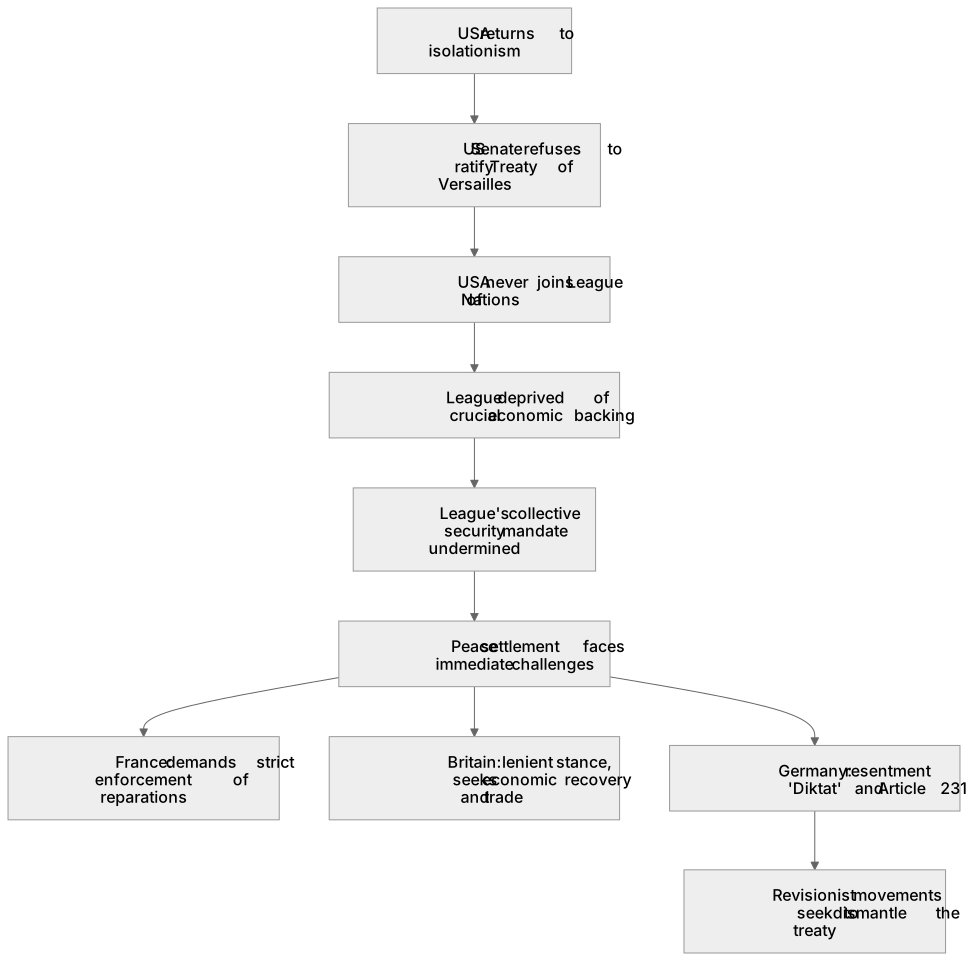
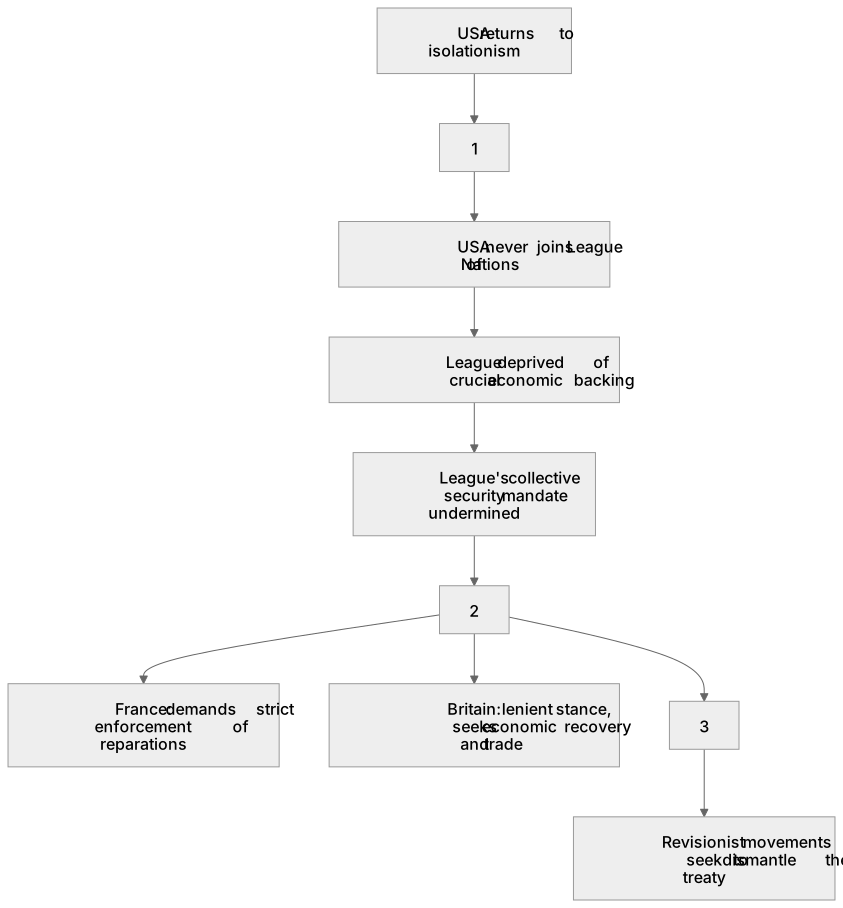
The peace settlement faced immediate challenges, weakened by the USA's return to isolationism. The US Senate's refusal to ratify the Treaty of Versailles deprived the League of Nations of crucial economic backing, undermining its collective security mandate. European responses diverged sharply. France, fearing aggression without a US guarantee, demanded strict enforcement of reparations to keep Germany weak. Conversely, Britain sought economic recovery and viewed a prosperous Germany as a vital trading partner, leading to a more lenient stance. Germany responded with profound resentment, viewing the 'Diktat' and Article 231 as a national humiliation, fuelling revisionist movements that sought to dismantle the treaty entirely.
What earns the marks
- Explain the impact of the US Senate's rejection of the Versailles Treaty on the League of Nations' authority and resources.
- Analyse French insecurity and their consequent demand for the strict execution of the Versailles terms, particularly regarding reparations.
- Evaluate Britain's shifting attitude towards Germany, prioritising trade and a balance of power over punitive measures.
- Assess the German domestic reaction to the 'Diktat', focusing on the psychological and political impact of the War Guilt Clause.
Common mistakes and how to put them right
Claiming the USA joined the League of Nations but later withdrew.
Put it right: State that the USA never joined the League of Nations because the Senate refused to ratify the Treaty of Versailles.
Assuming Britain and France shared identical views on enforcing the treaty.
Put it right: Contrast French demands for strict enforcement and security with British desires for German economic recovery and trade.
Describing German resentment solely in economic terms.
Put it right: Emphasise the psychological humiliation of the 'Diktat' and the War Guilt Clause (Article 231) alongside economic grievances.
Exam tips
- Use the term 'Diktat' when discussing the German response to demonstrate understanding of their perception of the dictated peace.
- Contrast the foreign policy aims of Britain and France to explain the lack of a unified Allied front in the early 1920s.
- Link the USA's isolationism directly to the structural weakness of the League of Nations when evaluating challenges to the peace settlement.
Try the lesson
The start of the 2K International Relations and Global Conflict, c1890–1941 (A-level only) – Second World War, 1917–1941 The end of the First World War and the peace settlement, 1917–1923: Challenges to the peace settlement: the consequences of the USA’s return to isolationism and the League of Nations; the responses to the post-war settlement in France, Britain and Germany lesson, made from checked teaching notes for this specification point.
Have a go first
What was a direct consequence of the United States Senate refusing to ratify the Treaty of Versailles in 1919?
Listen
The peace settlement faced immediate challenges, weakened by the USA's return to isolationism. The US Senate's refusal to ratify the Treaty of Versailles deprived the League of Nations of crucial economic backing, undermining its collective security mandate. European responses diverged sharply. France, fearing aggression without a US guarantee, demanded strict enforcement of reparations to keep Germany weak. Conversely, Britain sought economic recovery and viewed a prosperous Germany as a vital trading partner, leading to a more lenient stance. Germany responded with profound resentment, viewing the 'Diktat' and Article 231 as a national humiliation, fuelling revisionist movements that sought to dismantle the treaty entirely. A strong answer earns marks for these points. Explain the impact of the US Senate's rejection of the Versailles Treaty on the League of Nations' authority and resources. Analyse French insecurity and their consequent demand for the strict execution of the Versailles terms, particularly regarding reparations. Evaluate Britain's shifting attitude towards Germany, prioritising trade and a balance of power over punitive measures. Assess the German domestic reaction to the 'Diktat', focusing on the psychological and political impact of the War Guilt Clause. A common slip: Claiming the USA joined the League of Nations but later withdrew. Instead, State that the USA never joined the League of Nations because the Senate refused to ratify the Treaty of Versailles. Exam tip: Use the term 'Diktat' when discussing the German response to demonstrate understanding of their perception of the dictated peace.
See it
Key words
Say what each word means before you turn the card.
Isolationism
Try answering aloud or in your head before turning the card.
Collective security
Try answering aloud or in your head before turning the card.
Revisionism
Try answering aloud or in your head before turning the card.
Balance of power
Try answering aloud or in your head before turning the card.
See every definition
- Isolationism
- The USA's return to this stance weakened the peace settlement, as the Senate's refusal to ratify the Treaty of Versailles deprived the League of Nations of crucial economic backing.
- Collective security
- The League of Nations' mandate was undermined when the USA's isolationism deprived it of crucial economic backing.
- Revisionism
- Movements in Germany, fuelled by resentment of the 'Diktat' and Article 231 as a national humiliation, sought to dismantle the treaty entirely.
- Balance of power
- Britain prioritised trade and this over punitive measures, viewing a prosperous Germany as a vital trading partner and seeking economic recovery.
Label the diagram
Some boxes have lost their names. Pick the right name for each number.
1Box 1
2Box 2
3Box 3
There is more to this lesson
The full lesson goes on to check your understanding and help you earn the marks. Create a free account to carry on, with your progress saved.
A week of Premium from your first lesson · Then the free plan continues · No card, no charge
Test your understanding of 2K International Relations and Global Conflict, c1890–1941 (A-level only) – Second World War, 1917–1941 The end of the First World War and the peace settlement, 1917–1923: Challenges to the peace settlement: the consequences of the USA’s return to isolationism and the League of Nations; the responses to the post-war settlement in France, Britain and Germany
Active recall beats re-reading. Take an instant quiz now to test what you’ve learned and lock it into long-term memory.
A week of Premium from your first lesson · Then the free plan continues · No card, no charge