AQA · A-Level · History
Course version: 7042 · Version from Sept 2017
The state of international relations by 1923: the position of the USA and…
Full specification wording
2K International Relations and Global Conflict, c1890–1941 (A-level only) – Second World War, 1917–1941 The end of the First World War and the peace settlement, 1917–1923: The state of international relations by 1923: the position of the USA and Russia in world affairs; continuing border disputes; the occupation of the Ruhr and its consequences
By 1923, international relations were highly unstable.
Checked against the AQA 7042 specification (opens in a new tab) on .
- Point 4 of 4
Study notes
From the checked teaching notes for this specification point.
The idea
By 1923, international relations were highly unstable. The USA retreated into political isolationism, exerting influence through economic power rather than diplomacy. Bolshevik Russia, excluded from the League of Nations, remained a pariah state, though the 1922 Treaty of Rapallo showed a pragmatic alignment with Germany. Eastern Europe suffered continuing border disputes, such as clashes over Vilna, highlighting the fragility of new boundaries. The crisis peaked with the 1923 occupation of the Ruhr by French and Belgian troops responding to German reparation defaults. This triggered German passive resistance, catastrophic hyperinflation, and a collapse in Franco-German relations, forcing international intervention to stabilise the region.
What earns the marks
- Assess the impact of the USA's political isolationism and reliance on economic diplomacy on global stability.
- Explain Russia's diplomatic isolation and its strategic response, such as the Treaty of Rapallo with Germany.
- Identify and evaluate the significance of unresolved border disputes in Eastern Europe, such as Vilna or the Polish-Soviet conflicts.
- Analyse the causes of the Ruhr occupation, specifically French frustration over German reparation defaults.
- Evaluate the consequences of the Ruhr occupation, including German hyperinflation and the subsequent need for the Dawes Plan.
Common mistakes and how to put them right
Stating that the USA had no involvement in world affairs by 1923.
Put it right: Clarify that while politically isolationist, the USA remained highly influential through its economic power and war debt collection.
Confusing the occupation of the Ruhr with the earlier occupation of the Rhineland.
Put it right: Specify that the Ruhr was occupied in 1923 by France and Belgium specifically to extract unpaid reparations.
Assuming Russia was completely isolated from all European powers.
Put it right: Note that Russia formed a diplomatic and economic relationship with Germany through the Treaty of Rapallo in 1922.
Exam tips
- Use the Treaty of Rapallo as a key example of how pariah states (Russia and Germany) bypassed the post-war settlement.
- Link the occupation of the Ruhr directly to the ensuing hyperinflation crisis in Germany to demonstrate cause and effect.
- When discussing border disputes, mention specific examples like Vilna or Memel to ground your argument in concrete historical evidence.
Try the lesson
The start of the 2K International Relations and Global Conflict, c1890–1941 (A-level only) – Second World War, 1917–1941 The end of the First World War and the peace settlement, 1917–1923: The state of international relations by 1923: the position of the USA and Russia in world affairs; continuing border disputes; the occupation of the Ruhr and its consequences lesson, made from checked teaching notes for this specification point.
Have a go first
What was the primary reason for the French and Belgian occupation of the Ruhr in January 1923?
Listen
By 1923, international relations were highly unstable. The USA retreated into political isolationism, exerting influence through economic power rather than diplomacy. Bolshevik Russia, excluded from the League of Nations, remained a pariah state, though the 1922 Treaty of Rapallo showed a pragmatic alignment with Germany. Eastern Europe suffered continuing border disputes, such as clashes over Vilna, highlighting the fragility of new boundaries. The crisis peaked with the 1923 occupation of the Ruhr by French and Belgian troops responding to German reparation defaults. This triggered German passive resistance, catastrophic hyperinflation, and a collapse in Franco-German relations, forcing international intervention to stabilise the region. A strong answer earns marks for these points. Assess the impact of the USA's political isolationism and reliance on economic diplomacy on global stability. Explain Russia's diplomatic isolation and its strategic response, such as the Treaty of Rapallo with Germany. Identify and evaluate the significance of unresolved border disputes in Eastern Europe, such as Vilna or the Polish-Soviet conflicts. Analyse the causes of the Ruhr occupation, specifically French frustration over German reparation defaults. A common slip: Stating that the USA had no involvement in world affairs by 1923. Instead, Clarify that while politically isolationist, the USA remained highly influential through its economic power and war debt collection. Exam tip: Use the Treaty of Rapallo as a key example of how pariah states (Russia and Germany) bypassed the post-war settlement.
See it
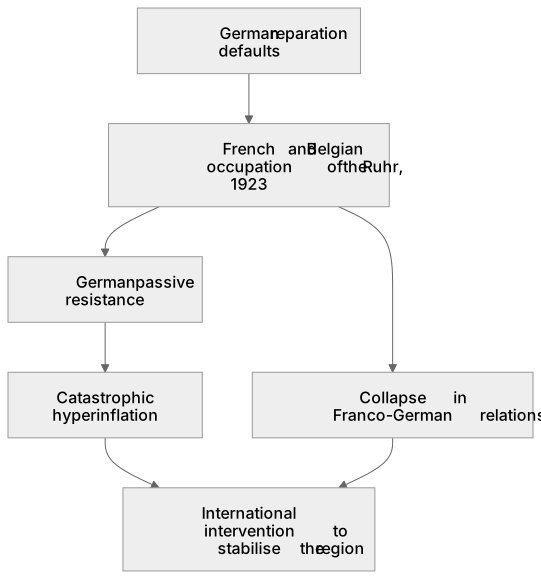
Label the diagram
Some boxes have lost their names. Pick the right name for each number.
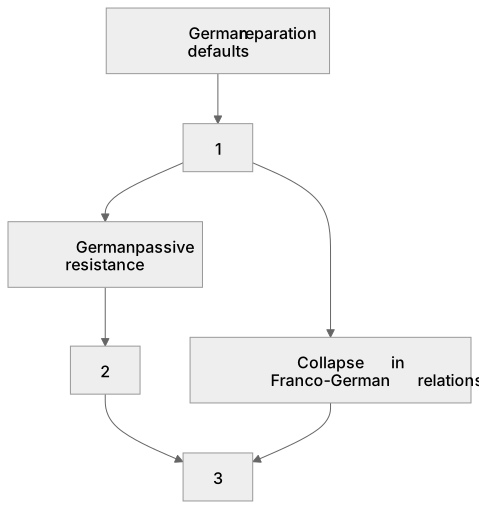
1Box 1
2Box 2
3Box 3
There is more to this lesson
The full lesson goes on to check your understanding and help you earn the marks. Create a free account to carry on, with your progress saved.
A week of Premium from your first lesson · Then the free plan continues · No card, no charge
Test your understanding of 2K International Relations and Global Conflict, c1890–1941 (A-level only) – Second World War, 1917–1941 The end of the First World War and the peace settlement, 1917–1923: The state of international relations by 1923: the position of the USA and Russia in world affairs; continuing border disputes; the occupation of the Ruhr and its consequences
Active recall beats re-reading. Take an instant quiz now to test what you’ve learned and lock it into long-term memory.
A week of Premium from your first lesson · Then the free plan continues · No card, no charge