AQA · A-Level · History
Course version: 7042 · Version from Sept 2017
From European to World War: the escalation of the conflict; Italy’s…
Full specification wording
2K International Relations and Global Conflict, c1890–1941 (A-level only) – The coming of war, 1911–1917: From European to World War: the escalation of the conflict; Italy’s motives for war; reasons for the entry of the USA
The transformation of the 1914 European conflict into a global World War involved significant escalation and the entry of new powers.
Checked against the AQA 7042 specification (opens in a new tab) on .
- Point 4 of 4
- 4 key terms
Study notes
From the checked teaching notes for this specification point.
The idea
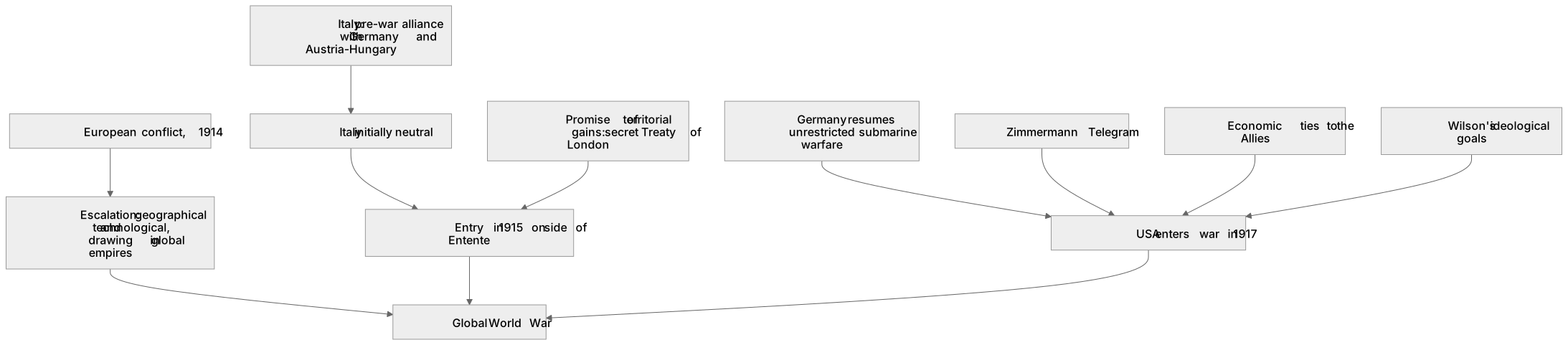
The transformation of the 1914 European conflict into a global World War involved significant escalation and the entry of new powers. The conflict escalated geographically and technologically, drawing in global empires. Italy, despite its pre-war alliance with Germany and Austria-Hungary, initially remained neutral. Its eventual entry in 1915 on the side of the Entente was driven by opportunistic motives, specifically the promise of territorial gains secured through the secret Treaty of London. The entry of the USA in 1917 was catalysed by Germany's resumption of unrestricted submarine warfare, which threatened American shipping, alongside the provocative Zimmermann Telegram. These factors, combined with economic ties to the Allies and Wilson's ideological goals, forced the USA into the war.
What earns the marks
- Detail the factors that escalated the conflict from a European dispute into a global war, including colonial involvement and naval warfare.
- Analyse Italy's shift from the Triple Alliance to joining the Entente, focusing on the territorial promises in the 1915 Treaty of London.
- Evaluate the impact of unrestricted submarine warfare and the Zimmermann Telegram on shifting US public opinion and political stance.
- Assess the underlying economic and ideological reasons for the USA's entry into the war in 1917 under President Woodrow Wilson.
Common mistakes and how to put them right
Stating the sinking of the Lusitania immediately caused the USA to enter the war.
Put it right: Clarify that the Lusitania sank in 1915, and while it damaged US-German relations, the USA did not declare war until 1917 following the resumption of unrestricted submarine warfare.
Assuming Italy was always allied with Britain and France.
Put it right: Emphasise that Italy was a member of the Triple Alliance before the war but declared neutrality in 1914 because the alliance was defensive.
Ignoring the economic ties between the USA and the Allies.
Put it right: Include the significant loans and trade between the USA and the Entente powers as a crucial underlying motive for American entry.
Exam tips
- Weigh the relative importance of ideological motives versus practical economic and security concerns when explaining the USA's entry into the war.
- Use the Treaty of London as a specific example of how secret diplomacy and territorial ambitions drove Italy's motives for war.
- When discussing escalation, ensure you reference both the geographical spread, such as the use of colonial troops, and the intensification of the methods of warfare.
Try the lesson
The start of the 2K International Relations and Global Conflict, c1890–1941 (A-level only) – The coming of war, 1911–1917: From European to World War: the escalation of the conflict; Italy’s motives for war; reasons for the entry of the USA lesson, made from checked teaching notes for this specification point.
Have a go first
Which combination of events was the primary catalyst for the United States' decision to enter the First World War in April 1917?
Listen
The transformation of the 1914 European conflict into a global World War involved significant escalation and the entry of new powers. The conflict escalated geographically and technologically, drawing in global empires. Italy, despite its pre-war alliance with Germany and Austria-Hungary, initially remained neutral. Its eventual entry in 1915 on the side of the Entente was driven by opportunistic motives, specifically the promise of territorial gains secured through the secret Treaty of London. The entry of the USA in 1917 was catalysed by Germany's resumption of unrestricted submarine warfare, which threatened American shipping, alongside the provocative Zimmermann Telegram. These factors, combined with economic ties to the Allies and Wilson's ideological goals, forced the USA into the war. A strong answer earns marks for these points. Detail the factors that escalated the conflict from a European dispute into a global war, including colonial involvement and naval warfare. Analyse Italy's shift from the Triple Alliance to joining the Entente, focusing on the territorial promises in the 1915 Treaty of London. Evaluate the impact of unrestricted submarine warfare and the Zimmermann Telegram on shifting US public opinion and political stance. Assess the underlying economic and ideological reasons for the USA's entry into the war in 1917 under President Woodrow Wilson. A common slip: Stating the sinking of the Lusitania immediately caused the USA to enter the war. Instead, Clarify that the Lusitania sank in 1915, and while it damaged US-German relations, the USA did not declare war until 1917 following the resumption of unrestricted submarine warfare. Exam tip: Weigh the relative importance of ideological motives versus practical economic and security concerns when explaining the USA's entry into the war.
See it
Key words
Say what each word means before you turn the card.
Secret diplomacy and treaties
Try answering aloud or in your head before turning the card.
Economic warfare and trade
Try answering aloud or in your head before turning the card.
Ideology and public opinion
Try answering aloud or in your head before turning the card.
Globalisation of conflict
Try answering aloud or in your head before turning the card.
See every definition
- Secret diplomacy and treaties
- The promise of territorial gains secured through the secret Treaty of London drove Italy's motives for war.
- Economic warfare and trade
- Germany's resumption of unrestricted submarine warfare threatened American shipping, while economic ties to the Allies were an underlying reason for the USA's entry.
- Ideology and public opinion
- Wilson's ideological goals, alongside the provocative Zimmermann Telegram, helped force the USA into the war.
- Globalisation of conflict
- The conflict escalated geographically and technologically, drawing in global empires and colonial involvement.
Label the diagram
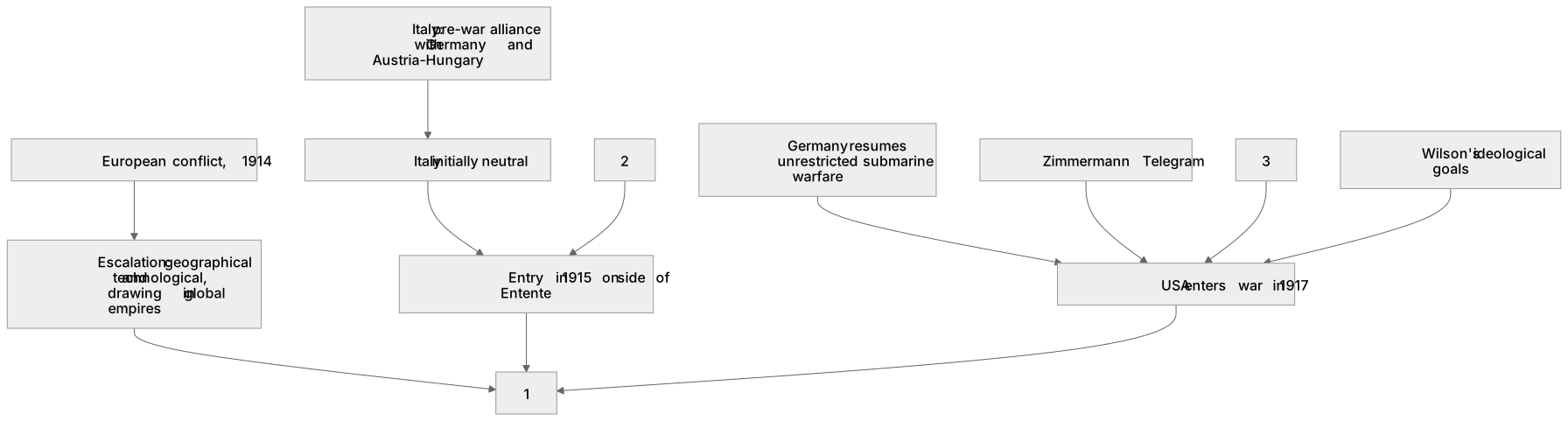
Some boxes have lost their names. Pick the right name for each number.
1Box 1
2Box 2
3Box 3
There is more to this lesson
The full lesson goes on to check your understanding and help you earn the marks. Create a free account to carry on, with your progress saved.
A week of Premium from your first lesson · Then the free plan continues · No card, no charge
Test your understanding of 2K International Relations and Global Conflict, c1890–1941 (A-level only) – The coming of war, 1911–1917: From European to World War: the escalation of the conflict; Italy’s motives for war; reasons for the entry of the USA
Active recall beats re-reading. Take an instant quiz now to test what you’ve learned and lock it into long-term memory.
A week of Premium from your first lesson · Then the free plan continues · No card, no charge