AQA · A-Level · History
Course version: 7042 · Version from Sept 2017
General war in Europe: mobilisation of German and Russian forces; the…
Full specification wording
2K International Relations and Global Conflict, c1890–1941 (A-level only) – The coming of war, 1911–1917: General war in Europe: mobilisation of German and Russian forces; the implementation of the Schlieffen Plan and the invasion of Belgium; Britain’s declaration of war; the key decision makers and their motives
The outbreak of general war in Europe in 1914 was driven by rapid military mobilisation and rigid strategic planning.
Checked against the AQA 7042 specification (opens in a new tab) on .
- Point 3 of 4
- 3 key terms
Study notes
From the checked teaching notes for this specification point.
The idea
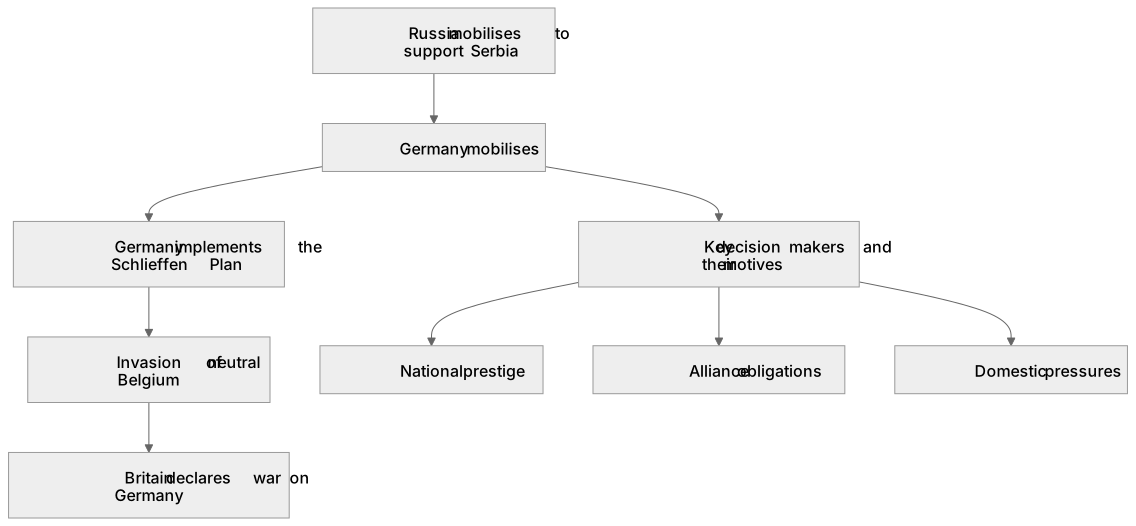
The outbreak of general war in Europe in 1914 was driven by rapid military mobilisation and rigid strategic planning. Russia's early mobilisation to support Serbia triggered Germany's own mobilisation, driven by fears of a two-front war. To counter this, Germany implemented the Schlieffen Plan, a strategy requiring a swift defeat of France via the invasion of neutral Belgium before turning east to face Russia. This violation of Belgian neutrality provided the catalyst for Britain’s declaration of war on Germany. Key decision makers, such as Kaiser Wilhelm II, Tsar Nicholas II, and British Foreign Secretary Sir Edward Grey, acted on complex motives including national prestige, alliance obligations, and domestic pressures, ultimately transforming a regional Balkan crisis into a continental conflict.
What earns the marks
- Explain the timeline and impact of Russian and German mobilisation in escalating the July Crisis.
- Analyse the strategic rationale behind the Schlieffen Plan and how its reliance on invading Belgium forced a wider conflict.
- Evaluate the motives behind Britain's declaration of war, balancing the moral outrage over Belgium with long-term strategic concerns regarding German hegemony.
- Assess the roles and motives of key decision makers, such as Bethmann Hollweg, Sazonov, and Grey, in the failure of diplomacy.
Common mistakes and how to put them right
Claiming Britain went to war solely because of the 1839 Treaty of London.
Put it right: Acknowledge that while the treaty was the official casus belli, strategic concerns about the balance of power and naval security were crucial motives.
Stating the Schlieffen Plan was executed exactly as originally designed.
Put it right: Note that Moltke modified Schlieffen's original plan, weakening the right wing, which impacted its implementation and ultimate failure.
Assuming mobilisation meant immediate combat.
Put it right: Explain that mobilisation was the preparation and movement of troops, which in 1914 was seen as tantamount to a declaration of war due to rigid railway timetables.
Exam tips
- When discussing the outbreak of war, explicitly link military plans like the Schlieffen Plan to the diplomatic failures of the key decision makers.
- Use specific dates from the July Crisis to demonstrate how the speed of mobilisation limited the window for diplomatic resolution.
- Contrast the public justifications for war, such as defending neutrality, with the underlying strategic motives of the Great Powers.
Try the lesson
The start of the 2K International Relations and Global Conflict, c1890–1941 (A-level only) – The coming of war, 1911–1917: General war in Europe: mobilisation of German and Russian forces; the implementation of the Schlieffen Plan and the invasion of Belgium; Britain’s declaration of war; the key decision makers and their motives lesson, made from checked teaching notes for this specification point.
Have a go first
What was the primary strategic objective of the Schlieffen Plan implemented by Germany in 1914?
Listen
The outbreak of general war in Europe in 1914 was driven by rapid military mobilisation and rigid strategic planning. Russia's early mobilisation to support Serbia triggered Germany's own mobilisation, driven by fears of a two-front war. To counter this, Germany implemented the Schlieffen Plan, a strategy requiring a swift defeat of France via the invasion of neutral Belgium before turning east to face Russia. This violation of Belgian neutrality provided the catalyst for Britain’s declaration of war on Germany. Key decision makers, such as Kaiser Wilhelm II, Tsar Nicholas II, and British Foreign Secretary Sir Edward Grey, acted on complex motives including national prestige, alliance obligations, and domestic pressures, ultimately transforming a regional Balkan crisis into a continental conflict. A strong answer earns marks for these points. Explain the timeline and impact of Russian and German mobilisation in escalating the July Crisis. Analyse the strategic rationale behind the Schlieffen Plan and how its reliance on invading Belgium forced a wider conflict. Evaluate the motives behind Britain's declaration of war, balancing the moral outrage over Belgium with long-term strategic concerns regarding German hegemony. Assess the roles and motives of key decision makers, such as Bethmann Hollweg, Sazonov, and Grey, in the failure of diplomacy. A common slip: Claiming Britain went to war solely because of the 1839 Treaty of London. Instead, Acknowledge that while the treaty was the official casus belli, strategic concerns about the balance of power and naval security were crucial motives. Exam tip: When discussing the outbreak of war, explicitly link military plans like the Schlieffen Plan to the diplomatic failures of the key decision makers.
See it
Key words
Say what each word means before you turn the card.
Mobilisation
Try answering aloud or in your head before turning the card.
Schlieffen Plan
Try answering aloud or in your head before turning the card.
Key decision makers
Try answering aloud or in your head before turning the card.
See every definition
- Mobilisation
- The preparation and movement of troops, which in 1914 was seen as tantamount to a declaration of war due to rigid railway timetables.
- Schlieffen Plan
- A strategy requiring a swift defeat of France via the invasion of neutral Belgium before turning east to face Russia.
- Key decision makers
- Figures such as Kaiser Wilhelm II, Tsar Nicholas II and Sir Edward Grey, who acted on complex motives including national prestige, alliance obligations and domestic pressures.
Label the diagram
Some boxes have lost their names. Pick the right name for each number.
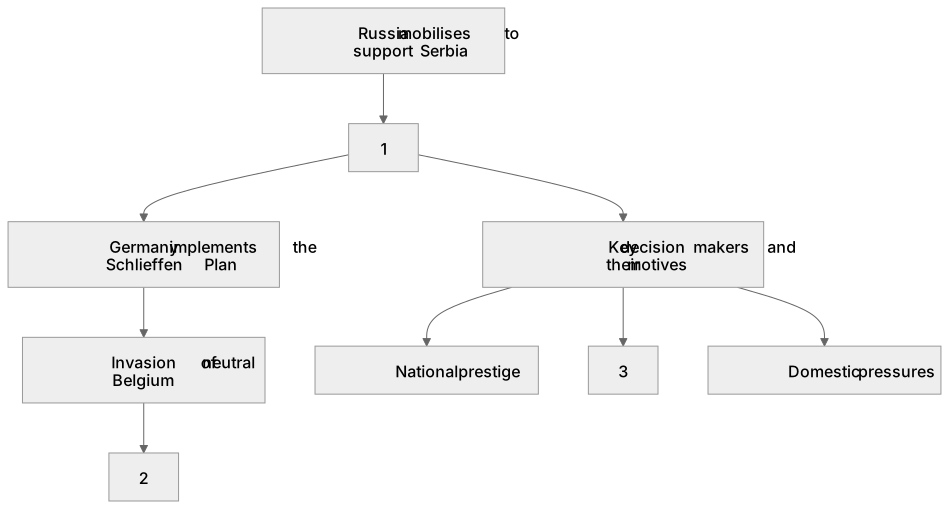
1Box 1
2Box 2
3Box 3
There is more to this lesson
The full lesson goes on to check your understanding and help you earn the marks. Create a free account to carry on, with your progress saved.
A week of Premium from your first lesson · Then the free plan continues · No card, no charge
Test your understanding of 2K International Relations and Global Conflict, c1890–1941 (A-level only) – The coming of war, 1911–1917: General war in Europe: mobilisation of German and Russian forces; the implementation of the Schlieffen Plan and the invasion of Belgium; Britain’s declaration of war; the key decision makers and their motives
Active recall beats re-reading. Take an instant quiz now to test what you’ve learned and lock it into long-term memory.
A week of Premium from your first lesson · Then the free plan continues · No card, no charge