AQA · A-Level · History
Course version: 7042 · Version from Sept 2017
The First and Second Balkan Wars: causes; attempts by the Great Powers to…
Full specification wording
2K International Relations and Global Conflict, c1890–1941 (A-level only) – The coming of war, 1911–1917: The First and Second Balkan Wars: causes; attempts by the Great Powers to impose peace on the region; the impact of the Balkan Wars on the Great Powers and Serbia
The First Balkan War (1912) was caused by the Balkan League (Serbia, Bulgaria, Greece, Montenegro) exploiting Ottoman weakness to seize European territories.
Checked against the AQA 7042 specification (opens in a new tab) on .
- Point 1 of 4
- 3 key terms
Study notes
From the checked teaching notes for this specification point.
The idea
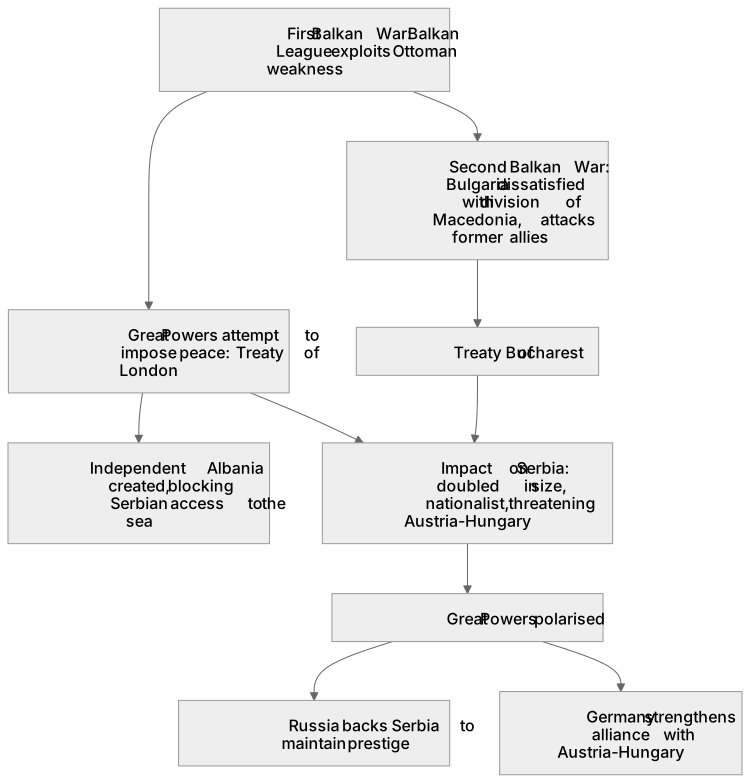
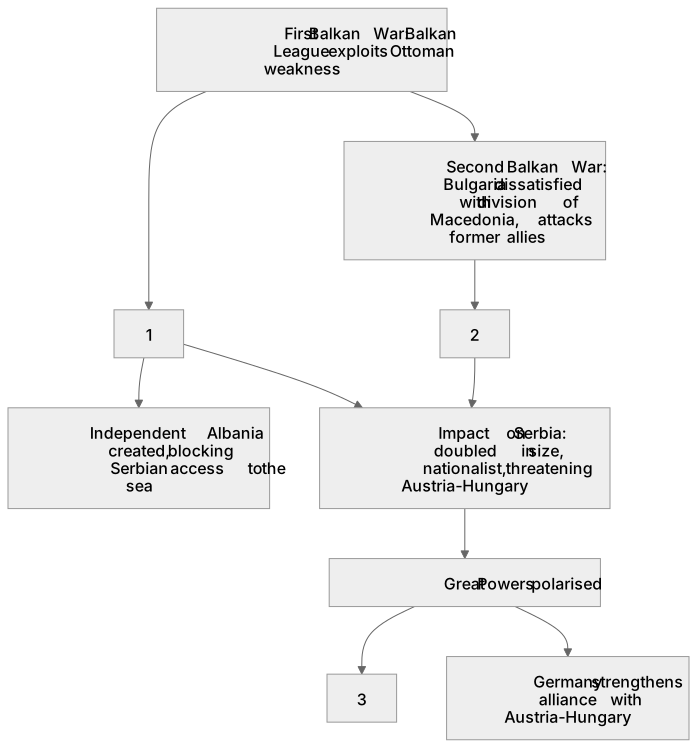
The First Balkan War (1912) was caused by the Balkan League (Serbia, Bulgaria, Greece, Montenegro) exploiting Ottoman weakness to seize European territories. The Second Balkan War (1913) erupted when Bulgaria, dissatisfied with the division of Macedonia, attacked its former allies. The Great Powers attempted to impose peace through the Treaty of London (1913), creating an independent Albania to block Serbian access to the sea, and the Treaty of Bucharest (1913). These conflicts profoundly impacted the region: Serbia doubled in size and grew increasingly nationalist, threatening Austria-Hungary. The Great Powers were polarised; Russia felt compelled to back Serbia in future crises to maintain prestige, while Germany strengthened its alliance with Austria-Hungary, escalating tensions.
What earns the marks
- Explain the formation of the Balkan League and its role in causing the First Balkan War by attacking the Ottoman Empire.
- Analyse the causes of the Second Balkan War, specifically Bulgaria's dissatisfaction with the territorial settlements in Macedonia.
- Evaluate the Great Powers' attempts to impose peace, such as the London Conference (1912-1913) and the creation of Albania.
- Assess the impact on Serbia, noting its territorial expansion, increased military confidence, and heightened nationalist agitation against Austria-Hungary.
- Discuss the impact on the Great Powers, particularly the hardening of the Austro-German alliance and Russia's commitment to supporting Serbia.
Common mistakes and how to put them right
Confusing the causes of the two wars.
Put it right: The First was against the Ottoman Empire for territory, while the Second was an internal dispute among the Balkan League over the spoils.
Assuming the Great Powers were united in their peace efforts.
Put it right: Peace conferences like the Treaty of London were fraught with Great Power rivalries, particularly between Austria-Hungary and Russia.
Underestimating Serbia's gains; correction: Serbia emerged significantly larger and more militarily confident, which directly destabilised its relationship with Austria-Hungary.
Exam tips
- Link the outcomes of the Balkan Wars directly to the heightened tensions that precipitated the July Crisis of 1914.
- Use specific treaties, such as the Treaty of London (1913) and Treaty of Bucharest (1913), to demonstrate the Great Powers' attempts to impose peace.
- Contrast the differing impacts on Russia and Austria-Hungary to evaluate how the wars polarised the alliance system.
Try the lesson
The start of the 2K International Relations and Global Conflict, c1890–1941 (A-level only) – The coming of war, 1911–1917: The First and Second Balkan Wars: causes; attempts by the Great Powers to impose peace on the region; the impact of the Balkan Wars on the Great Powers and Serbia lesson, made from checked teaching notes for this specification point.
Have a go first
What was the primary objective of the Balkan League when it declared war on the Ottoman Empire in October 1912?
Listen
The First Balkan War (1912) was caused by the Balkan League (Serbia, Bulgaria, Greece, Montenegro) exploiting Ottoman weakness to seize European territories. The Second Balkan War (1913) erupted when Bulgaria, dissatisfied with the division of Macedonia, attacked its former allies. The Great Powers attempted to impose peace through the Treaty of London (1913), creating an independent Albania to block Serbian access to the sea, and the Treaty of Bucharest (1913). These conflicts profoundly impacted the region: Serbia doubled in size and grew increasingly nationalist, threatening Austria-Hungary. The Great Powers were polarised; Russia felt compelled to back Serbia in future crises to maintain prestige, while Germany strengthened its alliance with Austria-Hungary, escalating tensions. A strong answer earns marks for these points. Explain the formation of the Balkan League and its role in causing the First Balkan War by attacking the Ottoman Empire. Analyse the causes of the Second Balkan War, specifically Bulgaria's dissatisfaction with the territorial settlements in Macedonia. Evaluate the Great Powers' attempts to impose peace, such as the London Conference (1912-1913) and the creation of Albania. Assess the impact on Serbia, noting its territorial expansion, increased military confidence, and heightened nationalist agitation against Austria-Hungary. A common slip: Confusing the causes of the two wars. Instead, the First was against the Ottoman Empire for territory, while the Second was an internal dispute among the Balkan League over the spoils. Exam tip: Link the outcomes of the Balkan Wars directly to the heightened tensions that precipitated the July Crisis of 1914.
See it
Key words
Say what each word means before you turn the card.
Nationalism
Try answering aloud or in your head before turning the card.
Alliance Systems
Try answering aloud or in your head before turning the card.
Diplomacy and Treaties
Try answering aloud or in your head before turning the card.
See every definition
- Nationalism
- A force that grew in Serbia as it doubled in size, threatening Austria-Hungary with heightened nationalist agitation.
- Alliance Systems
- The alignment of the Great Powers, which became polarised as Germany strengthened its alliance with Austria-Hungary and Russia felt compelled to back Serbia.
- Diplomacy and Treaties
- Attempts by the Great Powers to impose peace through the Treaty of London and the Treaty of Bucharest.
Label the diagram
Some boxes have lost their names. Pick the right name for each number.
1Box 1
2Box 2
3Box 3
There is more to this lesson
The full lesson goes on to check your understanding and help you earn the marks. Create a free account to carry on, with your progress saved.
A week of Premium from your first lesson · Then the free plan continues · No card, no charge
Test your understanding of 2K International Relations and Global Conflict, c1890–1941 (A-level only) – The coming of war, 1911–1917: The First and Second Balkan Wars: causes; attempts by the Great Powers to impose peace on the region; the impact of the Balkan Wars on the Great Powers and Serbia
Active recall beats re-reading. Take an instant quiz now to test what you’ve learned and lock it into long-term memory.
A week of Premium from your first lesson · Then the free plan continues · No card, no charge