AQA · A-Level · History
Course version: 7042 · Version from Sept 2017
The outbreak of war in the Balkans and the July Crisis: Austria-Hungary’s…
Full specification wording
2K International Relations and Global Conflict, c1890–1941 (A-level only) – The coming of war, 1911–1917: The outbreak of war in the Balkans and the July Crisis: Austria-Hungary’s and Germany’s response to the assassination in Sarajevo; Russia's response to Austria-Hungary’s demands on Serbia; the bombardment of Belgrade
The July Crisis began with the assassination of Archduke Franz Ferdinand in Sarajevo.
Checked against the AQA 7042 specification (opens in a new tab) on .
- Point 2 of 4
- 4 key terms
Study notes
From the checked teaching notes for this specification point.
The idea
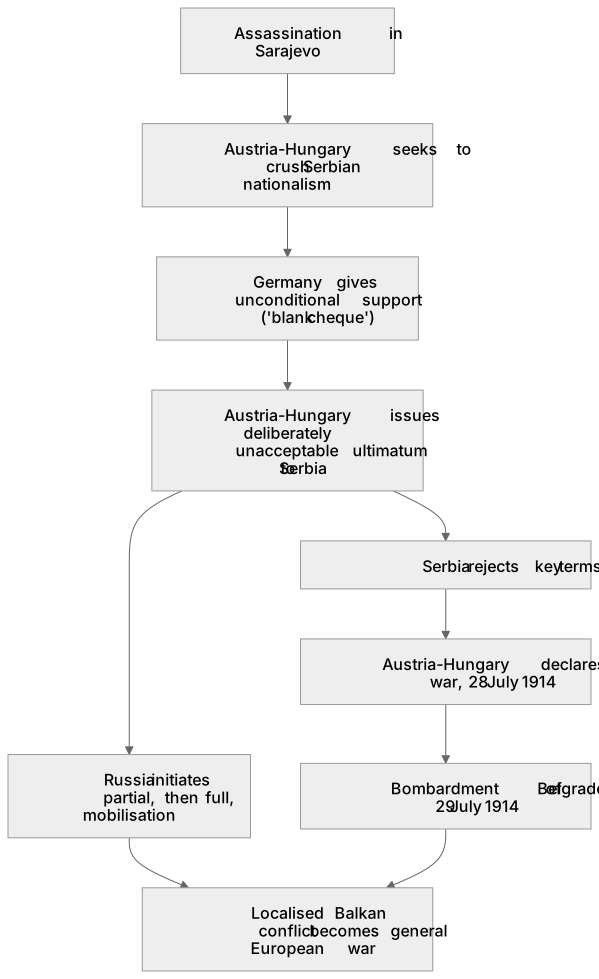
The July Crisis began with the assassination of Archduke Franz Ferdinand in Sarajevo. Austria-Hungary responded by seeking to crush Serbian nationalism, securing Germany's unconditional support via the 'blank cheque'. This emboldened Vienna to issue a deliberately unacceptable ultimatum to Serbia. When Serbia rejected key terms, Austria-Hungary declared war on 28 July 1914. The subsequent bombardment of Belgrade on 29 July 1914 marked the definitive outbreak of war in the Balkans. Russia responded to Austria-Hungary's demands on Serbia by initiating partial, then full, military mobilisation to defend its Slavic ally and maintain its Great Power status. This escalation transformed a localised Balkan conflict into a general European war.
What earns the marks
- Detail Austria-Hungary's response to the Sarajevo assassination, focusing on the drafting of the July Ultimatum designed to be rejected by Serbia.
- Explain Germany's role in the crisis, specifically the issuing of the 'blank cheque' which encouraged Austro-Hungarian aggression.
- Analyse Russia's response to the Austro-Hungarian demands, including the decision to mobilise its army to protect Serbia and preserve Russian prestige.
- Describe the significance of the bombardment of Belgrade on 29 July 1914 as the definitive transition from diplomatic crisis to armed conflict in the Balkans.
- Evaluate how the interplay between Austro-German aggression and Russian mobilisation escalated the local conflict into a global war.
Common mistakes and how to put them right
Stating that Germany forced Austria-Hungary to declare war.
Put it right: Germany provided unconditional support (the blank cheque), but the initiative and ultimatum came from Austria-Hungary.
Claiming Russia mobilised solely because of a formal treaty with Serbia.
Put it right: Russia had no formal military alliance with Serbia but mobilised due to pan-Slavism, strategic interests, and the need to restore prestige after the Bosnian Crisis.
Overlooking the bombardment of Belgrade or dating it incorrectly.
Put it right: Explicitly mention the bombardment of Belgrade on 29 July 1914 (following the declaration of war on 28 July) as the physical outbreak of the war, ending the diplomatic phase of the July Crisis.
Exam tips
- Trace the chronological escalation of the July Crisis to demonstrate how diplomatic miscalculations led to the bombardment of Belgrade.
- Analyse the concept of the 'blank cheque' to evaluate the extent of German responsibility for the outbreak of war.
- Discuss Russian mobilisation as a critical turning point that forced Germany to enact the Schlieffen Plan, broadening the conflict.
Try the lesson
The start of the 2K International Relations and Global Conflict, c1890–1941 (A-level only) – The coming of war, 1911–1917: The outbreak of war in the Balkans and the July Crisis: Austria-Hungary’s and Germany’s response to the assassination in Sarajevo; Russia's response to Austria-Hungary’s demands on Serbia; the bombardment of Belgrade lesson, made from checked teaching notes for this specification point.
Have a go first
Following the assassination of Archduke Franz Ferdinand in June 1914, what was the significance of the 'Blank Cheque' provided by Germany to Austria-Hungary?
Listen
The July Crisis began with the assassination of Archduke Franz Ferdinand in Sarajevo. Austria-Hungary responded by seeking to crush Serbian nationalism, securing Germany's unconditional support via the 'blank cheque'. This emboldened Vienna to issue a deliberately unacceptable ultimatum to Serbia. When Serbia rejected key terms, Austria-Hungary declared war on 28 July 1914. The subsequent bombardment of Belgrade on 29 July 1914 marked the definitive outbreak of war in the Balkans. Russia responded to Austria-Hungary's demands on Serbia by initiating partial, then full, military mobilisation to defend its Slavic ally and maintain its Great Power status. This escalation transformed a localised Balkan conflict into a general European war. A strong answer earns marks for these points. Detail Austria-Hungary's response to the Sarajevo assassination, focusing on the drafting of the July Ultimatum designed to be rejected by Serbia. Explain Germany's role in the crisis, specifically the issuing of the 'blank cheque' which encouraged Austro-Hungarian aggression. Analyse Russia's response to the Austro-Hungarian demands, including the decision to mobilise its army to protect Serbia and preserve Russian prestige. Describe the significance of the bombardment of Belgrade on 29 July 1914 as the definitive transition from diplomatic crisis to armed conflict in the Balkans. A common slip: Stating that Germany forced Austria-Hungary to declare war. Instead, Germany provided unconditional support (the blank cheque), but the initiative and ultimatum came from Austria-Hungary. Exam tip: Trace the chronological escalation of the July Crisis to demonstrate how diplomatic miscalculations led to the bombardment of Belgrade.
See it
Key words
Say what each word means before you turn the card.
Blank cheque
Try answering aloud or in your head before turning the card.
Pan-Slavism
Try answering aloud or in your head before turning the card.
Bombardment of Belgrade
Try answering aloud or in your head before turning the card.
July Ultimatum
Try answering aloud or in your head before turning the card.
See every definition
- Blank cheque
- Germany's unconditional support for Austria-Hungary, which encouraged Austro-Hungarian aggression after the Sarajevo assassination.
- Pan-Slavism
- A reason for Russia's mobilisation to defend its Slavic ally Serbia, alongside strategic interests and the need to restore prestige.
- Bombardment of Belgrade
- The event on 29 July 1914 that marked the definitive outbreak of war in the Balkans and the transition from diplomatic crisis to armed conflict.
- July Ultimatum
- A deliberately unacceptable set of demands issued to Serbia by Austria-Hungary, designed to be rejected.
Label the diagram
Some boxes have lost their names. Pick the right name for each number.
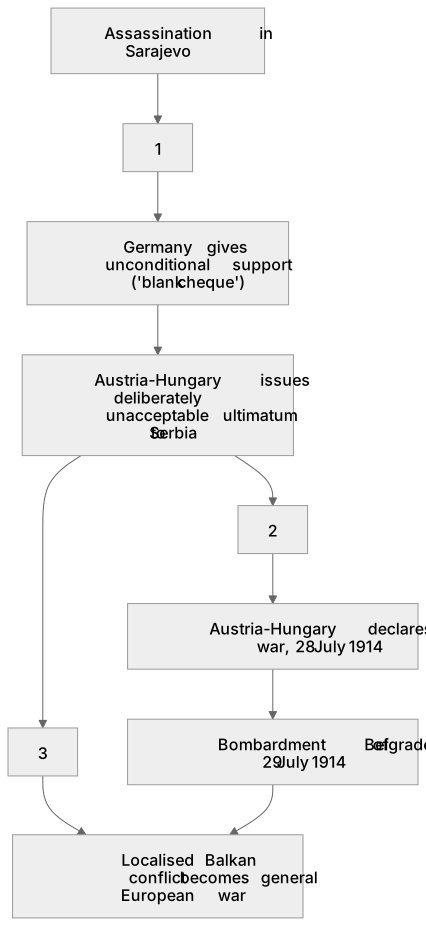
1Box 1
2Box 2
3Box 3
There is more to this lesson
The full lesson goes on to check your understanding and help you earn the marks. Create a free account to carry on, with your progress saved.
A week of Premium from your first lesson · Then the free plan continues · No card, no charge
Test your understanding of 2K International Relations and Global Conflict, c1890–1941 (A-level only) – The coming of war, 1911–1917: The outbreak of war in the Balkans and the July Crisis: Austria-Hungary’s and Germany’s response to the assassination in Sarajevo; Russia's response to Austria-Hungary’s demands on Serbia; the bombardment of Belgrade
Active recall beats re-reading. Take an instant quiz now to test what you’ve learned and lock it into long-term memory.
A week of Premium from your first lesson · Then the free plan continues · No card, no charge