AQA · A-Level · History
Course version: 7042 · Version from Sept 2017
From Western European to World War: the reasons for the escalation to…
Full specification wording
2K International Relations and Global Conflict, c1890–1941 (A-level only) – The coming of war, 1935–1941: From Western European to World War: the reasons for the escalation to world war; the entry of the Soviet Union; Japan, Pearl Harbor and the entry of the USA
The escalation from a Western European conflict to a global world war was driven by ideological ambitions and imperial expansion.
Checked against the AQA 7042 specification (opens in a new tab) on .
- Point 4 of 4
Study notes
From the checked teaching notes for this specification point.
The idea
The escalation from a Western European conflict to a global world war was driven by ideological ambitions and imperial expansion. The entry of the Soviet Union occurred in June 1941 when Hitler launched Operation Barbarossa, breaking the Nazi-Soviet Pact to pursue Lebensraum. This forced the USSR into an alliance with Britain. Concurrently, Japan sought to dominate the Asia-Pacific, leading to tensions with the USA over oil embargoes. Japan's surprise attack on the US fleet at Pearl Harbor in December 1941 triggered the entry of the USA. Hitler's subsequent declaration of war on the USA inextricably linked the European and Pacific theatres, transforming the hostilities into a truly global world war.
What earns the marks
- Analyse the ideological and strategic reasons for Germany's invasion of the Soviet Union, including the pursuit of Lebensraum and resources.
- Evaluate the impact of US economic sanctions and oil embargoes on Japan's decision to attack Pearl Harbor.
- Assess how Hitler's declaration of war on the USA in December 1941 served as the crucial link merging the European and Pacific conflicts.
- Explain the significance of the Soviet Union's entry into the war in shifting the balance of power and creating a two-front war for Germany.
Common mistakes and how to put them right
Claiming the USA declared war on Germany immediately after Pearl Harbor.
Put it right: Clarify that the USA initially only declared war on Japan; it was Germany that declared war on the USA days later.
Viewing the European and Pacific wars as completely separate conflicts before 1941.
Put it right: Highlight the Tripartite Pact (1940) and how European colonial weaknesses in Asia encouraged Japanese expansion, linking the theatres.
Stating the Soviet Union joined the Allies voluntarily.
Put it right: Emphasise that the USSR entered the war because it was invaded by Germany during Operation Barbarossa, forcing an alliance of convenience.
Exam tips
- When discussing the escalation to world war, explicitly connect events in Europe (like the fall of France) to Japanese opportunism in French Indochina.
- Analyse Operation Barbarossa not just as a military campaign, but as the ultimate expression of Nazi ideological goals.
- Consider the entry of the USA and the USSR as the definitive turning points that altered the industrial and demographic balance of the war.
Try the lesson
The start of the 2K International Relations and Global Conflict, c1890–1941 (A-level only) – The coming of war, 1935–1941: From Western European to World War: the reasons for the escalation to world war; the entry of the Soviet Union; Japan, Pearl Harbor and the entry of the USA lesson, made from checked teaching notes for this specification point.
Have a go first
Which event directly caused the United States to enter the Second World War in December 1941?
Listen
The escalation from a Western European conflict to a global world war was driven by ideological ambitions and imperial expansion. The entry of the Soviet Union occurred in June 1941 when Hitler launched Operation Barbarossa, breaking the Nazi-Soviet Pact to pursue Lebensraum. This forced the USSR into an alliance with Britain. Concurrently, Japan sought to dominate the Asia-Pacific, leading to tensions with the USA over oil embargoes. Japan's surprise attack on the US fleet at Pearl Harbor in December 1941 triggered the entry of the USA. Hitler's subsequent declaration of war on the USA inextricably linked the European and Pacific theatres, transforming the hostilities into a truly global world war. A strong answer earns marks for these points. Analyse the ideological and strategic reasons for Germany's invasion of the Soviet Union, including the pursuit of Lebensraum and resources. Evaluate the impact of US economic sanctions and oil embargoes on Japan's decision to attack Pearl Harbor. Assess how Hitler's declaration of war on the USA in December 1941 served as the crucial link merging the European and Pacific conflicts. Explain the significance of the Soviet Union's entry into the war in shifting the balance of power and creating a two-front war for Germany. A common slip: Claiming the USA declared war on Germany immediately after Pearl Harbor. Instead, Clarify that the USA initially only declared war on Japan; it was Germany that declared war on the USA days later. Exam tip: When discussing the escalation to world war, explicitly connect events in Europe (like the fall of France) to Japanese opportunism in French Indochina.
See it
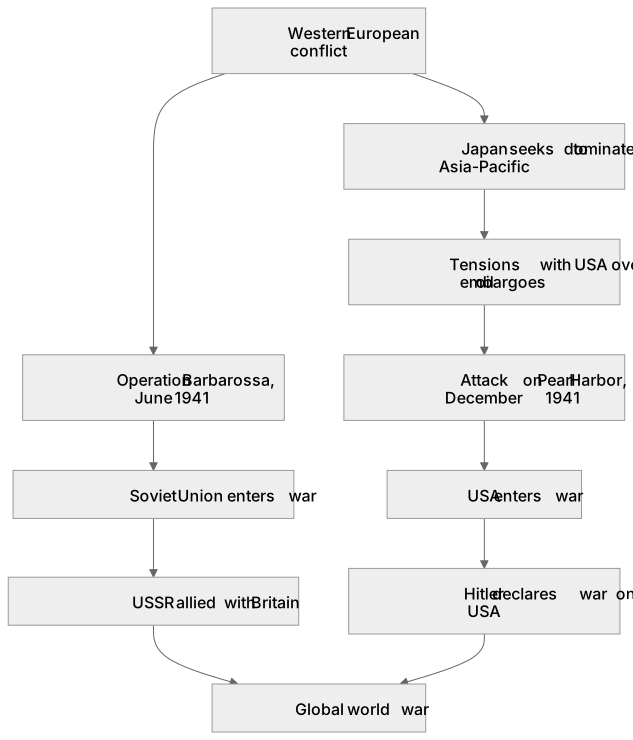
Label the diagram
Some boxes have lost their names. Pick the right name for each number.
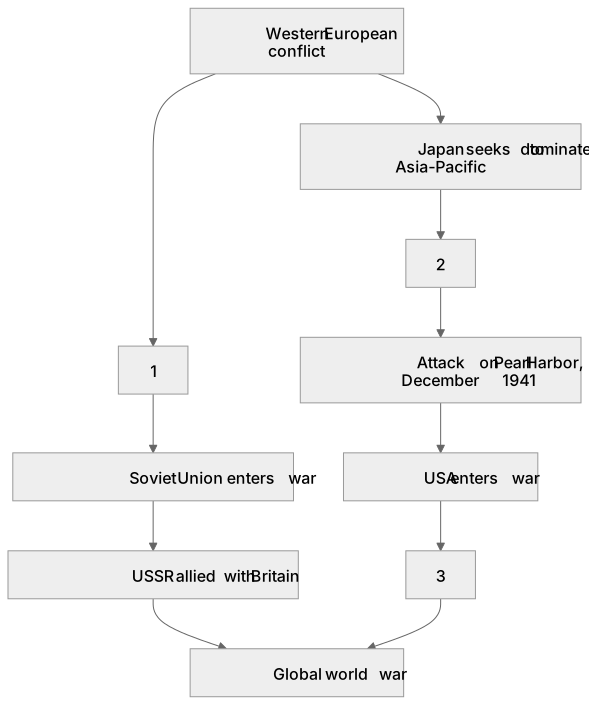
1Box 1
2Box 2
3Box 3
There is more to this lesson
The full lesson goes on to check your understanding and help you earn the marks. Create a free account to carry on, with your progress saved.
A week of Premium from your first lesson · Then the free plan continues · No card, no charge
Test your understanding of 2K International Relations and Global Conflict, c1890–1941 (A-level only) – The coming of war, 1935–1941: From Western European to World War: the reasons for the escalation to world war; the entry of the Soviet Union; Japan, Pearl Harbor and the entry of the USA
Active recall beats re-reading. Take an instant quiz now to test what you’ve learned and lock it into long-term memory.
A week of Premium from your first lesson · Then the free plan continues · No card, no charge