AQA · A-Level · History
Course version: 7042 · Version from Sept 2017
The outbreak of war in Europe: appeasement; the Czech Crisis; the crisis…
Full specification wording
2K International Relations and Global Conflict, c1890–1941 (A-level only) – The coming of war, 1935–1941: The outbreak of war in Europe: appeasement; the Czech Crisis; the crisis over Poland and the Nazi-Soviet Pact; the outbreak of war; the reaction of Italy to the outbreak of war
The outbreak of war in Europe stemmed from the failure of appeasement, highlighted by the 1938 Czech Crisis where Britain and France conceded the Sudetenland at Munich.
Checked against the AQA 7042 specification (opens in a new tab) on .
- Point 3 of 4
- 4 key terms
Study notes
From the checked teaching notes for this specification point.
The idea
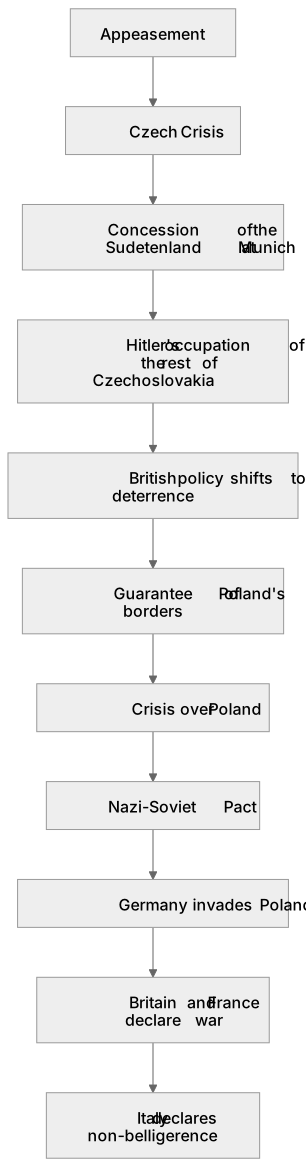
The outbreak of war in Europe stemmed from the failure of appeasement, highlighted by the 1938 Czech Crisis where Britain and France conceded the Sudetenland at Munich. Hitler's 1939 occupation of the rest of Czechoslovakia shifted British policy to deterrence, guaranteeing Poland's borders. The crisis over Poland escalated when Hitler secured his eastern flank via the August 1939 Nazi-Soviet Pact, dividing Eastern Europe. This enabled Germany to invade Poland, prompting Britain and France to declare war. Despite the Pact of Steel, Italy reacted to the outbreak by declaring non-belligerence, as Mussolini knew his military was unprepared for a major conflict.
What earns the marks
- Evaluate the motivations behind British and French appeasement during the Czech Crisis, including military unpreparedness and public anti-war sentiment.
- Analyse the strategic significance of the Nazi-Soviet Pact in removing the threat of a two-front war for Germany and sealing Poland's fate.
- Assess the shift in British foreign policy from appeasement to deterrence following the dismantling of Czechoslovakia in March 1939.
- Explain Mussolini's decision to declare Italy a 'non-belligerent' in September 1939, contrasting this with his earlier commitments in the Pact of Steel.
Common mistakes and how to put them right
Assuming the Nazi-Soviet Pact was a formal military alliance.
Put it right: Describe it as a non-aggression pact with secret protocols for dividing Eastern Europe, not a mutual defence treaty.
Stating Italy entered the war in September 1939 alongside Germany.
Put it right: Note that Italy declared 'non-belligerence' in 1939 and did not enter the war until June 1940.
Confusing the Sudetenland crisis with the invasion of the rest of Czechoslovakia.
Put it right: Distinguish between the September 1938 Munich Agreement (Sudetenland) and the March 1939 occupation of Prague, which ended appeasement.
Exam tips
- When evaluating appeasement, avoid hindsight; analyse the policy based on the economic and military realities facing Chamberlain in 1938.
- Link the Nazi-Soviet Pact directly to the outbreak of war by explaining how it gave Hitler the confidence to invade Poland without fearing Soviet intervention.
- Use Italy's reaction to the outbreak of war to demonstrate the limitations of the Rome-Berlin Axis and the Pact of Steel.
Try the lesson
The start of the 2K International Relations and Global Conflict, c1890–1941 (A-level only) – The coming of war, 1935–1941: The outbreak of war in Europe: appeasement; the Czech Crisis; the crisis over Poland and the Nazi-Soviet Pact; the outbreak of war; the reaction of Italy to the outbreak of war lesson, made from checked teaching notes for this specification point.
Have a go first
What was Italy's immediate reaction to the outbreak of the Second World War in September 1939?
Listen
The outbreak of war in Europe stemmed from the failure of appeasement, highlighted by the 1938 Czech Crisis where Britain and France conceded the Sudetenland at Munich. Hitler's 1939 occupation of the rest of Czechoslovakia shifted British policy to deterrence, guaranteeing Poland's borders. The crisis over Poland escalated when Hitler secured his eastern flank via the August 1939 Nazi-Soviet Pact, dividing Eastern Europe. This enabled Germany to invade Poland, prompting Britain and France to declare war. Despite the Pact of Steel, Italy reacted to the outbreak by declaring non-belligerence, as Mussolini knew his military was unprepared for a major conflict. A strong answer earns marks for these points. Evaluate the motivations behind British and French appeasement during the Czech Crisis, including military unpreparedness and public anti-war sentiment. Analyse the strategic significance of the Nazi-Soviet Pact in removing the threat of a two-front war for Germany and sealing Poland's fate. Assess the shift in British foreign policy from appeasement to deterrence following the dismantling of Czechoslovakia in March 1939. Explain Mussolini's decision to declare Italy a 'non-belligerent' in September 1939, contrasting this with his earlier commitments in the Pact of Steel. A common slip: Assuming the Nazi-Soviet Pact was a formal military alliance. Instead, Describe it as a non-aggression pact with secret protocols for dividing Eastern Europe, not a mutual defence treaty. Exam tip: When evaluating appeasement, avoid hindsight; analyse the policy based on the economic and military realities facing Chamberlain in 1938.
See it
Key words
Say what each word means before you turn the card.
Appeasement
Try answering aloud or in your head before turning the card.
Nazi-Soviet Pact
Try answering aloud or in your head before turning the card.
Non-belligerence
Try answering aloud or in your head before turning the card.
Deterrence
Try answering aloud or in your head before turning the card.
See every definition
- Appeasement
- A policy whose failure was a cause of the outbreak of war in Europe, and which Britain shifted away from after March 1939.
- Nazi-Soviet Pact
- An August 1939 agreement that secured Hitler's eastern flank and divided Eastern Europe, enabling Germany to invade Poland.
- Non-belligerence
- The stance Italy declared at the outbreak of war, despite the Pact of Steel, as Mussolini knew his military was unprepared.
- Deterrence
- The British policy that replaced appeasement after Hitler's occupation of the rest of Czechoslovakia, guaranteeing Poland's borders.
Label the diagram
Some boxes have lost their names. Pick the right name for each number.
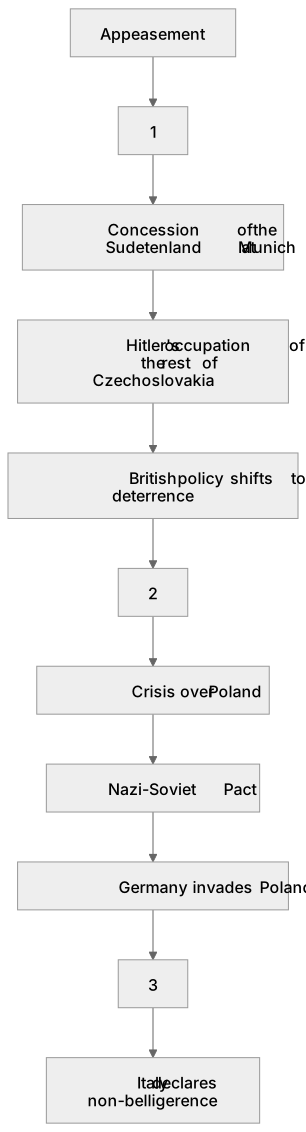
1Box 1
2Box 2
3Box 3
There is more to this lesson
The full lesson goes on to check your understanding and help you earn the marks. Create a free account to carry on, with your progress saved.
A week of Premium from your first lesson · Then the free plan continues · No card, no charge
Test your understanding of 2K International Relations and Global Conflict, c1890–1941 (A-level only) – The coming of war, 1935–1941: The outbreak of war in Europe: appeasement; the Czech Crisis; the crisis over Poland and the Nazi-Soviet Pact; the outbreak of war; the reaction of Italy to the outbreak of war
Active recall beats re-reading. Take an instant quiz now to test what you’ve learned and lock it into long-term memory.
A week of Premium from your first lesson · Then the free plan continues · No card, no charge